White Paper
25 November 2026
Estimated reading time: 10 min
Dutch BESS revenues and the investment case for 2027
Revenue stacking, grid transport charges, and the investment case for 2027
Introduction
By the end of 2025, Dutch batteries larger than 1 MWh had reached a cumulative capacity of 753 MW /1,575 MWh, compared with 350 MW / 620 MWh one year earlier, according to Statistics Netherlands (CBS).1 As more projects enter operation, developers and investors face a more immediate question about the income these assets can earn after the costs of trading and using the grid.
On 9 November 2026, the Dutch government outlined an indicative need for 110 GWh of storage by 2040 across utility-scale, commercial, household, and vehicle-to-grid applications, supported by 25 agreed actions.2 The long-term system requirement is substantial, but project delivery will still depend on access to the grid and sufficient revenue certainty to attract capital.
Storage duration is also changing. Modo Energy estimated an average duration of 2.2 hours in the operational utility-scale fleet in September 2026, compared with 3.7 hours in its development pipeline.3 Projects offering at least four hours of storage accounted for 85% of the tracked pipeline by MW. Additional storage hours create more room for energy trading, although they require more investment in energy capacity.
This report compares the potential revenues of Dutch batteries operating in the day-ahead market with published multi-market benchmarks, then considers how grid transport charges and commercial agreements affect the investment case. A Solarplaza simulation based on historical prices provides a day-ahead reference, while KYOS and Modo Energy data bring broader trading strategies and costs into view.
How market conditions shape revenues
Power and stored energy have to be allocated between competing opportunities. Day-ahead arbitrage earns a margin by charging when electricity is cheaper and discharging when prices are higher. Frequency services instead remunerate capacity held available or energy activated to support system balance. Committing a battery to one service may limit what it can offer elsewhere, so market price changes can alter the preferred dispatch strategy.
Recent Dutch prices point to a changing revenue mix. The number of imbalance settlement periods above €500/MWh fell from 744 in the first nine months of 2024 to 153 in the corresponding period of 2026.4 Day-ahead prices were negative for a total of 393 hours between January and September 2026, calculated from 1,572 negative 15-minute trading intervals. The figures point to tighter competition for exceptionally high balancing returns alongside continuing opportunities to shift electricity between low- and high-priced hours.
Longer-duration batteries can capture more of that daily price movement. In Modo Energy's latest analysis (published in October 2026), day-ahead trading contributed €77,000/MW/year to the modeled revenue stack of a four-hour battery during the first nine months of 2026, compared with €19,000/MW/year across 2025.5 These figures represent the day-ahead contribution of a battery also participating in other markets, rather than its standalone day-ahead revenue potential. Wider price spreads, partly driven by higher gas prices, contributed to the increased opportunity.
Market design changes have provided battery operators with greater trading flexibility. Day-ahead trading moved to 15-minute products on 1 October 2025, allowing more precise scheduling. On 11 November 2025, TenneT introduced four-hour aFRR capacity contracts alongside the existing 24-hour product.6 Shorter commitments allow battery operators to allocate capacity to other markets during the remaining hours, potentially improving the opportunities for revenue optimization.
What the revenue models show
The starting point is a battery trading only in the day-ahead market. Its earnings depend on the spread and timing of prices, the amount of energy it can store, and the losses incurred during charging and discharging. A physically constrained simulation makes those relationships visible even before we add intraday and balancing services to the discussion.
Day-ahead arbitrage under dispatch constraints
We modeled batteries with 1 MW of power and one, two, or four hours of energy storage against Dutch 15-minute day-ahead prices from 1 November 2025 to 31 October 2026, using the Energy-Charts series published by Fraunhofer ISE.7 Each battery operated at 88% round-trip efficiency with no more than one full equivalent charging cycle per day. The simulation follows charging and discharging in chronological order, respects the battery's physical storage limits, and requires all stored energy to be discharged by the end of each day, without carrying energy into the following day. Because the model is based on historical prices, the results describe idealized trading margins rather than observed earnings.
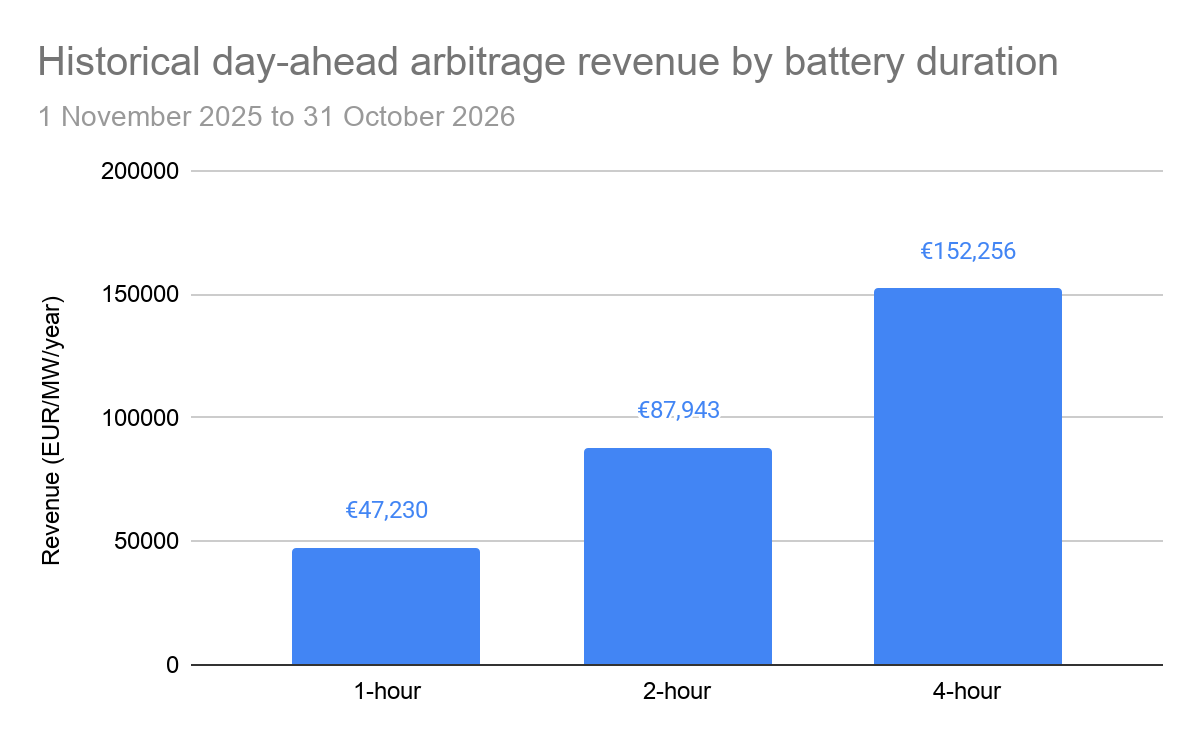
Over the 365 days, modeled day-ahead margins reached €47,230/MW for one-hour storage, €87,943/MW for two-hour storage, and €152,256/MW for four-hour storage. These amounts are calculated after charging energy costs but before grid charges, market fees, maintenance, degradation, or financing. Longer duration provides more opportunity to trade across price spreads, although the additional MWh also increases capital requirements.
The additional value of market participation
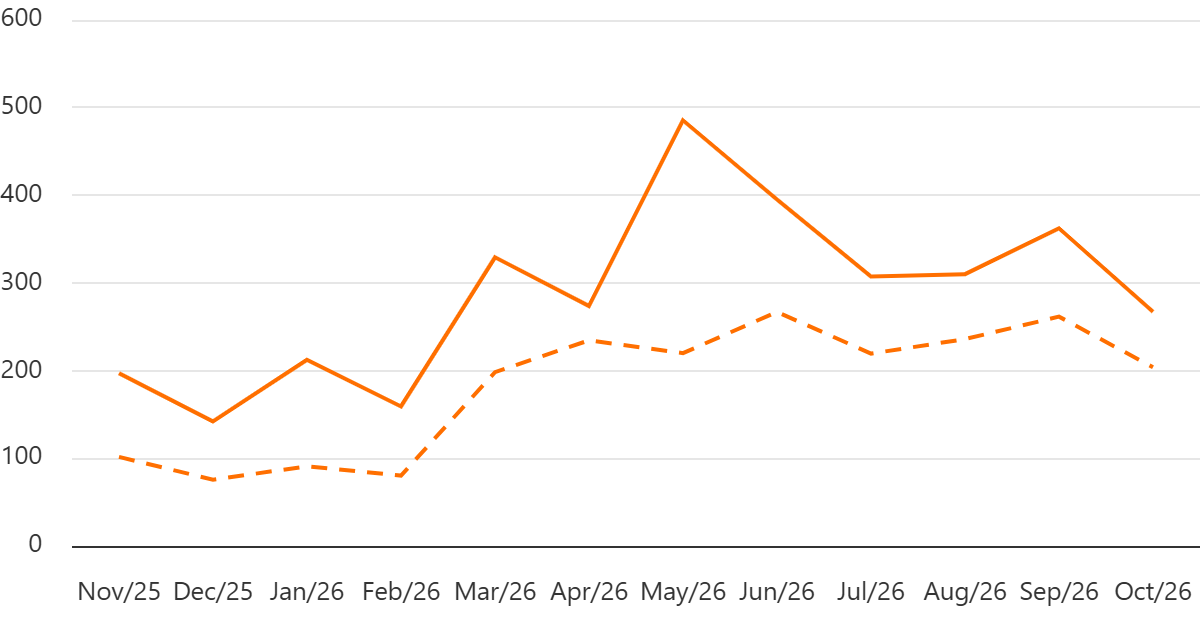
The day-ahead spread forms only part of the available revenue pool. KYOS's ReFlex index models a 10 MW / 40 MWh battery trading in day-ahead and continuous intraday markets alongside aFRR, including free energy bids. Its assumptions include 88% round-trip efficiency and a limit of 1.33 cycles per day.8 KYOS also publishes a TB4 benchmark based on the four hours with the highest and lowest day-ahead electricity prices each day. While TB4 provides a useful indication of potential arbitrage value, it does not account for the chronological order of charging and discharging or the battery's physical operating constraints. Solarplaza's simulation incorporates these limitations, providing a more realistic estimate of achievable day-ahead arbitrage margins under the modeled conditions. However, like TB4, it assumes perfect price foresight.
For the 12 months from November 2025 through October 2026, KYOS's monthly annualized ReFlex readings averaged about €286,800/MW/year, compared with €182,400/MW/year for its TB4 day-ahead reference. ReFlex was approximately 57% higher, indicating additional revenue opportunities from broader market participation. However, this difference does not represent a directly measurable uplift from revenue stacking, since the two benchmarks use different approaches to battery dispatch and cycling.
Monthly BESS revenue (kEUR/MW/year) - ReFlex (solid), TB4 (dashed)
Source: KYOS
The monthly results also varied considerably. KYOS's ReFlex reading fell to €159,200/MW/year in February 2026 before rising to €485,600/MW/year in May. Each value annualizes one month's modeled opportunity, which can change substantially with market conditions.
The changing contribution of balancing services
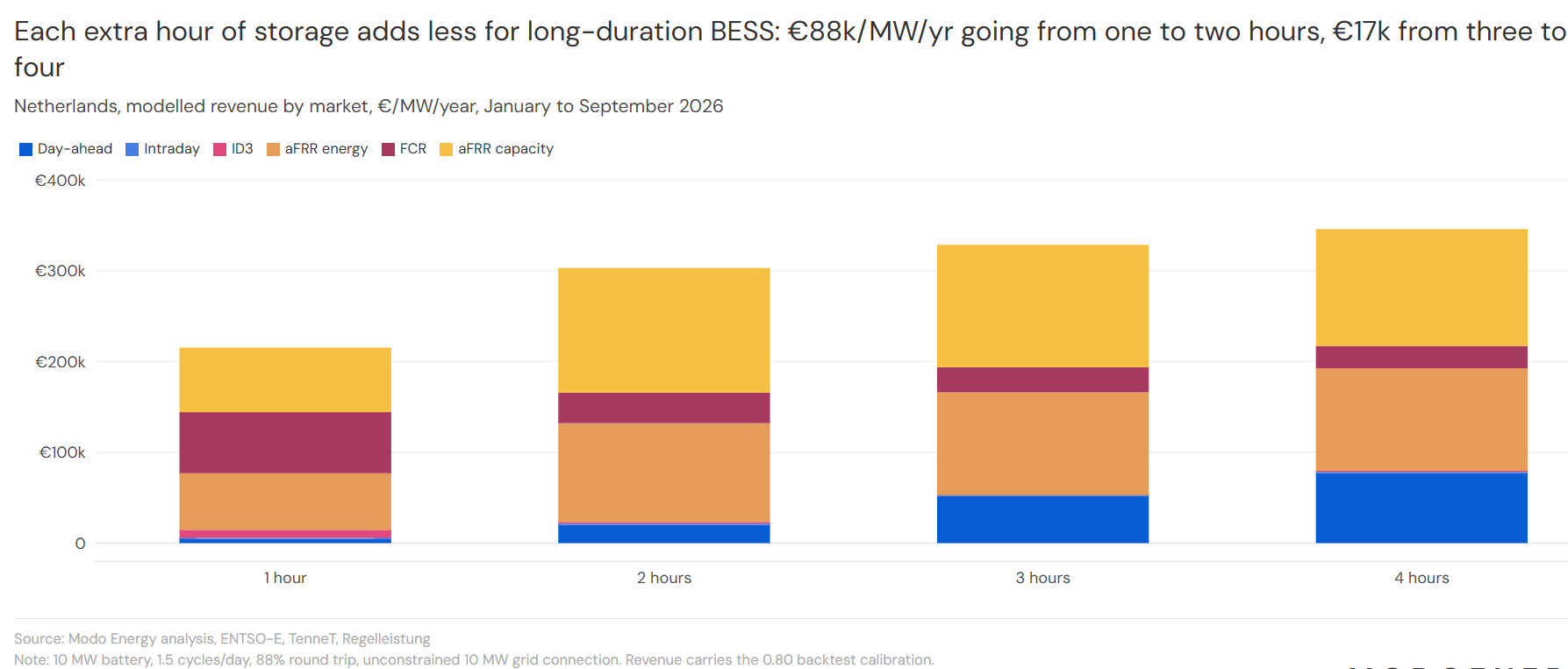
The contribution of different markets changes with battery duration, although additional storage hours produce diminishing revenue gains. In Modo Energy's analysis, extending battery duration from one to two hours increased modeled annual revenue by €88,000/MW, largely through greater participation in aFRR capacity markets. Increasing duration from three to four hours added a further €17,000/MW.5 Longer-duration batteries offer greater wholesale trading potential, while balancing services remain an important part of the revenue mix.
The Modo benchmark models day-ahead trading, intraday auctions, continuous intraday activity, FCR capacity, aFRR capacity, and aFRR activated energy.6 Because individual battery trading receipts are not publicly reported in the Netherlands, the index estimates what a representative asset could earn rather than measuring the returns of operating projects. Modo applies an 80% revenue calibration informed by British operating experience, which moderates simulated outcomes but does not establish the capture rate of Dutch batteries.
Modo reported €303,000/MW/year in annualized modeled revenue for a two-hour battery during the first nine months of 2026. When the model was rerun without ancillary services, a four-hour battery trading exclusively in wholesale markets retained 53% of its full-stack revenue potential, compared with 38% for a two-hour battery. This indicates that longer-duration systems are less dependent on balancing markets, although their total investment costs are also higher.
Source: Modo Energy
What remains after grid transport charges
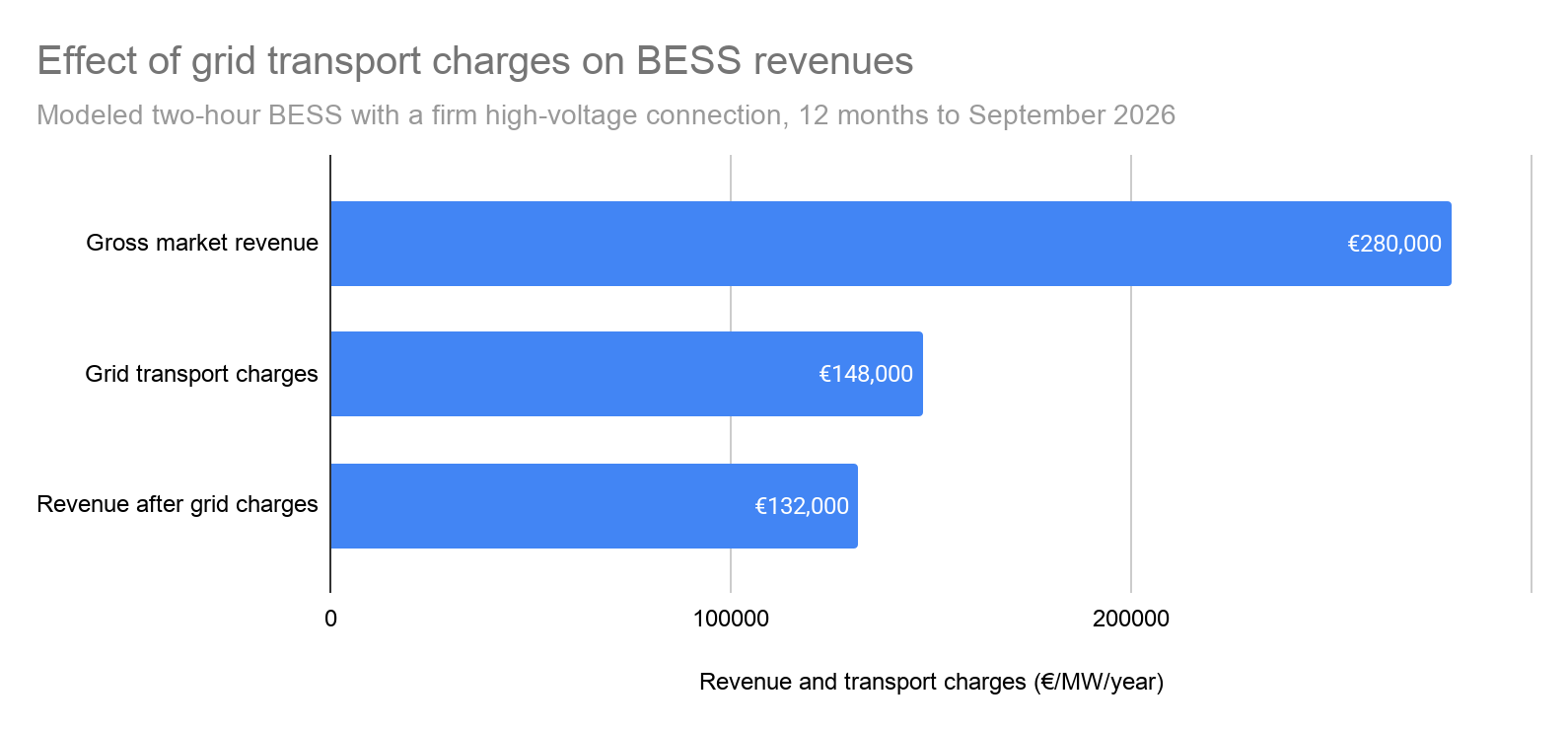
Gross trading revenues leave out one of the largest costs facing Dutch battery projects. In a separate analysis, Modo added TenneT's 2026 high-voltage transport tariffs to modeled market earnings for a two-hour battery with a full, firm connection.9 For the 12 months ending September 2026, the calculation produced €280,000/MW/year in trading revenue and €148,000/MW/year in transport charges. Approximately €132,000/MW/year remained before operating and financing costs. This analysis tests a grid connection and tariff configuration, rather than introducing another revenue market.
Source: Modo Energy
The tariff burden depends on contracted import capacity and when peak imports occur. Under Modo Energy's assumptions for a demand-congested area, a time duration-based transport right (TDTR) increased modeled revenue after grid charges by €54,000/MW/year for a two-hour battery with full import capacity.9 Such a connection permits the grid operator to restrict access for up to 15% of the year. Savings therefore have to be assessed alongside the trading opportunities lost during restricted periods.
Even the €132,000/MW/year remaining after grid charges is not project profit. Optimizer fees, operations and maintenance, insurance, augmentation, financing, and taxes still need to be covered. Availability, efficiency, and battery degradation determine how much of the projected trading opportunity can be converted into cash over the asset's life.
Storage duration affects both revenue potential and investment cost. Modo Energy's 2026 international CAPEX survey found that a four-hour BESS carried an estimated 22% cost premium over a two-hour system, down from 38% in 2024.3 Although project costs vary by market and connection requirements, the narrower premium has improved the relative economics of additional storage duration. The investment decision still depends on whether the additional capacity generates sufficient revenue over the asset's lifetime.
Contract choices and project bankability
Two batteries with similar market forecasts can offer contrasting degrees of cash-flow certainty. Merchant and profit-sharing agreements leave owners exposed to trading performance, while floor-based contracts offer some downside protection. A fixed-fee toll can provide more predictable receipts in return for operational and availability obligations. These arrangements determine who carries price, execution, and counterparty risks, and therefore affect how much debt a project can support.
In August 2026, Return and Vattenfall agreed a long-term fixed-fee toll for the 200 MW / 800 MWh Sirius project in Winschoten.10 Return reported approximately €180 million of project investment and financing commitments of up to €400 million across a wider battery portfolio involving five banks. Sirius is expected to begin commercial operation in the fourth quarter of 2027. The undisclosed toll price prevents a direct comparison with merchant revenue benchmarks, while the transaction demonstrates the financing role of contracted cash flow.
The contractual structure does not remove grid or operating risk. Lenders also review the rights to import and export power, allocation of curtailment losses, availability guarantees, battery degradation, and the creditworthiness of counterparties.11 A credible revenue forecast must therefore be consistent with both the physical battery and the obligations in its commercial agreement.
C&I BESS | VALUE BEHIND THE METER
For commercial and industrial (C&I) sites, battery value may come from peak shaving, improved use of on-site solar, greater resilience, and flexibility where grid capacity is constrained.12 The business case depends on the site's consumption profile and connection agreement. Charging at the wrong time can add to local congestion.
Liander's FlexPlus Battery arrangement provides eligible businesses with additional transport capacity in exchange for making flexibility available to the grid operator, with fixed compensation under the scheme.13 Battery size and operating rules must accommodate both the host's needs and the agreed grid service.
The Solarplaza Summit Energy Storage The Netherlands will feature a dedicated C&I track in 2027, with sessions on distribution-grid contracts, system integration, project economics, and financing for commercial-scale projects.
The investment choices ahead in 2027
Additional batteries will bring greater competition for balancing services, while variable renewable output will continue to create spreads between low- and high-priced hours. The value of these opportunities will depend on market participation, storage duration, grid access, and charging costs. Revenue forecasts based on exceptionally strong trading periods warrant particular scrutiny as the Dutch storage fleet expands.
For developers and investors, three questions remain central to the investment case. Can the battery deliver its modeled revenues within its physical operating limits? How much revenue remains after grid transport and operating costs? And do the commercial agreements provide sufficient protection against downside risks to support financing?
These questions will take center stage at the Solarplaza Summit Energy Storage The Netherlands on 13 April 2027 in Utrecht. From actual BESS earnings and evolving grid contracts to project financing, trading strategies, and asset valuations, the program brings together the commercial and technical challenges facing the Dutch storage sector. A dedicated C&I track will address the opportunities and challenges of smaller battery projects, while the Energy Storage 101 masterclass offers a practical introduction for those newer to the sector.
With so many investment decisions at stake, a ticket to Utrecht might be one of the easier ones to make. For companies looking to connect with developers, investors, and other key players shaping the Dutch storage market, sponsoring the event offers another opportunity to turn these discussions into business relationships.
Sources
- CBS (2026) Grote batterijen voor opslag van elektriciteit. Retrieved from https://www.cbs.nl/nl-nl/cijfers/detail/85929NED
- Government of the Netherlands (2026) Overheid en energiesector spreken doel en acties af voor meer grote batterijen in Nederland. Retrieved from https://www.rijksoverheid.nl/actueel/nieuws/2026/11/09/overheid-en-energiesector-spreken-doel-en-acties-af-voor-meer-grote-batterijen-in-nederland
- Modo Energy (2026) Netherlands BESS buildout Q3 2026, four hours stand-alone will become the default. Retrieved from https://modoenergy.com/research/en/netherlands-bess-buildout-q3-2026-four-hour-standalone
- Solarplaza and Stratergy (2026) Storage value is growing, but the easy money is gone. Retrieved from https://www.solarplaza.com/resource/13591/post-show-report-storage-value-is-growing-but-the-easy-money-is-gone-2026/
- Modo Energy (2026) Dutch BESS benchmark is live, wholesale trading is taking over the value stack. Retrieved from https://modoenergy.com/research/en/dutch-bess-benchmark-wholesale-trading-duration
- Modo Energy (2026) Netherlands Methodology, updated 3 November 2026. Retrieved from https://modoenergy.com/benchmarks/methodology/virtual-asset/netherlands
- Fraunhofer ISE (2026) Energy-Charts, Day-Ahead Auction spot prices, Netherlands, November 2025 to October 2026. Retrieved from https://energy-charts.info/charts/price_spot_market/chart.htm?l=en&c=NL&interval=month&legendItems=7y5&year=2025&month=12
- KYOS Energy Consulting (2026) KYOS Battery Index, monthly Netherlands ReFlex and TB4 series, through September 2026. Retrieved from https://power.kyos.com/bess-index
- Modo Energy (2026) Should a Dutch BESS contract less import capacity? Retrieved from https://modoenergy.com/research/en/dutch-bess-import-capacity-tdtr-grid-charges
- Return (2026) Return and Vattenfall sign long-term agreement for Sirius as project reaches financial close. Retrieved from https://return.energy/news/return-and-vattenfall-sign-long-term-agreement-for-sirius-as-project-reaches-financial-close
- Stibbe (2026) Battery storage (BESS) financing in the Netherlands. Retrieved from https://www.stibbe.com/publications-and-insights/battery-storage-bess-financing-in-the-netherlands
- Netherlands Enterprise Agency (RVO) (2026) Energieopslag: investeren in een batterij voor uw bedrijf. Retrieved from https://www.rvo.nl/onderwerpen/netcongestie/investeren-batterij
- Energy Storage NL (2026) FlexPlus Battery uses grid capacity more efficiently, but the business case remains crucial. Retrieved from https://www.energystoragenl.nl/en/2026/09/01/flexplus-batterij-benut-netcapaciteit-slimmer-maar-businesscase-blijft-cruciaal/
Contact details
Project team
Solarplaza Summit Energy Storage The Netherlands
Frannie Flinterman
Project Manager
[email protected]
Ward Schuuring
Business Developer
[email protected]
Zsolt Szalay
Research Analyst
[email protected]
Disclaimer: This overview is provided by Solarplaza International BV (“Solarplaza”) as a service to its customers on an “as-is, as-available” basis for informational purposes only. Solarplaza assumes no responsibility for any errors or omissions in these materials. Solarplaza makes no commitment to update the information contained herein. This overview is protected by copyright laws, and may only be reproduced, republished, distributed, transmitted, displayed, broadcast, or otherwise exploited in any manner only by accrediting Solarplaza as the source of it and providing a full hyperlink to https://www.solarplaza.com/event/solarplaza-summit-energy-storage-the-netherlands/ where it was originally published.
Copyright © Solarplaza 2026

To learn more about
the topic beyond this white paper,join Solarplaza Summit Energy Storage The Netherlands on 13 April, taking place in Utrecht.
