We asked the audience at the Solarplaza Summit Asset Management Europe for the biggest buzzword in asset management right now. 'AI' won. By the end of the day in Prague, on 27 October 2026, the word had come up in nearly every session.
Buzzwords earn skepticism, so we went back through the day's sessions with one question: where is artificial intelligence (AI) doing real work in a renewable portfolio today, according to the people running one? The answer is five places, each with clear limits.
Key takeaways
- AI is furthest along in trading and dispatch, where most decisions are already automated.
- In asset management teams, the first uses are routine document work, with a person reviewing the output.
- Every speaker who uses it kept skilled people and liability in the loop.
1. Trading and dispatch
This is where automation is oldest. Gerard Reid of Alexa Capital explained the difference between classic software and AI with a power market example. The old rule says: if X happens, do Y. The new instruction says: "If power prices fall by 5%, figure out what you should do." In his words, the complexity of storage, hedging, and volatile prices is "just too complex for the human being."
Operators confirmed it. Berto Martins of EDP Renewables said his team anticipates the next day's system needs "with some algorithms, some more traditional, some more using AI tools already." Mikkel Kring of Our New Energy sees a wave of new short-term trading houses built around automated execution, and battery optimizer Entrix was introduced on stage as placing 30,000 trades a day.
2. Reports, spare parts, and invoices
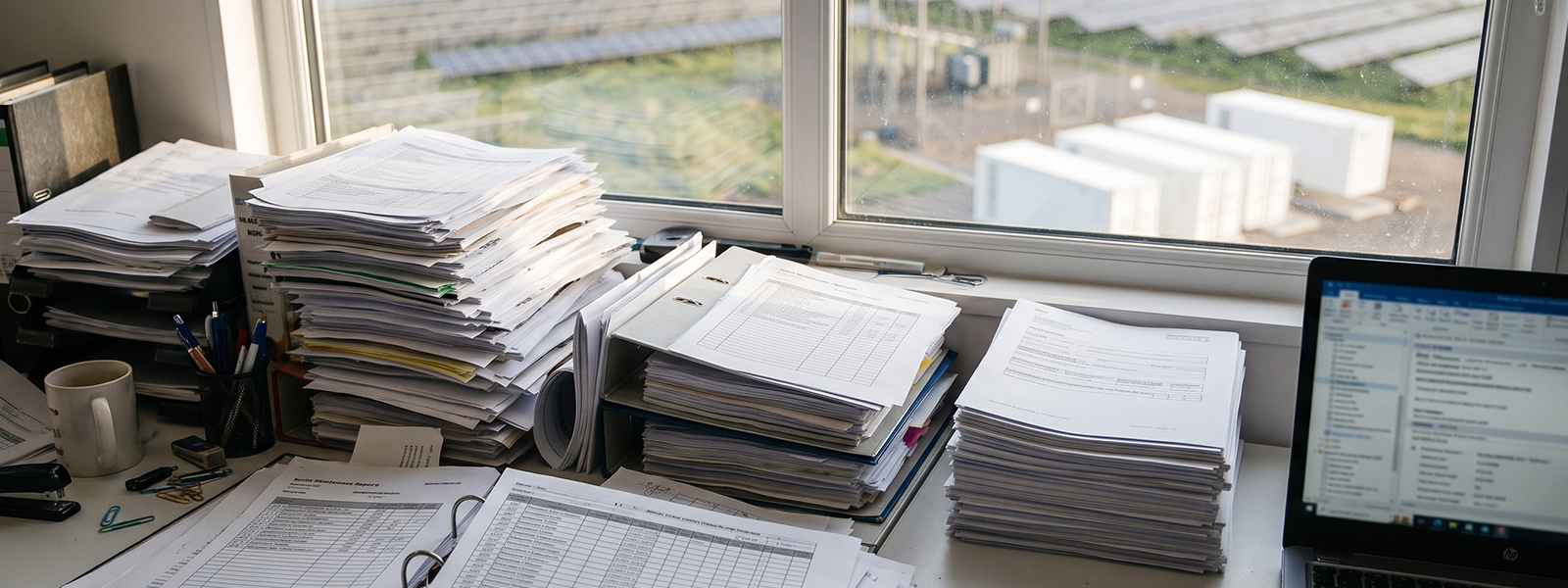
The most detailed example came from Lightsource bp, working with software company Alentis. Matt Rimmer described why they chose the unglamorous end of the job: "If you're an asset manager, you will know that you spend a lot of your time dealing with painful processes." When one portfolio grew from 40 to 80 assets in about three months, the team pointed software agents at three tasks: reading monthly O&M (operations and maintenance) reports, building a history of spare part use, and reconciling export statements against contracts.
The companies report that the portfolio doubled with two additional asset managers. Rimmer called that ratio "not a scientific KPI", and no numerical target was set beforehand, so treat it as one team's experience. The method is easier to copy than the result: start from a problem, not from a tool, and let the people who do the work describe it.
3. Handover and acceptance
At EDP, Margarida Correia Pires manages more than 9,500 commercial and industrial solar assets. For the smallest systems, acceptance from construction into operations is fully automated, built on existing systems and scripts, and documents are checked by an automated process "not by human work". That is rule-based automation, and she listed AI as a next step: "We want to guarantee that we have more and more automated processes and more intelligent processes."
4. Filling data gaps
Tatjana Venditti of Econergy called manual data collection "my personal nightmare". Some equipment is simply not integrated into the monitoring system, and her team uses AI to bring that data into reporting. Erman Terciyanlı of inavitas marked the boundary. Telemetry and images are easy to capture now. What is still missing is proof of what a field technician did on site: "We know the problem. We also want to know how you fixed it."
5. Matching assets and buyers
Carmen Izquierdo of nTeaser described a matching algorithm that recommends projects to investors based on their stated criteria and their behavior on the platform. Jan Krcmar of the Czech Solar Association mentioned companies using AI to scan the surroundings of older plants for potential local power customers.
Where it stops
Nobody on stage argued for handing over the keys. Asked whether it is safe to rely solely on AI, John-Henry Charles of Alentis answered: "No. Personally, I don't." Vicki Andrews of Lightsource bp said nothing; they have automated "is going to get us a penalty", because those tasks stay with trained asset managers. Rimmer added that liability does not move: "AI is a tool."
Venditti would invest in people before monitoring: "The AI can suggest you something, but we need somebody that is very, very skilled to understand the suggestion." On robotics in the field, Gavin Cornall of Roxtec was brief: "The more complex, the less chance."
Adoption is its own hurdle. Reid is introducing AI in his own firm and called it "tough because you've resistance". When half a team uses it, and the other half cannot keep up, the firm can end up worse off. His warning stands all the same: "If you don't embrace AI, you will be killed."
For a sober planning assumption, take Rimmer's question: "If you're not relying on AI, you're relying on a human who's overworked, who's got 20 to 40 assets to manage and is looking through a hundred pages of contracts. So where do you want to put your risk?"
This article is based on sessions at the Solarplaza Summit Asset Management Europe 2026. Read the full post-show report here.

