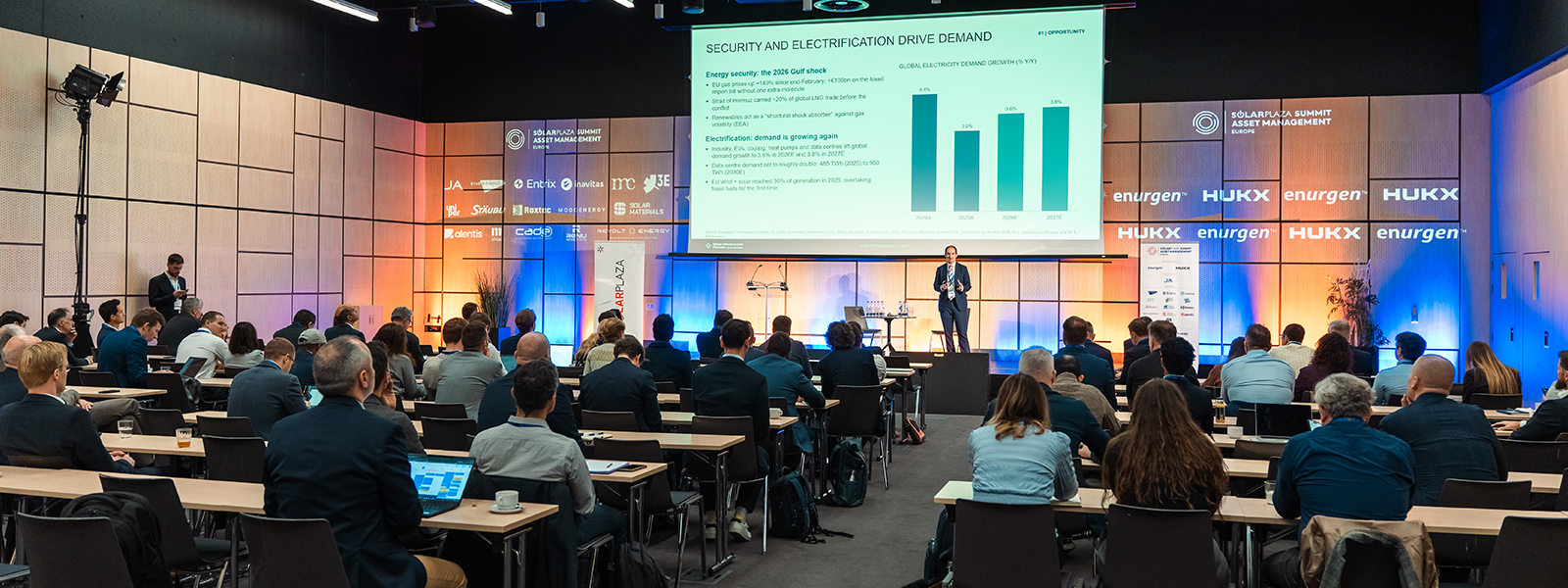
Negative power prices show up in maybe 10 to 15% of the hours in a year. But those are the hours when the sun shines, so 30 to 40% of solar production and revenue is potentially at risk. That calculation, from Thomas Luypaert of Global Infrastructure Partners (GIP), opened the Solarplaza Summit Asset Management Europe in Prague on Tuesday, 27 October, 2026. It framed everything that followed.
Across two tracks and some 40 speakers, the day moved from capital markets to pyranometers and back. When we asked the room for the biggest buzzword in asset management, 'AI' won. When we counted the words in the audience's questions at the end of the day, 'BESS' (battery energy storage systems) came out on top. Both tell you where the profession is heading. Below, we summarize what we learned, by theme.
Key takeaways
- Merchant exposure is now the default for European renewables, which is exactly why unhedged, solar-only projects no longer work as a business model.
- Solar is not dead: S&P Global Energy expects 474 GW of new capacity in Europe from 2026 to 2030, but new projects need storage, a customer, or both.
- Battery revenue is concentrated in a few hours and fades as fleets grow. In western Denmark, 35.5% of one year's balancing revenue came from 5% of the hours.
- Asset management is shifting from availability and reporting to trading, hedging, and contracts. The line between investor and asset manager is disappearing.
- The basics still decide the outcome. A performance ratio that lands 1% below guarantee can cost €1.84 million on a 100 MW plant.
- AI is proving itself first in the dull work: reports, spare parts, and invoices.
- Feed-in tariffs end for large Czech and Italian fleets around 2030, which makes them a test case for solar without subsidies.
Merchant risk is the new normal
Every renewable asset in Europe now carries more market risk than its original business case assumed. Luypaert's conclusion from the negative-price math was blunt: "Merchant solar is no longer a viable business model." The exposure itself is not going away. What no longer works is carrying it with a single technology and no hedge.
Demand is not the problem. Luypaert named two drivers he considers more durable than climate policy: security of supply and electrification. "Energy security is national security," he said, and Spain's power demand grew by about 3% last year. Capital is still available too. It has become selective, going to platforms built for merchant risk. He listed three success factors: presence in several countries, more than one technology, and the commercial capability to offer baseload power to customers.
"The renewables industry is moving from what I would call almost a real estate industry, where you were finding land, developing a project, moving on to the next, to actually being in the power generation business." Thomas Luypaert, GIP
Gerard Reid of Alexa Capital went a step further. "Negative pricing is structural. You can't change it overnight," he said, pointing to a recent weekend when a storm pushed German prices to zero for two days. In his view, an independent power producer (IPP) that only sells solar into the system is not an IPP at all: "Nobody buys solar electricity. They buy electricity or clean electricity."
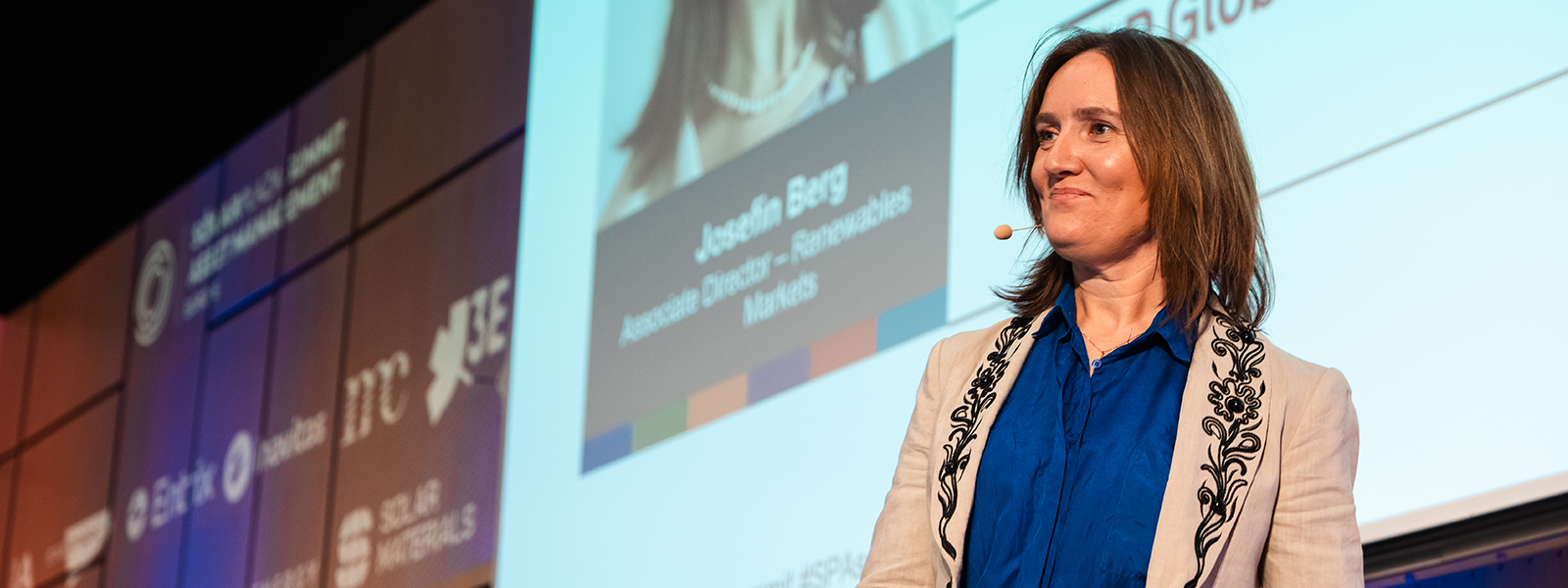
Josefin Berg of S&P Global Energy brought the data. Negative prices are now structural across Western Europe and cluster around midday. Spanish prices have bottomed out around minus €15/MWh, while Germany has seen minus €499/MWh. Italy recorded its first negative prices this October.
What would help? Luypaert asked policymakers for clarity on auction schedules, indexation, how negative prices are treated, and who pays for curtailment. "The stability and visibility is a lot more important than the financial support these days," he said. The room agreed on one point. Asked whether two-way contracts for difference (CfDs) are a hidden tax on successful projects, a clear majority voted no.
Solar is not dead, but solar-only is in trouble
The sharpest disagreement of the day was about new solar. "Solar is not dead," Berg insisted. Global solar additions will fall by 8% this year, mainly because China drops by around 40%, while storage additions grow by 40%. Yet solar still accounts for the largest share of new capacity. In Europe, S&P Global Energy expects additions to stabilize around 90 GW a year, about half utility-scale, for a total of 474 GW from 2026 to 2030. Capture prices have even ticked up this year on low hydro output and higher gas prices.
Reid was not convinced. "Germany… makes no sense to build any solar there," he said, adding Denmark and Spain to the list. He sees no reason to build large-scale solar in markets where prices are zero or negative. His alternative is to build next to the customer, behind the meter, with storage. Luypaert took the middle ground on Spain: "There should be a pause on new solar developments, and then I think it will be resolved through a combination of batteries as well as new demand." When we polled the room on whether Europe has already built too much solar in some markets, the vote was close to a tie.
Where everyone agreed: solar on its own is the hard case. Asked whether Vattenfall still develops co-located assets from scratch, Claus Wattendrup needed three words.
"Yes. Full stop." Claus Wattendrup, Vattenfall
"All of our projects we develop, be it onshore or be it solar or be it BESS, we co-locate the other technologies to it if possible early on, because that's cheap," he explained. Adding a storage permit next to a solar or wind asset costs little and makes better use of "the scarce resource, which is the grid connection."
Jan Krcmar of the Czech Solar Association described a market that has lived without subsidies for new plants for years. "Nobody in their right mind, I think, would think about building standalone solar in Czechia," he said. Standalone projects developed a few years ago are now up for sale "because nobody wants them."
Two cautions came with the enthusiasm. Wattendrup noted that a merchant battery next to a merchant solar farm does not solve a financing problem: "What you would need, of course, is some secured revenues." And Berto Martins of EDP Renewables reminded the room that storage needs something to store. "From my knowledge, batteries are not charging themselves," he joked. With demand from data centers and industry rising, "we need solar."
The power purchase agreement is changing shape
Berg's contract data shows the same shift. Europe signs 25 to 30 GW of private offtake contracts a year, and the mix is moving from single-technology power purchase agreements (PPAs) to multi-technology and storage agreements. Mikkel Kring of Our New Energy described three products that a battery makes possible for corporate buyers:
- Pure load shifting, for buyers who have pledged 24/7 renewable supply and will pay a premium for it
- 'Pay-as-optimized', where the seller fixes the delivery profile the day before and keeps the optimization value
- A financially settled monthly baseload contract, which matches how corporates consume power
The baseload product works in markets with relatively high power prices, such as Denmark, Germany, and Poland, Kring said. It is unlikely to work in Sweden or Finland. For owners who want to add a battery to a plant with an existing PPA, he shared a simple fix from a Swedish project: install a separate solar meter so the buyer settles on solar production and the owner keeps the value the battery creates.
Batteries: the window is open, and it is closing
Capital is following the flexibility. Berg counted almost as many battery deals as solar deals in Europe this year, but the battery deals covered about three times the capacity. Luypaert put European storage installations at more than 50 GWh this year, up from 36 GWh in 2025, and expects that to triple by the end of the decade.
The catch is that battery revenue arrives in bursts. In Spain, 44% of modeled revenues come in 10% of the hours, Berg said, and she offered the analogy of the day:
"If you're a hotel owner and Taylor Swift decides to have a concert in your town, you know you can charge 500 euros, a thousand euros a night. But that doesn't matter if you've already booked all the rooms at 100 euros per night." Josefin Berg, S&P Global Energy
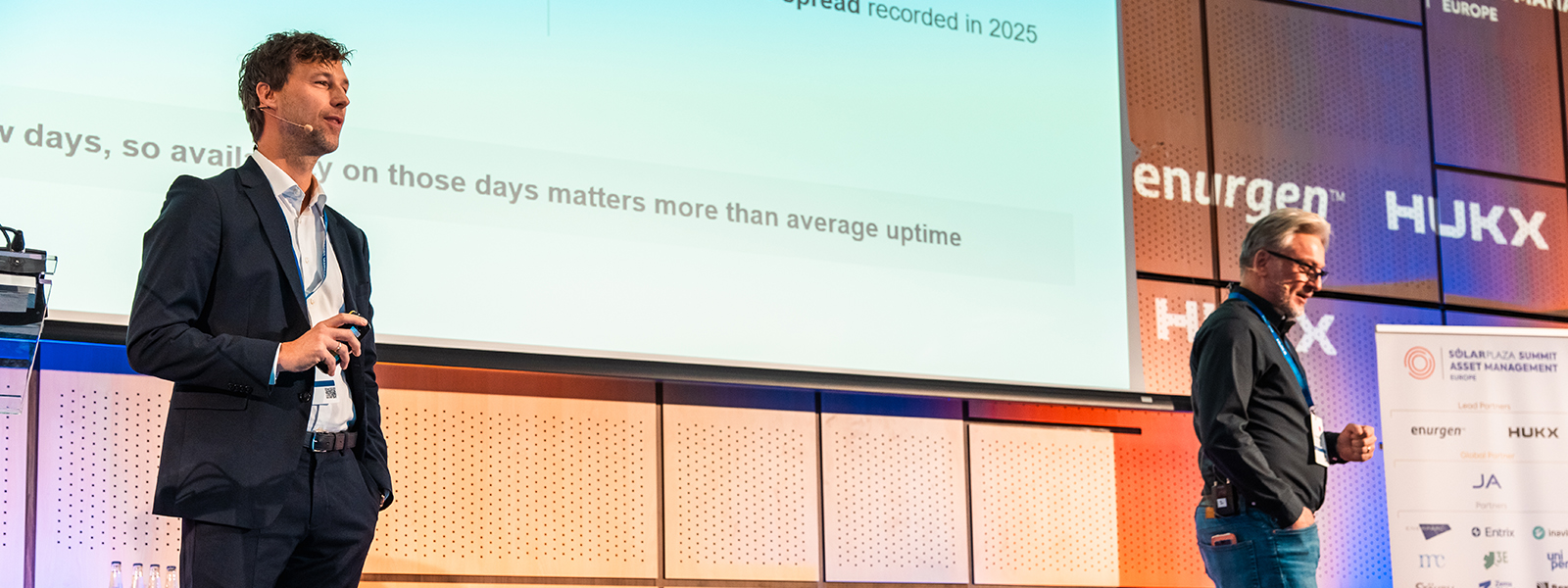
Kring showed the same pattern for western Denmark (the DK1 price zone). Over the past year, 35.5% of revenue from manual frequency restoration reserve (mFRR) activation was earned in 5% of the hours. That changes what availability means. "What we normally see in PPAs, there's allowed 10% unavailability for your solar asset," he said. "Well, on BESS, that can be a tremendous difference." Miss the wrong 5%, and a third of the year is gone.
Saturation arrives faster than expected
Several speakers warned that the good years are short. Cosima Sagmeister of Modo Energy pointed to Australia, where battery revenues "dropped by 65% from the best market point to the lowest market point within 12 months." Jan Fousek of the Czech Energy Storage Association (AKU-BAT) reported the same closer to home: Czech mFRR prices fell by 70% within a year, after only a few projects came online. With several gigawatts under construction, he said, Czech banks have "put a little bit of financing of batteries on hold" to see what happens next.
"I think we should know by now that this ancillary service saturation happens," Sagmeister said. "There's still sort of this bias to think that it won't affect your market as much as it has affected other markets." S&P Global Energy expects front-of-the-meter storage to equal more than 50% of peak demand in several European markets by 2035.
Sagmeister was equally frank about her own trade. "Forecasts are more wrong than right in terms of giving you an exact asset revenue, and I think everybody knows that," she said. What matters is understanding why a forecast missed, and whether the forecaster can defend the method to a lender.
Contract while you can
Kring's advice follows from that: "You should start contracting revenues before it becomes oversupplied." Solar owners underestimated how far capture rates would fall, and he expects batteries to repeat the pattern. "Offtake will be one of the scarce resources for battery storage." He also sees contracts splitting in two: a bankable offtaker that provides a toll or a floor, and a specialist trader on a one-to-three-year contract that can be replaced if it underperforms.
Felix Stephan of Entrix gave a back-of-the-envelope comparison for Germany. A fully merchant, all-equity battery earns roughly €180,000 per MW per year over seven years, for a return on equity of about 20%. Toll 80% of it at €145,000 to €150,000 per MW, add debt at around 6.5%, and the return on equity rises to roughly 30%. Availability still counts under a toll: "If the asset is 5%, 10% unavailable, that also reduces your tolling amount."
Lenders are adjusting as well. "Solar standalone becomes less and less attractive for us," said Leoni Hartung of Berenberg. "We have to shift our focus towards co-location and evaluate new risk, interface risk." Berenberg has provided a subordinated construction loan to a fully merchant battery, she confirmed, but only with conservative coverage buffers, aggressive cash sweeps, and a two- to three-year tenor.
Even a good market does not guarantee a good result. Jan Willem Zwang of Stratergy presented an operating four-hour battery whose owner received about 30% less than planned in its first months, although market prices beat the forecast. The contract formula, grid fees, and technical limits took the difference. We covered his analysis of contracts and battery economics in our masterclass report.
So is there a battery business case in five to ten years? "Not for a random battery on a field anywhere in a European context," Kring answered. Yes, if it's located near industrial demand or in congested areas. "But any battery anywhere, no, I don't believe in that."
The asset manager's new job description
If value moves from megawatt-hours produced to megawatt-hours sold at the right moment, the job of managing an asset changes with it. Reid described the old version as making sure the plant is available, maintained, reported on, and compliant.
"That world is the world of people like me who are finance people, and it's gone. It's over. I need engineers. I need computer scientists. I need people who understand the power markets, who can hedge." Gerard Reid, Alexa Capital
In his words, the new version is an "optimization stack" of storage, trading, data, and AI. He was specific about what trading means: "Trading is not optimization. For me, the key thing about trading is it's hedging." That includes the question many solar owners have postponed: "What happens after your PPA runs out in 10 years' time? What are you going to do with it?"
The utilities in the room already work this way. "We have had merchant generation assets for decades. And how do we manage revenue risk? We hedge," said Wattendrup. His other answer was to diversify across technologies and countries. He also told the story of a Swedish battery whose business case rested on ancillary services. The grid connection came late, revenues in that market had dropped by then, and Vattenfall's trading desk moved the asset to the intraday market. "You have to pivot." Martins described how EDP now runs 24/7 dispatch for six European markets from one location, because negative prices and real-time requests from grid operators leave no other option.
One team, from investment to operations
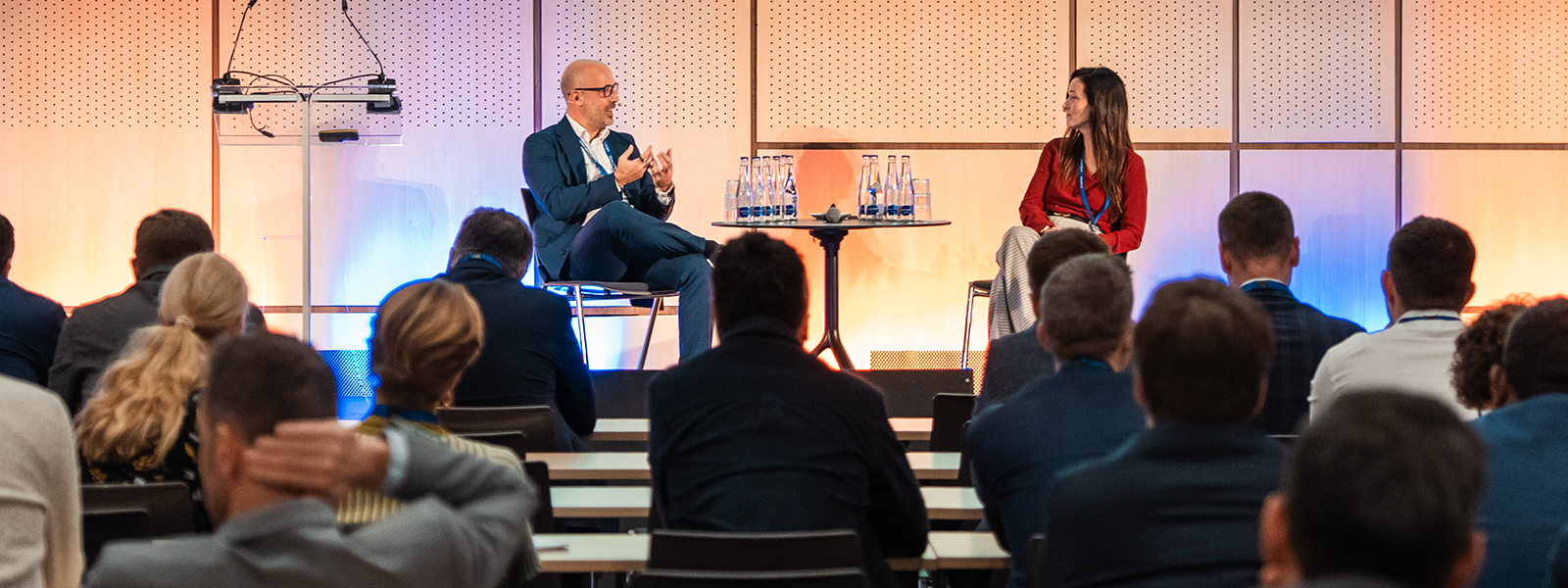
Domenico Tripodi of AIP Management and Marta Valien of Foresight Group were asked what investors and asset managers need to understand about each other. Their answer: the split itself is out of date. Tripodi recalled the time of 15-to-20-year contracted revenues, when the task was "defensive asset management", checking that the operator followed the contract.
Today, he said of the distinction between investor and asset manager, "I don't think it exists anymore." Investors are responsible "360, not just for the investment", as in private equity.
Valien measures the change in paperwork. An operations and maintenance (O&M) agreement used to be five pages, "and now it's tons of pages." Her team reads every PPA before it is signed, because a clause that looks fine on paper can fail in operation. And the unit of management has changed: "It's just not an asset anymore. It's more portfolio."
Both pointed at an obstacle that rarely makes it onto a conference stage. Funds are raised, invested over three or four years, and closed, each with different investors. That makes it legally difficult to manage assets from different funds as one portfolio, even when it would create value. Valien's example was a substation switchgear with a six-month lead time for an Australian asset, while an identical spare sat in a European fund's stock. Tripodi's practical answer: AIP now reserves "10% or more" of each fund for add-on investments and fixes.
Pierre Lebon of Zema Global summed up the shift from the risk side. "The game has changed from maximizing the number of megawatt-hours that you're getting out of your assets to extracting the megawatt-hours where it matters the most," he said. Underperformance, in his definition, is also carrying more risk than you planned for.
The basics still pay
While the main stage talked markets, the operations track made a quieter point: tighter margins make the fundamentals worth more, not less.
Handover: agree on what 'ready' means
Margarida Correia Pires of EDP manages more than 9,500 commercial and industrial solar assets, over 650 MW, in Portugal, Spain, Italy, and Poland. At the end of 2023, the handover from construction to operations had an uncontrolled backlog. The root cause was a conflict of interest: construction wants to deliver and move on, while asset management answers for performance. "What is ready for the construction team needs to be aligned with the concept of what is ready for the asset management teams," she said.
EDP's fix was to stop treating every plant the same. The smallest systems go through a fully automated check, mid-sized ones through a shared acceptance matrix of about 100 requirements with defined evidence, and the largest get a custom review. Billing starts as soon as contractual acceptance allows, so open items do not delay revenue. Both teams now look at the same backlog numbers. The results:
| Handover backlog | 2023 peak | 2026 year to date |
|---|---|---|
| Plants in backlog | 415 | 84 |
| Average age of backlog (days) | 199 | 20 |
| Plants in backlog for over three months | 268 | 15 |
Source: EDP
Her summary of what made the difference: "Alignment, alignment, alignment, and alignment."
Measurement: how sure are you of your performance ratio?
The performance ratio (PR) decides acceptance tests, guarantees, and valuations, yet it is only as good as the irradiance measurement behind it. Niek Rijnders of Hukx presented research done with Delft University of Technology. With a monitoring system that meets the top class of the IEC 61724-1 standard, PR uncertainty is about 3.6%, with the pyranometer as the main contributor.
That has a price. In Hukx's case study of a 100 MW plant in Western Europe, a PR that measures 1% below the guaranteed value translates into €1.84 million in performance liquidated damages. With high uncertainty, a plant can fail a test it should have passed, or pass one it should have failed. Maintenance matters as much as the sensor. The standard asks for recalibration every two years, but "only 10 to 20% of our customers return with their instruments," Rijnders said.
Losses: question the waterfall
Kibby Pollak of Enurgen took on the 'unexplained' bucket that sits in most loss waterfalls. Part of it is not a loss at all, but bias in the expected-production model. Part of it is real revenue leaking away, often on the direct current side, where strings and fuses are rarely measured. Across nine operating sites, Enurgen's full re-simulation differed from the owners' expected production by 2.5% to 11%, and far more at one site with a stuck tracker. The gap goes both ways, so no fixed correction factor works.
Where the irradiance sensor sits can alone shift measured plane-of-array irradiance by up to 6% on multi-tier systems. One owner's loss reporting covered 99% of losses against its own model, and only 88% against a full simulation. Pollak's advice: "Always question the waterfall." He also urged owners to move O&M contracts from availability to performance, because "availability does not equal performance."
Hybrid sites are one system
The O&M panel, moderated by Felix Hübner, dealt with what happens when a battery joins a solar plant. "A lost kilowatt-hour in PV is a lost revenue," said Shovon Goutam of 3E. "But in BESS, a missing kilowatt-hour not only means the lost opportunity, but also could be a penalty." A solar string can bypass a weak panel, but in a battery string of around 400 cells, "one cell can define the whole performance of the string."
Erman Terciyanlı of inavitas stressed that co-located is the wrong mental picture: "Actually, it's one system." Controls have to be designed in from the start, because a battery site must coordinate decisions within 100 milliseconds to stay grid compliant. "You cannot comply to the grid with the wrong design system." Gavin Cornall of Roxtec put a number on late fixes: solving a problem after a plant has gone live costs about "times five".
Tatjana Venditti of Econergy added a practice that fits the merchant era: her team schedules preventive maintenance in the hours when plants are curtailed for price reasons anyway. Asked where owners of growing portfolios should invest first, she chose people over tools: "The AI can suggest you something, but we need somebody that is very, very skilled to understand the suggestion."
Old plants and new weather
In the underperformance panel, moderated by Steven Xuereb of Kiwa PI Berlin, the audience named aging assets and poor O&M as leading causes. Jan Gustincic of Encavis agreed on the first: with assets older than ten years, "either you revamp them, or then they will cause you pain." Encavis has revamped more than 30 plants in recent years. Xuereb challenged the second, noting that owners who keep cutting O&M prices in "a race to the bottom" get what they pay for. Sophie Horak of meteocontrol sees European portfolios performing "rather well" overall, with investors now demanding direct access to plant data.
Ana Pérez Bao of Mitiga Solutions asked owners to update their baseline: "What you have designed considering the last 20 years cannot be the basis for your next 20 years, because the climate is changing." Valien had given an example in the morning, citing a recent study in which smoke from distant wildfires cut generation at solar sites by 8%. No physical damage means standard business interruption cover does not pay.
AI, minus the hype
The room voted 'AI' the buzzword of the year, and Reid delivered the hardest line: "If you don't embrace AI, you will be killed." He was also honest about how that goes in practice. Bringing AI into his own small firm is "tough because you've resistance", and when half a team uses it and half does not, the result can be negative.
The most concrete example came from Lightsource bp, which presented its work with software company Alentis. Matt Rimmer explained the starting point: one UK portfolio grew from 40 to 80 assets in about three months. "We didn't want more emails. We didn't want more meetings. We didn't want more Excel spreadsheets." The team aimed the tools at three routine jobs: checking monthly O&M reports (about 300,000 pages a month), tracking spare parts, and reconciling energy export statements that arrive in every imaginable format.
The outcome, as reported by the two companies, is that the portfolio doubled with two extra asset managers. Alentis puts the time saved on tracking O&M work at 75%. Rimmer was open about the limits of the evidence: no numerical target was set at the start, and the ratio "is not a scientific KPI, but it's as good a KPI as anything else."
The more transferable lessons were about scope. Vicki Andrews noted that the tools only touch the "mundane activities", with a person reviewing the output, and nothing that could trigger a contractual penalty. Liability stays with the asset manager. Asked whether it is safe to rely on AI alone, John-Henry Charles of Alentis said no. Rimmer added the counterpoint:
"If you're not relying on AI, you're relying on a human who's overworked, who's got 20 to 40 assets to manage and is looking through a hundred pages of contracts. So where do you want to put your risk?" Matt Rimmer, Lightsource bp
A snapshot of the transaction market
Carmen Izquierdo of nTeaser argued that renewable energy deals are still done by calling "the same 20 people", and presented her digital marketplace as the alternative. More useful for most of the room was her read of what is trading where:
- Spain: the market is "flooded" with solar developments, and prices are well below those of three years ago, while ready-to-build batteries fetch more than €100,000 per MW.
- Italy: the reverse, with solar and hybrid projects still drawing investors and appetite for standalone batteries lower since the first storage auction.
- Poland: attracting "enormous quantities of capital", much of it foreign.
- Romania: "a bit early", but one to watch.
Berg's observation fits that picture: battery transactions today look like solar transactions a few years ago, dominated by ready-to-build projects and pipelines, while solar deals now concentrate on operating plants.
Life after subsidies
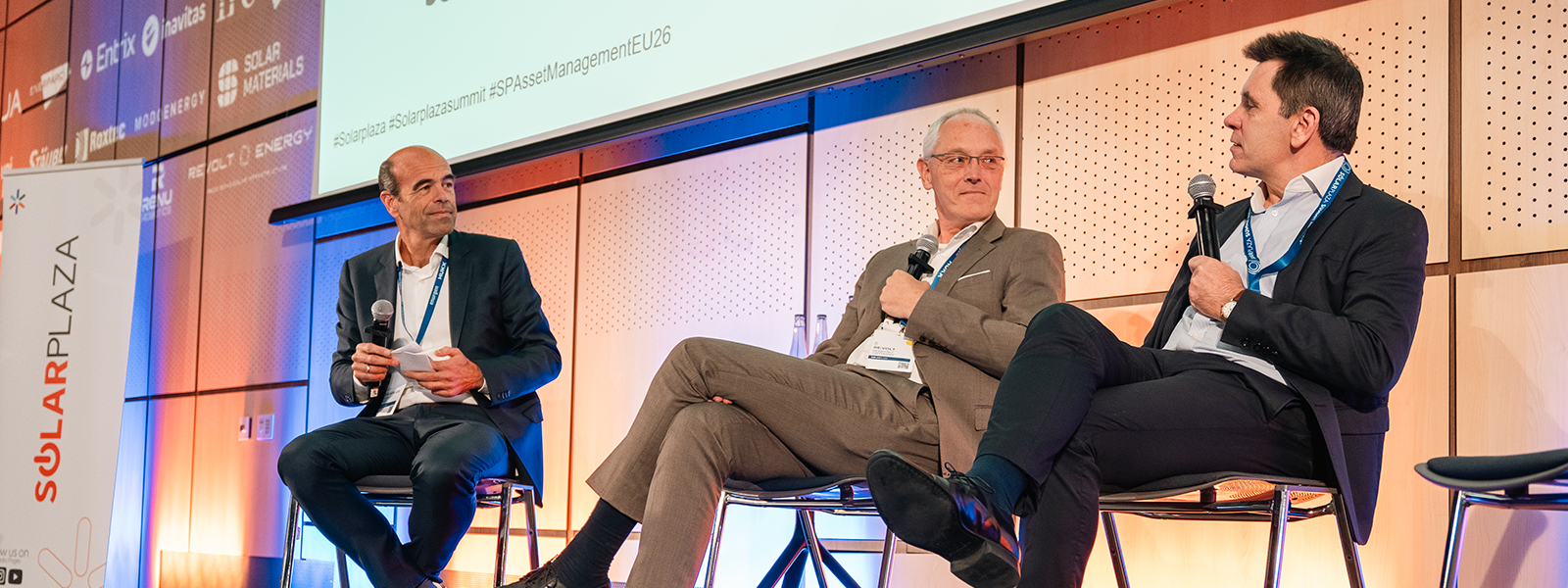
The closing fireside chat, led by our CEO Edwin Koot, brought Reid back on stage next to Benedikt Ortmann, CEO of re:volt and a developer of close to 10 GW over 25 years. Both want the industry off public support. "That industry globally has been hooked on that drug of subsidies for 20 years," Reid said. His argument is economic: most subsidies end up on the customer's bill, which makes electricity more expensive and electrification less attractive. Ortmann has argued the same since his first subsidy-free plant in Spain: "We are producing electrons, and we have to sell them at the point in time and to the partner who is willing to pay for this."
Neither wants governments to walk away. Ortmann asked for state guarantees that take some development risk off developers' shoulders, and for easier grid access. Without that, he expects a significant drop in new project development over the next 12 to 18 months.
Lessons from a hard year
The conversation didn't avoid what the whole industry has been talking about this autumn: Enerparc's insolvency filing in September and the restructuring at BayWa r.e. Both companies helped build European solar, and both have been part of our community for many years. Nobody on stage treated their troubles as a story about bad assets. Luypaert had set the tone in the morning: "We've seen very good reputable developers face difficult times because of overstretched balance sheets. Not that there's anything wrong with the assets per se." Capital structures, he said, had been "designed for perfection".
Reid, who has known the Enerparc team for 20 years, said: "They've done all the right things up to recently. So that makes me a little bit sad. We want people to be successful in this." Ortmann, who led global origination at BayWa r.e. before founding re:volt, described how quickly a large pipeline turns into a cash problem: "You have one big project being delayed for half a year, three quarters of a year, one year, because of grid connection, certification issues, God knows what. Then you are running very quickly into very serious liquidity issues."
His lesson for every developer: "Be always aware of the Icarus story." Overstretched financing, overstretched international reach, and overstretched portfolios, combined with underestimated timing and liquidity risk. Asked who wins the next decade, Ortmann pointed to companies with strong balance sheets and trading capability, and to small, fast players that watch their cash. Reid's answer was shorter: "It's not about building renewables, it's about providing customers with solutions."
The first fleets leave the feed-in tariff
For some owners, life after subsidies has a date. In Czechia, hundreds of plants built in the 2009 and 2010 boom, about 1.5 GW in total, lose their feed-in tariff in 2029 and 2030. The Czech Solar Association is drafting a decision tree for its members, Krcmar said, and the first question is the most basic one: "Do you actually still want to operate the power plant?" He expects many small owners to sell, portfolios to consolidate, and some plants to close. "A lot of power plants will not survive after 2030. That's also okay." Fousek sees adding storage, together with repowering, as the way to give these plants "a life for another 10, 15 years".
Italy faces the same moment in 2030 and 2031, with roughly 15 GW installed under feed-in tariffs. Paolo Rocco Viscontini of Italia Solare described owners whose income will fall from €300,000 or €400,000 a year to around €100,000, with new investment needed on top. Many will sell, he expects. His own advice to anyone revamping, after testing ten module brands side by side on one plant: choose on performance, not on price.
For buyers, an old plant holds two kinds of value, said Björn Broda of Uniper Renewables: the remaining lifetime, and the option to repower on a site that already has land, permits, and a grid connection, "the most scarce resource currently in the market." And the modules that come off the racks are no longer only a cost. Jan-Philipp Mai of SOLAR MATERIALS, in the panel moderated by Thomas Hillig of THEnergy, said Germany already sees about 30,000 tons of modules returning each year, with the steep growth expected from 2030. "We are already in the age where recycling brings money instead of costing money."
Closing words
Krcmar offered the most grounding thought of the day. When he describes the solar industry's worries about CfDs, auctions, and merchant risk to colleagues from manufacturing, "they really laugh at us", because finding a customer for your product is what every other business does. That is the adjustment the speakers in Prague described from every angle: financing built on contracted cash flows, batteries contracted before the market fills up, asset managers who hedge, and operations teams that can prove what a plant should have produced.
Our program manager, Victor Georgescu closed the first session with a line that fits the whole day: "If you're still making decisions using the same set of paradigms, then you're already doing something wrong."
We continue the conversation at the Solarplaza Summit Finland and at our BESS Seminars in Czechia and Ireland. See our event calendar for dates and programs.

