On 17 September 2026, solar, storage, and finance professionals met at the Danubius Hotel Hungaria in Budapest for the seventh Solarplaza Summit Hungary. In 2025, Hungary generated a larger share of its electricity from solar than any other country, according to Ember data presented by Jan Willem Zwang from Stratergy. That success has made midday power cheap. So the day's discussions focused on what comes next: battery energy storage systems (BESS), hybrid projects, and the contracts that make them bankable.
Key takeaways
- Only about a third of Hungary's roughly 9 GW of solar is exposed to market prices; the rest sits under support schemes.
- Hungary's battery fleet reached 966 MW / 1,955 MWh by August 2026, mostly driven by the METÁR storage support scheme.
- Balancing revenues are falling fast, and speakers expect wholesale arbitrage to carry most battery revenue from here.
- Banks now finance cash-flow durability rather than megawatts, and standalone merchant batteries remain hard to finance in Hungary.
- Corporate buyers mainly see power purchase agreements (PPAs) as a hedge and increasingly want hybrid, base-load-shaped profiles.
- Most new wind capacity is expected after 2030, and the new wind grid tender's energy-community clause split the closing panel.
The cost of midday
Dr. Pálma Szolnoki from Zero Carbon Hub opened the day with the numbers behind Hungary's solar boom. The country has almost 9 GW of solar, while summer demand peaks at 7.5 GW and winter demand at 8.2 GW. In April, when solar runs at full capacity but neither heating nor cooling demand is there, the solar capture rate fell below 40% this year. Hungary recorded 280 hours of negative prices last year, and Szolnoki expects 2026 to pass that number.
The market signal reaches only part of the fleet, though. Household systems on net metering and plants on feed-in tariffs make up around 3 GW each and are shielded from prices. Only about 35% of Hungary's solar capacity is actually exposed to the market.
The segment Szolnoki sees as having the most potential, large commercial and industrial (C&I) consumers, has stalled because of a support scheme. At the end of 2024, the government announced a subsidy for this group. Companies put their projects on hold to wait for it, even though Szolnoki's team calculates paybacks of two to four years for such investments. The terms only arrived at the end of August 2025, applications opened in early 2026, and few projects applied. She blamed "the badly managed government support scheme communication and process."
Storage is where the growth is. By August 2026, Hungary had 966 MW and 1,955 MWh of batteries installed, largely projects that had to come online by this summer under the METÁR storage scheme. Newer licenses are shifting from two-hour to four-hour systems. According to Szolnoki, these batteries are currently driven almost entirely by wholesale arbitrage, as prices for frequency restoration reserves have collapsed to below €10 per MW per hour.
Where battery revenue comes from now
Péter Horváth from Dunamenti Power Plant (MET Group) showed how battery value pools disappear in a set order as markets mature. In California, ancillary services went first, then intraday revenues, while day-ahead arbitrage held on longest. His colleague Bálint Vass from MET Group described how MET runs its batteries across markets and keeps positions open for volatility. "Batteries are options and options should be traded as such," he said.
Aurora Energy Research's modeling, presented by Louiza Moutafi, points the same way. Wholesale and balancing energy arbitrage accounts for around 80% of lifetime revenue for a merchant co-located solar and two-hour battery project. Because of charging fees, Aurora puts a standalone battery's internal rate of return (IRR) below 6%, against more than 12% for a co-located project.
Since the event, Hungary's transmission system operator MAVIR joined PICASSO, the European platform for exchanging automatic frequency restoration reserve (aFRR) balancing energy, on 1 October 2026.
Banks finance cash flow, not megawatts
"Today we are not focusing anymore on financing the megawatts. We are focusing on financing energy systems," said Nikoletta Zóna from K&H Bank. Hungarian banks have provided HUF 468 bln (about €1.3 billion) in solar financing, mostly backed by support schemes. Batteries are a different story. Zóna and the four bankers on the following panel agreed that a standalone battery without contracted revenues is rarely financed in Hungary today. Péter Gyurcsák from OTP Bank put it plainly: "on a purely merchant basis, at least the standalone projects won't fly."
The audience was more optimistic than the analysts. Asked how much utility-scale storage Hungary will have by 2030, about half voted for more than 3 GW. Moutafi said Aurora expects around 2 GW.
What corporate buyers want
The morning's buyer panel, moderated by renewable energy and corporate PPA expert Ákos Pesti, showed how much the offtake side has changed. Buyers now have energy managers who model capture rates, and base-load consumers such as Linde and Bosch want hybrid profiles that look more like their own demand. Katalin Szécsi from KPMG added that Hungarian PPAs typically run three to five years and that solar projects without a battery are now hard to sell.
Hybrid or stranded
The panel moderated by Beáta Szoboszlai from PwC started with an audience poll on the biggest difficulty for a new hybrid project. Revenue uncertainty came out on top. László Modos from Renalfa, which is developing 450 MW of solar with 250 MW of co-located storage, said the hardest part was not export capacity but import access, which lets batteries charge from the grid. Renalfa's banks accepted its revenue assumptions, and the project will run fully merchant.
Bálint Frang from E.ON described where projects lose time. Each distribution system operator (DSO) runs its own inverter approval process, a 30-day approval can stretch to 60 or 90 days, and battery commissioning takes longer than solar because the steering logic and revenue models need testing. Thomas Neff from meteocontrol urged developers to treat a hybrid site as a new asset with its own logic and to plan metering, controls, and cybersecurity upfront rather than at commissioning. In his view, the real value of a hybrid project is the grid connection it manages.
John Susa from WHES said many developers entering storage from solar underestimate the software and the interaction between components. He also does not expect battery prices to keep falling the way module prices did. "If I was a developer, I would want to build a project as soon as possible. I wouldn't wait," he said.
Asked what they would build with land and a grid connection in Hungary today, the panel split evenly. "Now for sure wind," said Modos. Frang and Neff picked solar and storage, and Susa chose wind and storage.

Toward 2030
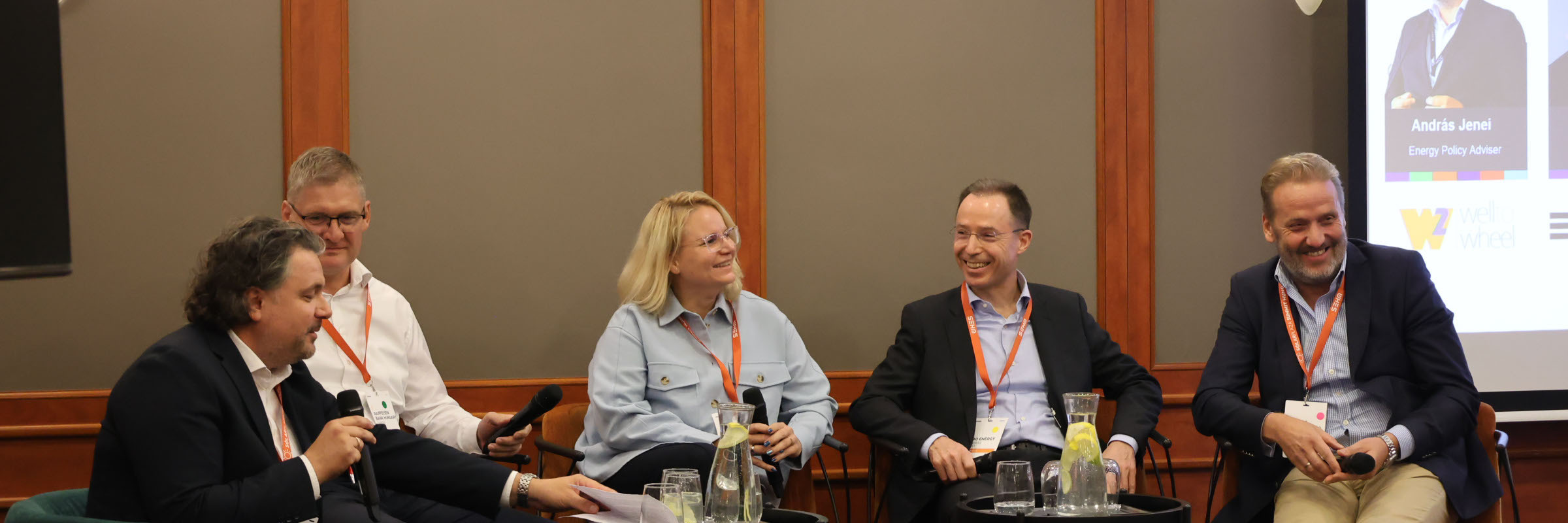
The closing panel, moderated by András Jenei from W2W (welltowheel), looked at the realistic energy mix for 2030. András Kósa from ABO Energy expects most of the roughly 3 GW of already allocated solar grid capacity to be built by 2030, with little added after that. For batteries, he sees around 1 GW and 2 GWh by the end of this year and another 1 to 2 GW in 2027 and 2028, mostly four-hour systems. "Everything is going to be hybridized," he said, but 2027 will show how fast the market saturates.
Eszter Nagy from Electron Holding was more cautious on solar, expecting maybe 1 GW of the allocated capacity to be built by 2030 because merchant projects struggle to get financing. On batteries, she said the market is "not as close to saturation as certain people just suggest." Gábor Makai from Raiffeisen Bank Hungary named the three things that drive debt sizing: economies of scale, flexibility through hybridization, and the certainty of the revenue stream.
Wind drew the strongest debate of the day. The panel expects new wind capacity mostly after 2030, and the new grid tender for wind requires bidders to grant a 25% call option on the project company to a government-designated renewable energy community. Csaba Polgár from Pontes did not hold back: "As a lawyer, that's a huge red flag." He expected the tender to be withdrawn or amended. Nagy took a softer line. In her view, the clause can work if the community's stake does not block standard project finance security and the community has a clear plan for funding its share. "This has to be worked out," she said. According to the published tender terms, the tender covers 702 MVA of grid capacity across nine nodes, with applications due by 30 October 2026 and results expected by 13 December 2026.
Polgár also asked whether removing every barrier is good for the industry, pointing to the cannibalization that followed Hungary's fast solar build-out. He argued for a phased 10-year plan that each government sticks to, and for the state to pre-screen the country for wind, bird, and military radar constraints and publish the results for developers.
We're already working on the next edition of the Solarplaza Summit Hungary. Stay tuned!
