Why it doubled in 2025 & how it can be solved
France’s power system is entering a new phase of the energy transition. As solar capacity expands rapidly within a system already dominated by nuclear generation, the country is increasingly facing periods where electricity supply exceeds demand.

In 2025, renewable electricity curtailment nearly doubled while negative price hours rose sharply. These trends highlight a growing mismatch between when electricity is produced and when it is consumed.This article explores the drivers behind this imbalance, including electricity demand trends, the rapid growth of solar capacity, and the rise in negative electricity prices. It also looks at the potential role of electrification and Battery Energy Storage Systems (BESS) in improving system flexibility and absorbing excess renewable generation.
Key insights from the article:
- Why France’s rapid solar expansion is starting to outpace electricity demand growth
- What is driving the sharp rise in negative electricity price hours
- How increasing renewable generation is leading to more frequent curtailment events
- Why system flexibility and storage are becoming critical for the next phase of the energy transition
- What role Battery Energy Storage Systems (BESS) could play in balancing the French power system
Access the full analysis
Create an account or log in to read the full article and explore the data behind France’s rising renewable curtailment and the growing role of flexibility and storage in the power system.
Introduction
France’s power system is rapidly expanding its clean electricity supply, yet the market is struggling to absorb it. As solar capacity continues to grow within a system already dominated by nuclear generation, midday electricity production is increasingly colliding with relatively flat demand. The result is a growing number of negative price hours, rising curtailment of renewable generation, and mounting questions about how the system should evolve to handle this new reality.
This article takes a closer look at the numbers behind this emerging imbalance. We examine electricity demand trends in the country, recent solar capacity additions, the rise in negative electricity price hours and curtailments, and the pace of electrification. Together, these data points help reveal whether the expected surge in electricity consumption is materialising quickly enough to keep pace with the renewable buildout.
At the same time, the discussion inevitably turns to system flexibility, and particularly the role of Battery Energy Storage System (BESS). If solar deployment continues to accelerate while demand grows more slowly than anticipated, storage may become a critical component of the power system. Understanding how much storage France might need will be key to assessing whether the next phase of the energy transition can translate abundant clean power into reliable system value rather than increasing volatility.
Electricity demand - a system waiting for growth
Despite years of policy discussion around electrification, from electric vehicles (EVs) to heat pumps and hydrogen, French electricity consumption has remained remarkably stable for more than two decades.
Historical data show that national electricity demand has largely hovered between 460 and 530 TWh since 2000 (EMBER, 2026). Consumption peaked in 2010 at around 532 TWh, but has since fluctuated within a relatively narrow range. In recent years, demand has actually moved toward the lower end of that range. After falling sharply during the pandemic and energy crisis, consumption reached 466 TWh in 2023, before recovering only slightly to 469 TWh in 2024 and 474 TWh in 2025.
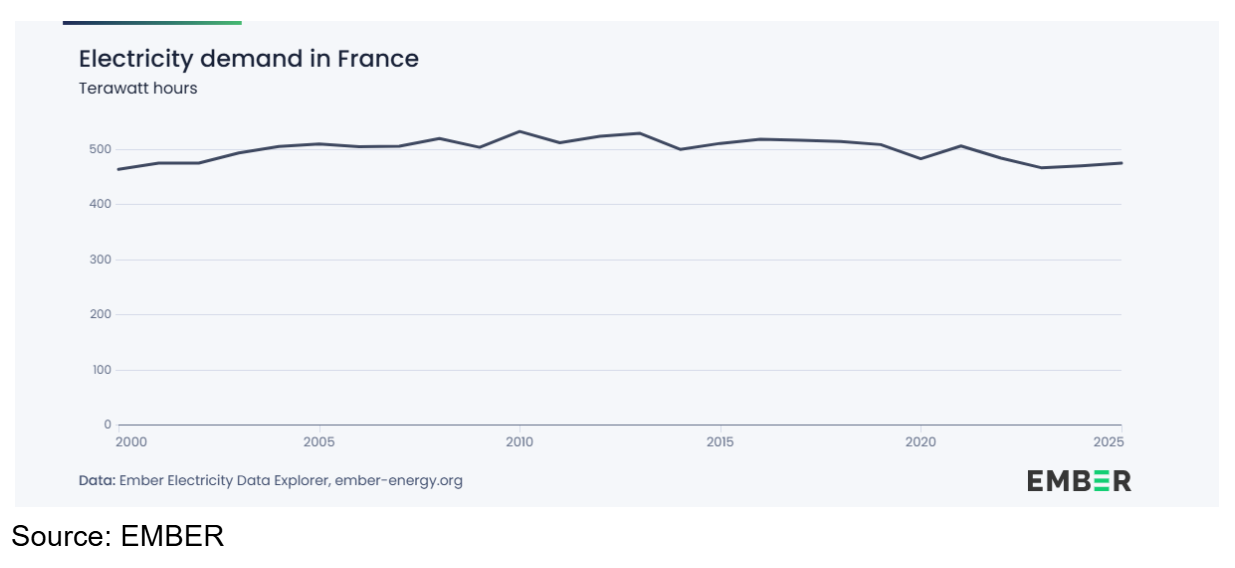
In other words, France is consuming roughly the same amount of electricity today as it did 25 years ago. The long-anticipated surge in demand from electrification has yet to materialize in the aggregate statistics.
This reality contrasts sharply with earlier expectations. A 2015 study by Jacques Després, ‘Modelling the Long-Term Deployment of Electricity Storage in the Global Energy System’, projected that French electricity demand could reach around 550 TWh by 2020, 600 TWh by 2030, and well over 800 TWh by 2050 (Després, 2015). Those projections assumed a steady rise in electricity use driven by the electrification of heating, transport, and industry.
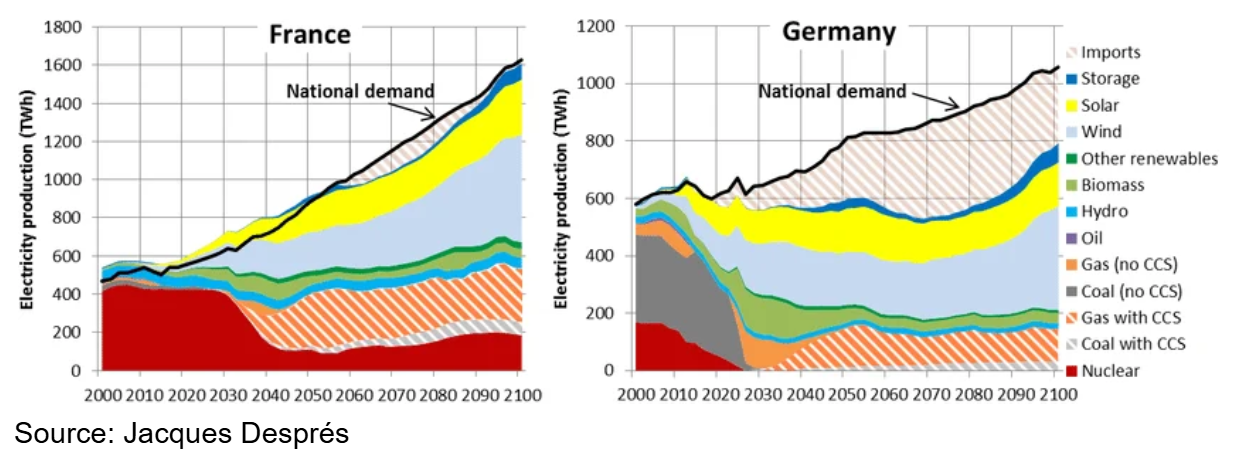
Reality has proven more modest. In its 2021 energy outlook, French transmission system operator RTE significantly revised demand expectations downward (RTE, 2021). Their scenario suggests electricity consumption of around 500 TWh by 2030 and approximately 650 TWh by 2050, reflecting slower electrification and stronger energy efficiency gains than previously assumed.
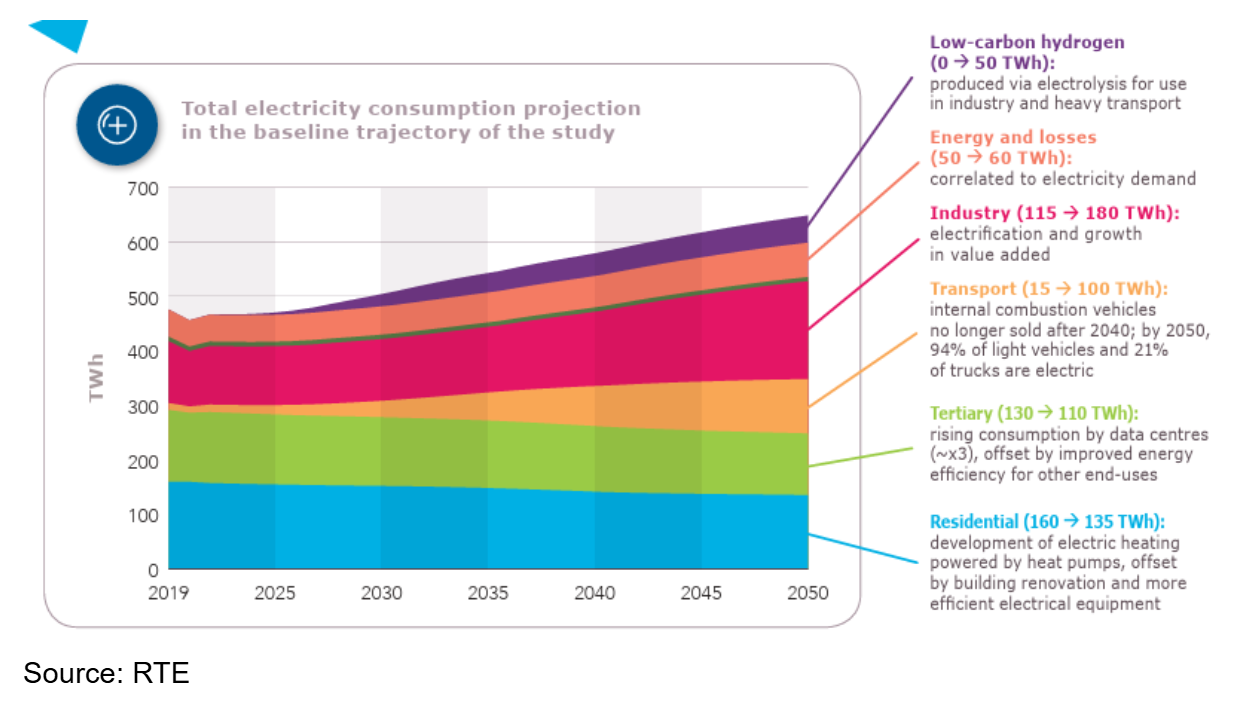
The difference between these projections highlights how the timeline of electrification has shifted. While the long-term direction toward a more electricity-driven energy system remains unchanged, the near-term trajectory is far less steep than earlier forecasts anticipated.
For the power system, this matters enormously. If electricity demand grows slowly while renewable capacity continues to expand rapidly, the result is a widening gap between when electricity is produced and when it is needed. In a system already dominated by nuclear baseload generation, this imbalance becomes particularly visible during sunny midday hours, setting the stage for the rising negative prices and curtailment now emerging across the French market.
Solar capacity expansion - growth accelerating faster than demand
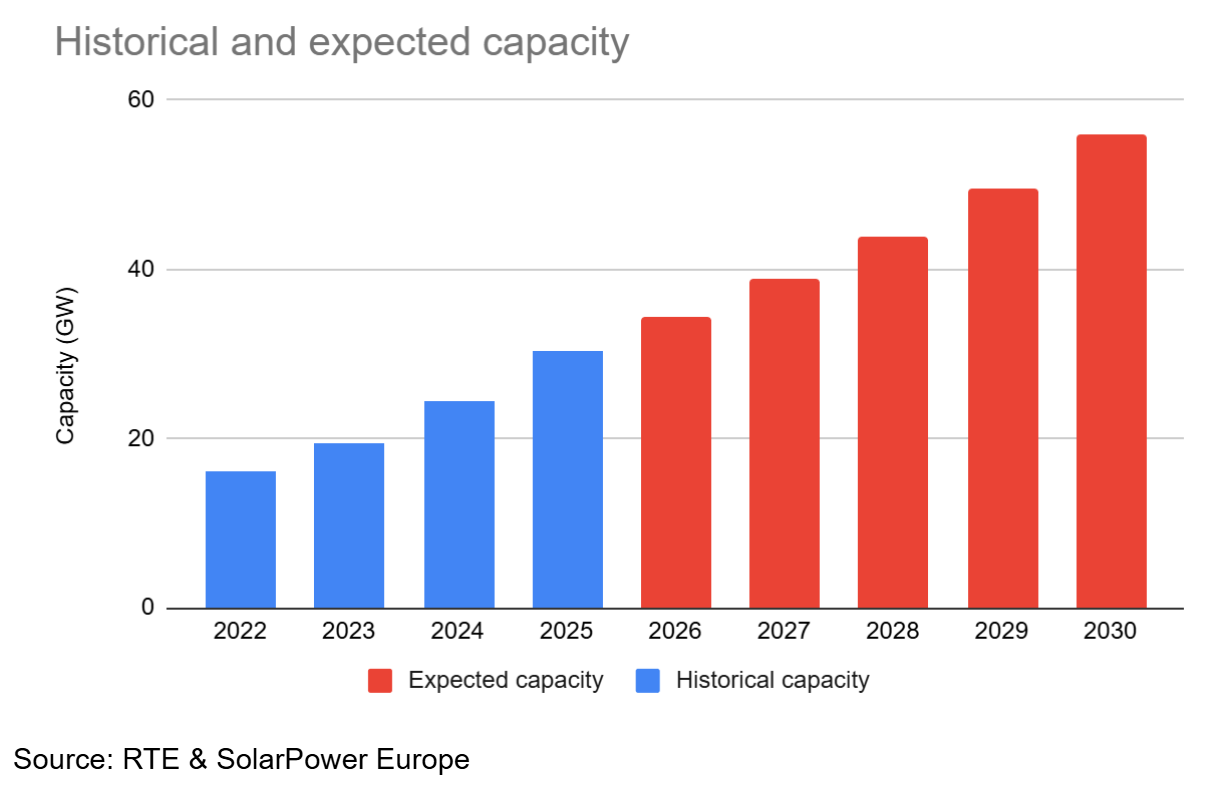
While electricity demand has remained largely flat, solar capacity in France has been expanding rapidly. Installed photovoltaic capacity increased from 16.1 GW in 2022 to 30.4 GW in 2025, reflecting the strong momentum behind solar deployment in the country (RTE, 2026). The pace of expansion has accelerated in recent years, with around 5.9 GW of new capacity added in 2025 alone, highlighting how quickly solar is scaling within the French power system.
Looking ahead, projections suggest this expansion will continue at a similar pace. According to SolarPower Europe, France could reach around 56 GW of installed solar capacity by 2030 (SolarPower Europe, 2025). Achieving this target would require the country to install approximately 5.1 GW of new solar capacity every year throughout the remainder of the decade.
However, the rapid growth of solar capacity is already beginning to test the power system’s limits during certain hours of the day. At 14:00 on July 10, 2025, solar generation reached 19.5 GW, marking the technology’s highest contribution that year.
This level of output already exceeds the residual load during solar hours, which refers to the portion of electricity demand not already covered by France’s nuclear fleet (Montel Energy, 2025). Residual load typically sits at around 16 GW in January and falls to roughly 11 GW in May.
This means that on sunny days, solar generation alone can already surpass the portion of demand available during daylight hours, even before accounting for the other generation technologies in the mix, like wind and hydropower. As solar capacity continues to grow toward the projected 56 GW by 2030, these situations are likely to become more frequent without further intervention, increasing pressure on prices, system flexibility, and the grid's ability to absorb additional generation.
Negative price hours
In France, the number of hours with negative day-ahead prices has risen sharply in recent years. The market recorded 147 negative price hours in 2023, which more than doubled to 352 hours in 2024. By 2025, this figure had climbed further to 513 hours (GEM Energy Analytics, 2026).
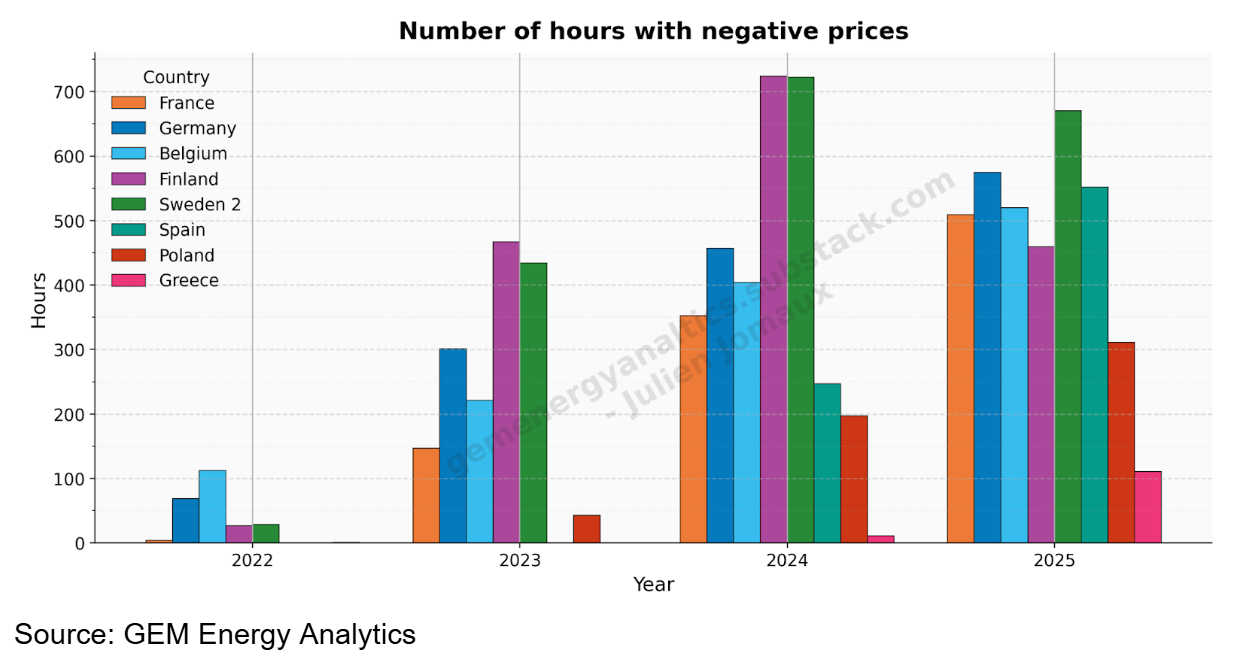
These negative price events are increasingly concentrated during sunny midday hours, when solar generation peaks while electricity demand remains relatively modest. In a system already dominated by nuclear baseload generation, this combination can lead to periods when supply temporarily exceeds the market’s capacity to absorb it.
The rise in negative price hours, therefore, reflects more than just short-term volatility. It signals a growing mismatch between electricity production and consumption timing.
Curtailment
As negative price periods have become more frequent, curtailment of renewable generation has also increased significantly. In 2025, nearly 3 TWh of renewable electricity was curtailed during negative-price periods, almost double the level recorded in 2024 (PV Magazine, 2026). Solar accounted for the largest share, with around 1.6 TWh of generation reduced, while onshore wind curtailed approximately 1.3 TWh (Montel News, 2026).
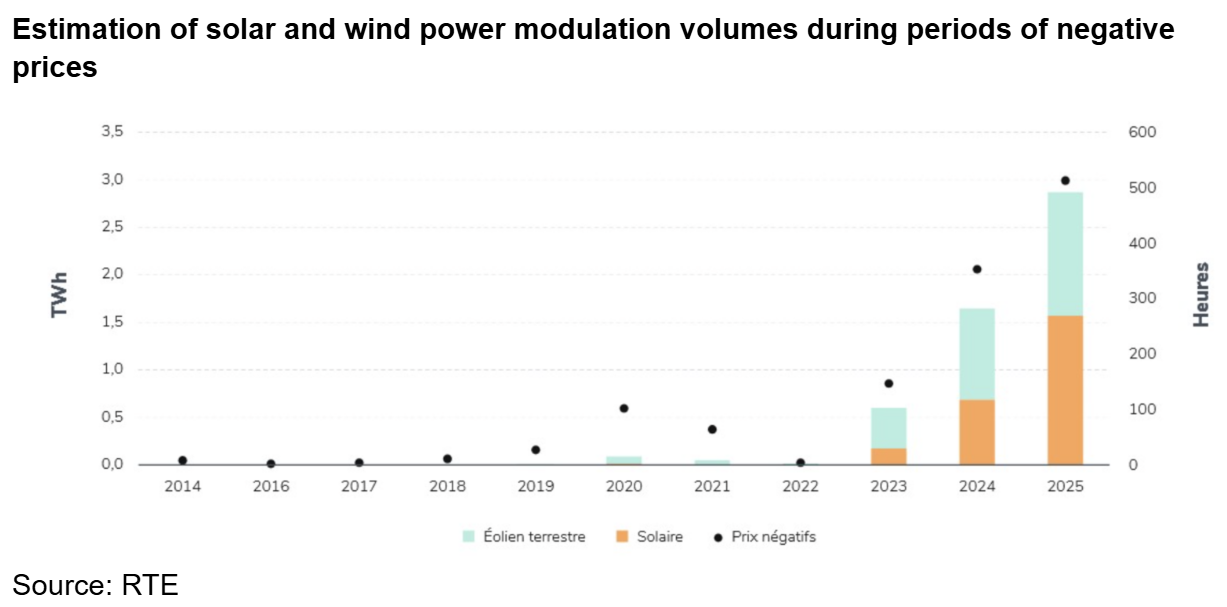
This increase reflects both market dynamics and the growing scale of renewable production. Rising solar and wind output, combined with a surge in hours with zero or negative wholesale prices, has pushed generators to curtail output more often when market prices fall below zero. Much of the recent change has been driven by the sharp increase in solar curtailment, which tends to occur during sunny midday periods when supply exceeds demand.
Another factor is the evolution of the support framework for renewable projects. A growing share of France’s renewable fleet now operates under premium schemes, which expose generators more directly to market price signals and encourage them to adjust output when prices fall below zero.
The rise in curtailment highlights a broader system challenge. As renewable penetration increases, the power system’s ability to absorb generation becomes just as important as the ability to produce it. More frequent negative-price periods, therefore, underscore the need for greater system flexibility, including energy storage, demand response, and improved forecasting, to ensure that clean electricity can be used efficiently rather than curtailed.
Solution? Electrification and more flexibility through BESS deployment
Now, back to the demand side. Part of the solution could come from electrification. As discussed earlier, technologies such as EVs, hydrogen electrolysers, heat pumps, and industrial electrification could absorb excess renewable generation. However, their deployment has progressed more slowly than expected.
At the same time, the French government is preparing a more ambitious energy strategy. According to Prime Minister Sébastien Lecornu, the upcoming plan aims to increase the role of electricity in the country’s energy mix from around 30% today to about 60% by 2030 (Modo Energy, 2025). Such a shift would support the continued growth of solar power while encouraging new uses of electricity across transport, heating, and industry.
Achieving this transformation would require major infrastructure investments, a significant expansion of the power grid, and a much faster increase in electricity demand than previously projected. Until that demand materialises, the French power system will need greater flexibility to manage the growing gap between renewable generation and consumption.
One of the main tools for providing this flexibility is the deployment of BESS. Yet compared with the scale of the challenge, this deployment remains modest. By the end of 2025, operational grid-scale BESS capacity in France stood at around 1.5 GW (Modo Energy, 2025). To absorb today’s midday solar surplus alone, Montel estimates that at least 15 GWh of storage capacity would be required (Montel Energy, 2025).
Forecasts nevertheless suggest rapid growth over the remainder of the decade. According to Modo Energy, BESS capacity could reach around 5.3 GW by 2030 (Modo Energy, 2025), while RTE expects roughly 6 GW by that time. Other analysts foresee even faster expansion. Aurora Energy Research estimates that BESS capacity could reach 9 GW by 2030 (Enspired, 2025).
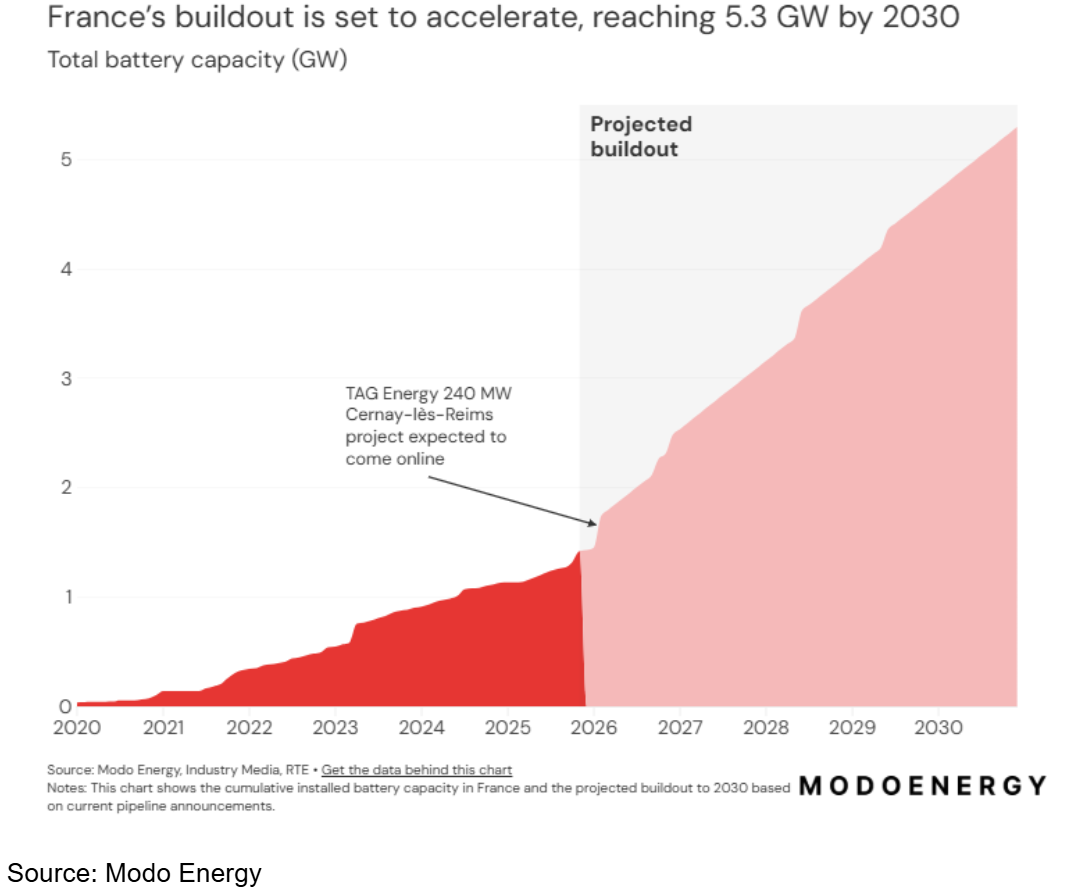
Even with this projected growth, storage capacity will remain relatively small compared with the scale of solar expansion. Solar-plus-storage projects, which could help mitigate midday oversupply, are still in their early stages in France. Through the first three quarters of 2025, only 162 MW of the 5.2 GW of new solar capacity was installed alongside BESS (SolarPower Europe, 2025). While this marks a noticeable increase compared with 2024, when just 34 MW of solar was deployed with BESS for the entire year, hybrid projects remain far from becoming the dominant model.
In that context, storage will likely play a central role in the coming years. Batteries alone will not eliminate negative prices or curtailment, but their expansion could help shift excess midday solar generation into evening hours, reduce market volatility, and allow a larger share of renewable electricity to be used rather than curtailed.
Understanding how much storage France might ultimately need remains difficult. The answer will depend on how quickly electrification accelerates, how much flexible demand emerges, and how the power system evolves as solar capacity continues to grow. For now, the comparison between today’s solar peaks and current storage capacity suggests that flexibility is expanding more slowly than renewable generation is growing.
The next phase of France’s energy transition will therefore be determined by how effectively the system can absorb renewable energy. Without sufficient storage, flexible demand, and grid upgrades, the risk is that more renewable capacity will simply produce more hours of oversupply. France is no longer facing a shortage of clean electricity. The real challenge now is making sure the system can use it.
Sources
Després, J. (2015) Modelling the long-term deployment of electricity storage in the global energy system. Retrieved from https://www.researchgate.net/publication/286089835_Modelling_the_long-term_deployment_of_electricity_storage_in_the_global_energy_system
EMBER (2026) Electricity Data Explorer. Retrieved from https://ember-energy.org/data/electricity-data-explorer/?data=demand&fuel=total&entity=France
Enspired (2025) BESS in France. Exploring commercial dynamics and opportunities with battery storage in France, which is poised to become one of Europe’s top markets. Retrieved from https://www.enspired-trading.com/blog/bess-in-france
GEM Energy Analytics (2026) Negative electricity prices: current trends and outlook. Retrieved from https://gemenergyanalytics.substack.com/p/negative-electricity-prices-current
Modo Energy (2025) France Battery Buildout Report: Capacity closing in on 1.5 GW. Retrieved from https://modoenergy.com/research/en/france-battery-buildout-bess-construction-energy-storage-november-2025
Montel Energy (2025) The French green power paradox: circuit overload. Retrieved from https://montel.energy/commentary/the-french-green-power-paradox-circuit-overload
Montel News (2026) French renewable power curtailment doubles in 2025 – TSO. Retrieved from https://montelnews.com/news/429205f5-6d9d-4bbf-9da9-dbd9de4f2a8c
PV magazine (2026) PV curtailment surges in France as grid adapts to rising solar output. Retrieved from https://www.pv-magazine.com/2026/03/02/pv-curtailment-surges-in-france-as-grid-adapts-to-rising-solar-output/
Reuters (2026) France to set out ambitious electrification drive this week. Retrieved from https://www.reuters.com/business/energy/france-set-out-ambitious-electrification-drive-this-week-2026-02-09/
RTE (2021) Energy Pathways to 2050. Retrieved from https://analysesetdonnees.rte-france.com/en/publications/energy-pathways-2050
RTE (2026) éCO2mix - Key figures. Retrieved from https://www.rte-france.com/en/data-publications/eco2mix/key-figures#solaire-France
RTE (2026) Generation. Retrieved from https://analysesetdonnees.rte-france.com/en/generation/solar
SolarPower Europe (2025) EU Solar Market Outlook 2025-2030. Retrieved from https://www.solarpowereurope.org/insights/outlooks/eu-solar-market-outlook-2025-2030

