Introduction
The EU’s shift toward renewable electricity is an imperative step in its strategy to mitigate the effects of climate change. With a target of generating 42.5% of its electricity from renewable energy sources (RES) by 2030, the energy transition is well underway. Yet alongside the environmental benefits of this transformation, managing the significant volumes of waste generated by renewable energy infrastructure is becoming an ever-increasing challenge.
From solar panels and wind turbines to battery energy storage systems (BESS), the build-out of green technologies requires large quantities of valuable materials, including steel, copper, aluminium, concrete, and fiberglass, as well as critical raw materials such as silicon, cobalt, lithium, and rare-earth elements. Changing technology designs and increasing deployment are all contributing to rising end-of-life volumes.
Recent analyses from the European Commission’s Joint Research Centre (JRC) and the European Federation for Transport and Environment shed light on the quantities of materials expected to come from solar, wind, and battery waste in the coming decades. In this article, we explore projected waste volumes from solar panels, wind power, and batteries, and examine the EU’s material recovery targets designed to ensure these resources remain in the economy for as long as possible.
Solar & wind
The EU faces a mounting wave of end-of-life solar and wind infrastructure that will demand both policy action and technological innovation. For solar energy alone, cumulative waste is projected to reach 6–13 million tonnes by 2040 and 21–35 million tonnes by 2050. Efficient recycling could play a key role in meeting the EU’s ambition for 40% domestic manufacturing of renewable energy systems. For example, silver recovered from discarded panels could meet the demand for new panel production if collected and processed effectively.
Wind power infrastructure will overtake solar in waste volume by mid-century. By 2030, the EU could host 42,500 turbines, which could double to 86,000 by 2050. Annual wind turbine waste is forecast at 10 million tonnes by 2050.
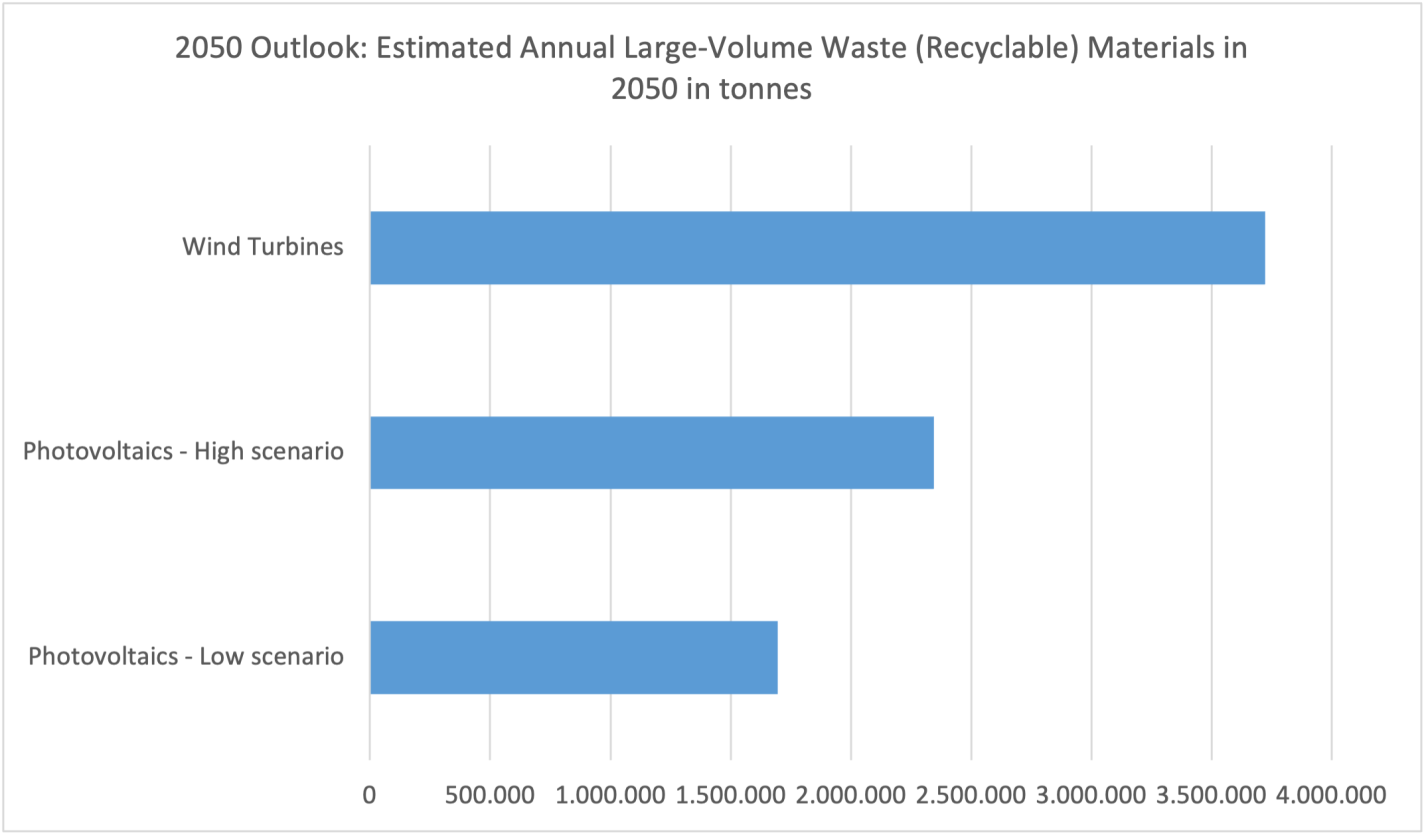
Source: EC
Although up to 90% of a turbine’s mass is recyclable, the composite materials in blades remain difficult to process. Innovative solutions, such as cement co-processing and creative reuse (like converting blades into bridges, playgrounds, or car park structures), are emerging to close this gap.
The material stakes are high. By 2050, PV panels and wind turbines combined could generate 2.9 million tonnes of steel, 191,527 tonnes of aluminium, and 52,874 tonnes of copper annually. Meeting the EU’s Waste Electrical and Electronic Equipment (WEEE) Directive target of 85% recovery and 80% reuse/recycling for PV panel waste remains a challenge, with only half of the reporting countries achieving compliance in 2021.
Economics is also in play. Solar panel recycling currently costs €300–500 per tonne, posing a significant financial hurdle for recycling businesses. However, advances in recycling technology are rapidly shifting the economics. Automated dismantling systems can cut processing costs by up to 60% compared to manual methods, handling up to 100 panels per hour versus just 10–15 manually. This can reduce labour needs by as much as 70%, while improving the quality of recovered materials.
Although the upfront investment in automation is substantial, ROI can be achieved within 2–3 years thanks to reduced operating costs and higher recovery rates. As the first major wave of solar installations approaches their end-of-life, these innovations are becoming pivotal for both economic and environmental sustainability. For stakeholders across Europe’s solar value chain, embracing cost-efficient recycling today will be critical to meeting future regulatory demands and capturing value from the materials loop.
Battery
The deployment of batteries became a key technology in Europe’s green transition. They are used for both enabling sustainable mobility and providing flexibility in the renewable energy-based electricity systems.
Demand from electric vehicles (EVs) and BESS in Europe is expected to reach 970 GWh by 2030, nearly doubling to 2 TWh by 2040. This growth will create a massive stream of end-of-life batteries of around 170 GWh available for recycling by 2035, and 470 GWh by 2040, making battery recycling an essential source of raw materials.
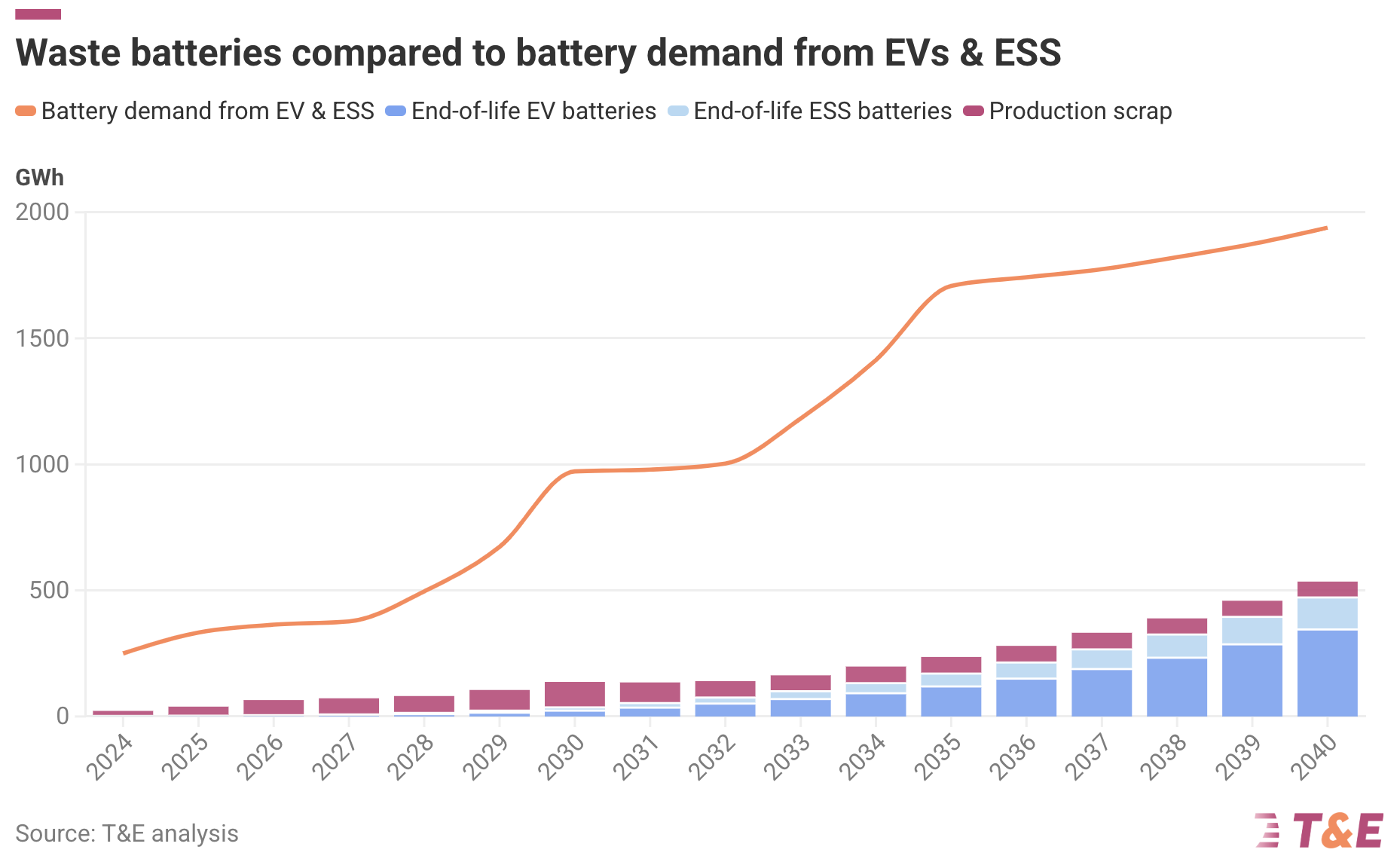
Source: T&E
The recycling potential of batteries is also substantial. Between 2030 and 2035, recycled lithium could meet 11% of demand, rising to 23% by 2040. Metals recovered from battery waste by 2030 could power 1.3–2.4 million electric vehicles, growing to as many as 15.4 million vehicles by 2040. In the near term, production scrap from Europe’s expanding gigafactories will dominate recycling feedstock, with over 100 GWh of scrap available annually by the end of the decade before EoL batteries become the primary source after 2035.
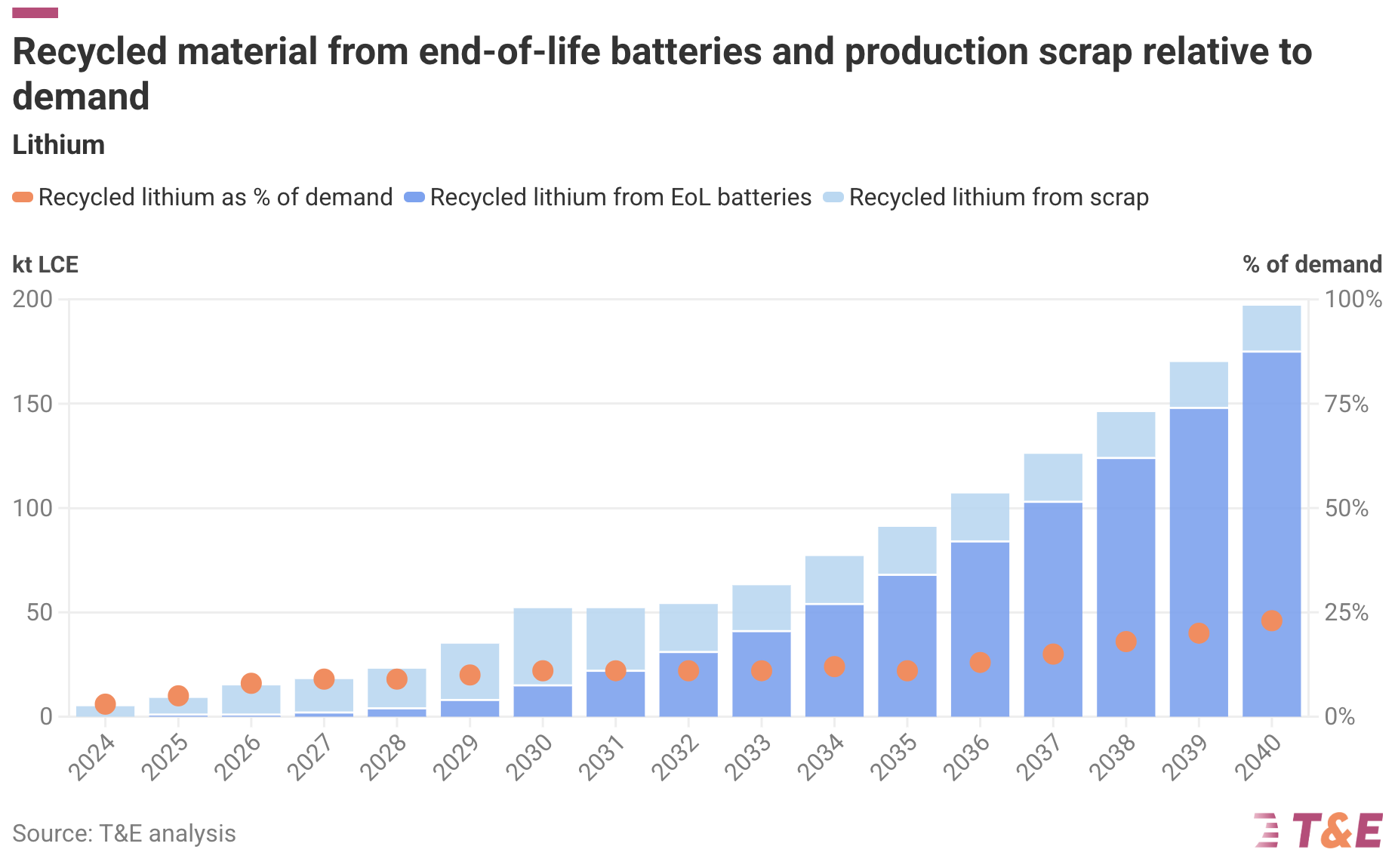
Source: T&E
EU regulation is setting ambitious benchmarks. Under the EC’s 2023 regulation concerning batteries and waste batteries (Annex XII of the Batteries Regulation), recyclers must meet efficiency targets by 2025. These are 75% for lead-acid, 65% for lithium-based, and 80% for nickel-cadmium batteries, with higher targets for 2030. Material recovery goals are equally demanding. 90% for cobalt, copper, lead, and nickel, and 50% for lithium by 2027, rising to 95% and 80% respectively by 2031.
However, Europe’s recycling capacity is currently 10 times below what will be required by 2030. Scaling up, especially in hydrometallurgical processing, will require billions in investment. Without rapid capacity growth, the region risks losing critical raw materials to export or landfill as well as a strategic opportunity to secure a domestic supply chain for its clean energy future.
Closing words
Europe’s renewable energy transition has a bold goal that is not just about deploying solar, wind, and BESS systems, but ensuring these technologies remain part of a truly circular economy. The data is clear. Soon, millions of tonnes of valuable materials will reach end-of-life, representing both a pressing waste challenge and an important resource opportunity.
Meeting the EU’s ambitious recycling and recovery targets will demand rapid investment, regulatory alignment, and the adoption of advanced processing technologies. The potential rewards are equally clear. Recycling could reduce reliance on imported raw materials, lower carbon footprints, and strengthen domestic manufacturing capacity.
The choices made in the following years will determine whether Europe closes the loop on its renewable technologies or risks losing critical resources to landfill and export. In that sense, recycling is an integral part of Europe’s foundation for its long-term resilience and sustainability.