Rooftop vs. ground-mounted growth, tender dynamics & structural challenges
France added 4.6 GW of new solar capacity in 2024, pushing its total to 22.1 GW. With ambitious targets set for 2030 and beyond, the country is ramping up ground-mounted and rooftop tenders, but faces critical headwinds in permitting, land availability, and price volatility. This article outlines key policy shifts, market segmentation, tender outcomes, and systemic challenges shaping the French solar landscape.
Introduction
Solar capacity deployment
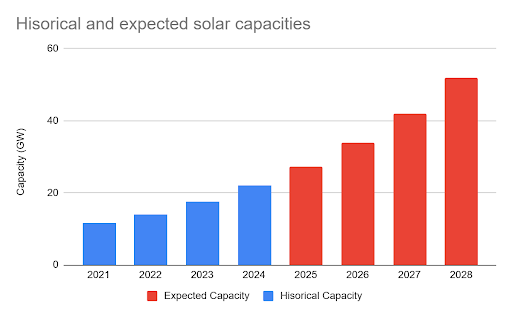
France’s solar energy market has experienced a robust upward trend in annual installed capacity in recent years. In 2024 alone, the country added 4.6 GW of new solar capacity, bringing its cumulative total to 22.1 GW.1 This growth shows no signs of slowing. According to SolarPower Europe, France’s operational solar capacity could reach 52 GW by 2028, implying an additional 30 GW of installations over the next four years.2
If this trajectory continues, France will be on track to nearly reach the revised 2030 target of 54 GW outlined in the country’s upcoming Multi-Year Energy Program (PPE3).3 The draft of PPE3 proposes lowering France’s 2035 solar PV goal from the previously set range of 75-100 GW to a revised 65-90 GW.
To meet these targets, France will rely heavily on structured tendering procedures. Beginning in the first half of 2025, the government plans to launch two annual tenders for ground-mounted solar projects, each awarding 1 GW of capacity. In parallel, three rooftop solar tenders per year are scheduled, with each round targeting approximately 300 MW. Complementing these will be an annual 500 MW technology-neutral auction, open to solar, onshore wind, and hydropower projects, encouraging diverse renewable deployment.
Source: Enedis & SolarPower Europe
Market segmentation
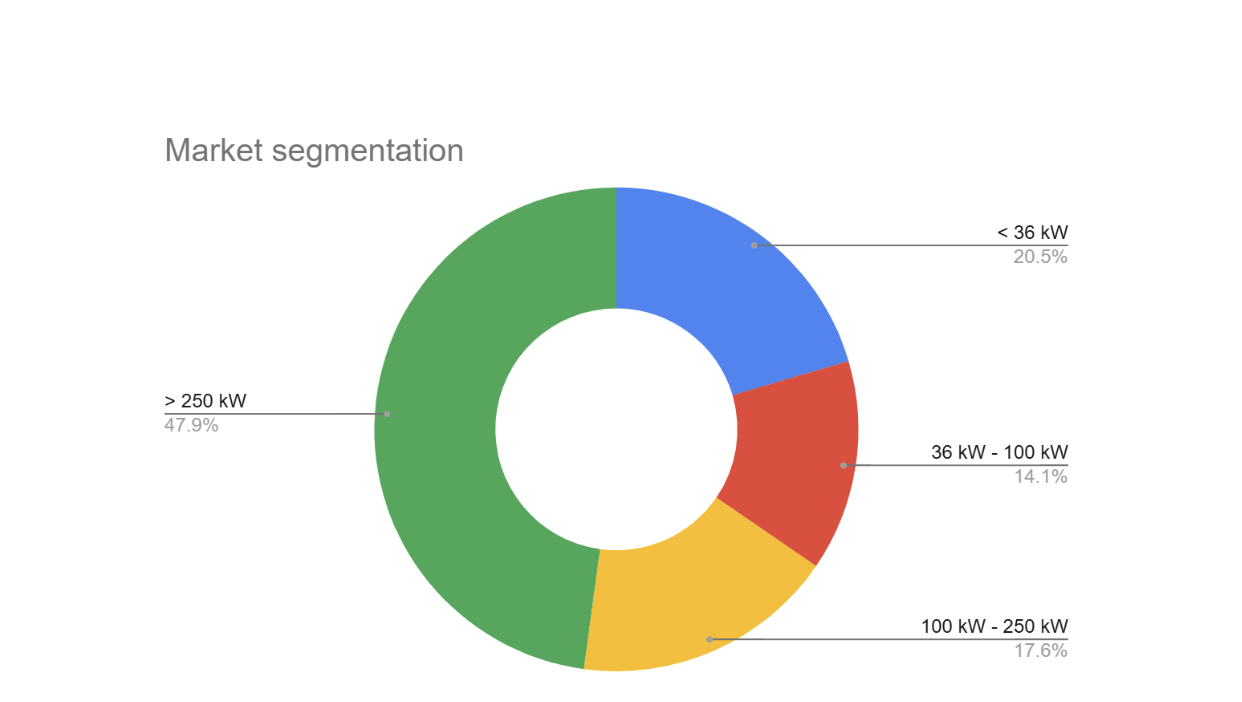
France’s solar market expansion is primarily fueled by the ‘S21’ feed-in tariff scheme, which incentivizes installations under 500 kW.2 Within this category, the 100–500 kW segment has emerged as the primary growth driver, accounting for a substantial share of new capacity additions. By the end of 2024, solar power plants above 100 kW in capacity represented nearly two-thirds of the country’s total installed solar base.1
The residential segment (installations below 36 kW) has also experienced strong growth momentum. In 2024, residential solar deployments exceeded 1 GW, bringing the total operational capacity in the segment to 4.5 GW.
Source: Enedis
Energy mix
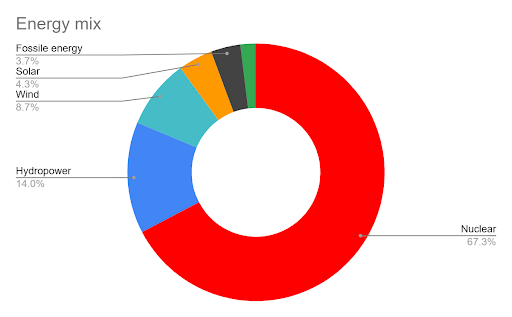
In 2024, solar energy contributed 23.2 TWh to France’s electricity generation, accounting for 4.3% of the national total.4 While this marks a modest share, solar energy generation increased steadily from 21.5 TWh in 2023.
Nuclear energy remains the cornerstone of France’s electricity system, providing a dominant 67.3% of total generation. This nuclear-heavy profile continues to support France's status as a low-emissions power producer.
Alongside solar, other renewable energy sources collectively contributed 29%, showcasing the country's broader commitment to diversifying its clean energy portfolio. In contrast, fossil fuels made up just 3.7%.
According to EMBER, France ranked as the 10th largest country in the world by electricity demand in 2024.5 Yet, despite its high consumption, the country maintains one of the lowest emissions footprints per capita in the global context, emitting only 0.4 tons of CO2 per person, which is just one-fifth of the global average.
Source: RTE
Recent tender result
Ground-mounted solar tender
The seventh round of France’s PPE2 tender for ground-mounted solar projects, concluded in early 2025, awarded 887.5 MW across 103 projects, just under the 925 MWp target.7 The average winning price declined slightly from €79.28/MWh in the previous round to €79.09/MWh, continuing a modest downward trend in pricing. Analysis by consulting firm Finegreen shows EDF leading this round with nine projects totaling 119.3 MW, followed by Germany’s Wpd (54.1 MW) and Engie (45.4 MW). Regional allocation was highest in Centre-Val de Loire (189.1 MW) and Nouvelle-Aquitaine (138.8 MW), reflecting strong solar activity in the southwestern regions of the country.
This seventh round follows the sixth PPE2 ground-mounted tender, which awarded 948.3 MW across 120 projects in late 2024, at an average tariff of €79.28/MWh.6 That round featured strong participation from developers such as Neoen (166.7 MW), Urbasolar (124.1 MW), TotalEnergies (68.7 MW), and Arkolia (56.8 MW), indicating a healthy competitive landscape.
France has committed to holding two ground-mounted solar tenders annually, each targeting 925 MW, as part of its strategy to accelerate utility-scale solar deployment and meet its 2030 and 2035 energy targets. Complementing these will be three rooftop solar tenders, which will collectively offer 1,200 MW, and a yearly 500 MW technology-neutral tender, open to solar, wind, and hydroelectric projects.
Rooftop solar tender
France’s rooftop solar segment continues to play a strategic role in the national energy transition, though recent tender rounds have faced slight undersubscription. In the eighth round of the PPE2 rooftop solar tender, the French Ministry of Solidarity and Ecological Transition awarded 253 MW of capacity across 72 winning projects, falling short of the 300 MW target.7 Despite this, the round marked an increase in participation compared to the seventh round, which awarded only 180 MW across 50 proposals.
This tender encompassed large rooftop solar systems, solar carports, and solar shadehouses, with all selected projects featuring capacities above 500 kW. While the tender was undersubscribed, pricing remained competitive, with the average awarded tariff dropping slightly to €99.95/MWh, down from €100.7/MWh in the previous call.
Technique Solaire emerged as the most successful bidder in this round, securing 59 MW of capacity. It was followed by Urbasolar with 39.9 MW and Sunrock with 21.1 MW, signaling strong involvement from experienced developers and a healthy level of competition in this market tier.
On December 6, France closed bidding for the ninth rooftop solar tender, which targeted an even larger volume of 400 MW. Looking ahead, the government has scheduled three more rooftop solar tender rounds for 2025, aiming to allocate a combined 1,200 MW of capacity throughout the year.
While some rounds have faced undersubscription, the rooftop solar market remains essential to achieving France’s medium-term targets. The segment not only supports distributed generation and better utilization of artificial surfaces but also contributes to easing land-use constraints on ground-mounted installations. With ongoing tender opportunities and falling price trends, rooftop solar is positioned to remain a critical pillar of France’s renewable energy goals.
Technology-neutral tender
In the most recent technology-neutral tender organized by the Ministry of Ecological Transition, solar power emerged as the clear frontrunner. Of the 500.6 MW awarded across all technologies, 463.7 MW was allocated to solar projects.6 This tender, aligned with the European Commission’s push for nondiscriminatory competition among renewables, was open to diverse project types, including ground-mounted solar, rooftop solar on barns and carports, floating solar, onshore wind farms, and hydroelectric plants.
Despite this diversity, solar secured 35 of the 38 winning projects. Among the most notable were Q Energy’s 30 MW agrivoltaic development in Côte d’Or, Soleil Elements’ 29 MW floating solar installation in Nièvre, and Urbasolar’s 33.95 MW project located on a repurposed military base in Meurthe-et-Moselle.
Challenges
Despite strong growth and favorable tender results, the French solar sector faces a number of structural and emerging challenges that could hinder its long-term development if left unaddressed.2
One of the most pressing concerns stems from France’s current economic downturn, which may lead to reduced political and financial support for the sector, particularly for smaller-scale projects under 500 kW. These installations often rely more heavily on stable subsidies and may be the first to feel the impact of constrained public budgets.
Additionally, permitting procedures remain slow and complex. The administrative burden is significant across all project segments, and the growing volume of applications has overwhelmed the permitting system.
Land availability is another growing bottleneck. While solar deployment is accelerating, developers are facing increased pressure to prioritize already artificialised or developed areas, such as rooftops, car parks, and degraded land. While this policy approach helps limit land-use conflicts and environmental impacts, it also narrows the pool of viable sites, especially for larger ground-mounted installations.
Compounding these issues is the rise in negative electricity price hours, which is beginning to affect the profitability and stability of solar generation. As solar penetration increases, curtailment risks and market volatility become more frequent. In the first half of 2024, negative electricity prices surged in the country. French grid operator RTE reported 233 negative hours in H1 2024, compared to just 53 throughout the first six months of 2023. Addressing this issue will require systemic reforms to the regulatory framework.10 One promising solution involves supporting the development of hybrid solar-storage plants, which can enhance grid flexibility and reduce overgeneration during low-demand periods.
Industry associations such as the Syndicat des Énergies Renouvelables (SER) and Syndicat des Professionnels de l'Énergie Solaire (SPE) have put forward a series of recommendations to mitigate these challenges.11 These include simplifying administrative procedures across all segments, introducing open-access mechanisms for rooftop systems above 100 kW, and opening up the self-consumption market to boost the residential sector. Furthermore, they emphasize the importance of reinforcing France’s domestic solar manufacturing base, expanding solar heating, and making solar energy a cornerstone of energy autonomy, particularly in overseas territories.
If France is to meet its ambitious solar targets and maintain momentum, addressing these challenges will be as critical as scaling up capacity. Regulatory agility, infrastructure investment, and strategic innovation will be key pillars in shaping a resilient, inclusive, and future-ready solar market.
Sources
1 Enedis (2025) Le Mix de production - Parc raccordé. Retrieved from https://data.enedis.fr/pages/parc-raccorde/
2 SolarPower Europe (2024) EU Market Outlook for Solar Power 2024-2028. Retrieved from https://www.solarpowereurope.org/insights/outlooks/eu-market-outlook-for-solar-power-2024-2028
3 Renewables Now (2025) France slashes 2035 solar target in latest energy plan. Retrieved from https://renewablesnow.com/news/france-slashes-2035-solar-target-in-latest-energy-plan-1272557/
4 RTE (2025) Production. Retrieved from https://analysesetdonnees.rte-france.com/production/synthese
5 EMBER (2025) France. Retrieved from https://ember-energy.org/countries-and-regions/france/
6 PV magazine (2025) France allocates 948.3 MW in ground-mounted PV tender. Retrieved from https://www.pv-magazine.com/2024/11/14/france-allocates-948-3-mw-in-ground-mounted-pv-tender/
7 Renewables Now (2024) France awards 253 MWp in undersubscribed rooftop PV tender. Retrieved from https://renewablesnow.com/news/france-awards-253-mwp-in-undersubscriped-rooftop-pv-tender-1267707/
8 PV magazine (2025) France awards 464 MW of 500 MW tech-neutral renewables tender to solar. Retrieved from https://www.pv-magazine.com/2025/01/07/france-awards-464-mw-of-500-mw-tech-neutral-renewables-tender-to-solar/
9 Finergreen (2025) Seventh PPE2 tender for ground-mounted PV
Retrieved from https://finergreen.com/portfolio/seventh-ppe2-tender-for-ground-mounted-pv/
10 PV magazine (2024) France records 233 hours of negative electricity prices in H1. Retrieved from https://www.pv-magazine.com/2024/09/09/france-records-233-episodes-of-negative-hours-in-h1/
11 SER (2025) Photovoltaic solar. Retrieved from https://www.syndicat-energies-renouvelables.fr/les-energies-renouvelables/solaire/solaire-photovoltaique/