Since 1 October 2026, every new solar panel of 1 m² or larger in Alberta carries a $14 CAD recycling fee. That fee also funds the recycling of panels already installed across the province. Dan Carrocci, President of Sunset Renewable Asset Management, flew from Canada to the Recycling Solar & BESS Summit in Amsterdam to explain how North America's first solar recycling program came about, and what both Europe and the US can learn from it.
Key takeaways
- Alberta's program, run by the Alberta Recycling Management Authority (ARMA), charges $14 CAD per new panel, transport included.
- Panels already installed in the province, roughly 4.5-5 GW according to Carrocci, are covered at no extra cost to owners.
- A separate rule from the Alberta Utilities Commission (AUC) requires financial security for full site reclamation, based on a third-party cost estimate.
- The two agencies did not coordinate, so some reclamation estimates now count recycling costs twice.
- Mobile recycling units that process a panel every 30 seconds on site can cut transport and handling costs.
Why Alberta acted
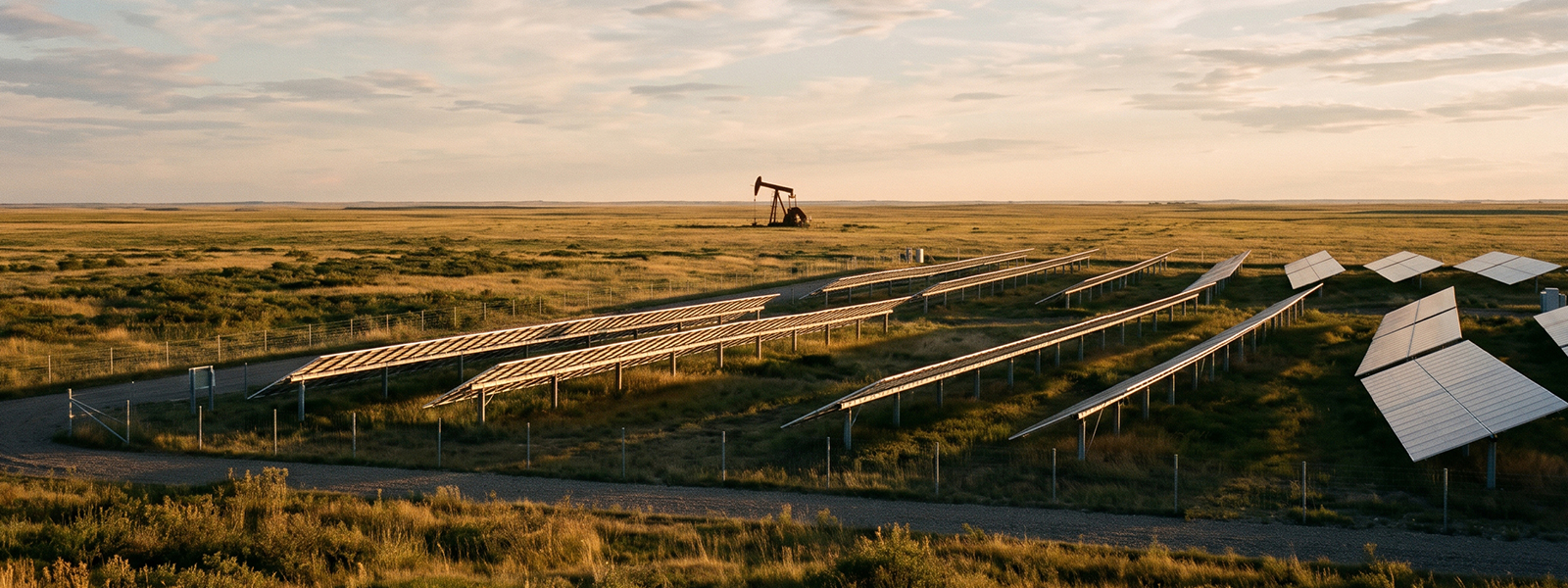
Alberta is where Canadian renewables have “just really exploded,” as Carrocci put it. Unlike more regulated Ontario, its open electricity market had no queue, so “anybody can build at any time,” Carrocci said. Large utility-scale solar and wind projects followed.
The province also carries a warning from its oil-and-gas past. Operators left more than 78,000 orphaned wells behind, with municipalities and property owners left to clean them up. Regulators did not want the same thing to happen with renewables. About three years ago, Alberta paused new renewable projects with a moratorium. “It was a hard stop,” Carrocci said, recalling that he had to lay off 120 employees. “The intent is good, but they could have done it with some better bedside manner.”
The rules written during that pause now shape the market in two ways: a recycling program for panels, and financial security for reclaiming the whole site.
How the recycling program works
ARMA's Electronics Recycling Program (Renewables), launched on 1 October 2026, starts with solar panels. Future phases are expected to add EV batteries and wind turbine electrical components.
| Element | How it works |
|---|---|
| Fee | $14 CAD per panel, for both crystalline silicon and thin-film panels, including transport (priced by zone) |
| Scope | Panels of 1 m² or larger for residential, commercial, industrial, and utility use |
| Excluded | Inverters, racking, BESS, cables, solar thermal panels, and products with built-in panels |
| Legacy panels | Everything already installed in Alberta is covered at no extra cost |
| Processing | Panels go to ARMA-approved processors, private recyclers audited by ARMA |
| Review | The fee is reviewed every two years |
Carrocci called it “not EPR, but it kind of is.” ARMA describes it as a stewardship program, and the fee moves up the chain from manufacturer to distributor, EPC, and asset owner. Tracing where every installed panel came from is now ARMA's big task.
Was the industry consulted? “I'd say industry was barely consulted, but they were,” Carrocci said, adding that ARMA mainly looked at what US companies were doing. Jan Clyncke of PV CYCLE, who also spoke with ARMA during preparation, described it as a rigid government organization that wanted a guarantee there would be enough money and did not want to take any risk.
For comparison, Sunset itself charges $15 CAD per panel at intake. That revenue funds the startup capital and technology development, much like early feed-in tariffs were set high and then came down. Carrocci expects the ARMA fee to follow the same path as technology improves.
Paying for the whole site, not just the panels
The second rule is AUC Rule 007, effective 5 November 2025. It governs applications to build, alter, operate, and dismantle power plants, and it raised the bar for renewables on several fronts: noise assessments, visual impact and glare studies, explicit safety requirements such as thermal runaway mitigation and emergency response plans for battery storage of 10 MW or more, and enhanced consultation, including with Indigenous communities.
For owners, the big change is reclamation security. Projects must provide bonding or surety for decommissioning and soil restoration, backed by a third-party cost estimate of what it takes to return the site “right back to zero or better.” Sunset writes such reports, about 40 pages each, based on today's commodity prices and labor rates, and reopens them every two years.
Carrocci shared the executive summary of one: the 140 MWac (182 MWdc) Big Sky Solar Project in the Municipal District of Acadia No. 34.
| Scope | Costs (CAD) | Salvage revenue (CAD) | Net (CAD) |
|---|---|---|---|
| Module recycling | $10,372,850 | $0 | $10,372,850 |
| Logistics | $3,090,400 | $0 | $3,090,400 |
| Racking deconstruction | $2,411,860 | -$1,075,550 | $1,336,310 |
| Gravel removal | $1,351,640 | -$158,550 | $1,193,090 |
| Electrical shutdown and removal | $1,165,330 | -$292,600 | $872,730 |
| Hardware removal | $877,690 | -$6,146 | $871,544 |
| Fencing removal | $741,960 | -$128,613 | $613,347 |
| Foundation extraction | $1,802,050 | -$1,412,775 | $389,275 |
| Substation removal | $81,750 | -$90,000 | -$8,250 |
| Total | $21,895,530 | -$3,164,234 | $18,731,296 |
The net comes to $134 CAD per kWac, as a class 3 estimate (-20%/+30%) before taxes and inflation. Module recycling alone is close to half of the gross cost.
Two rules, one bill counted twice
That module recycling line is where the problem sits. For the past year, the AUC had Sunset write reclamation reports that include a fee for recycling the panels. ARMA then introduced its eco-fee, which already covers that recycling. “They didn't talk,” Carrocci said. “So policy's good, but it's got to be common sense.” He now expects to reopen the reports Sunset has written. “Come on, guys, it was foreseeable.”
Bringing the factory to the field
Sunset is an Indigenous-owned company and, by Carrocci's account, Canada's only recycler of renewable energy waste. It developed its own technology, bootstrapped for six years, and has received federal support since January through Global Affairs Canada and the National Research Council's Industrial Research Assistance Program.
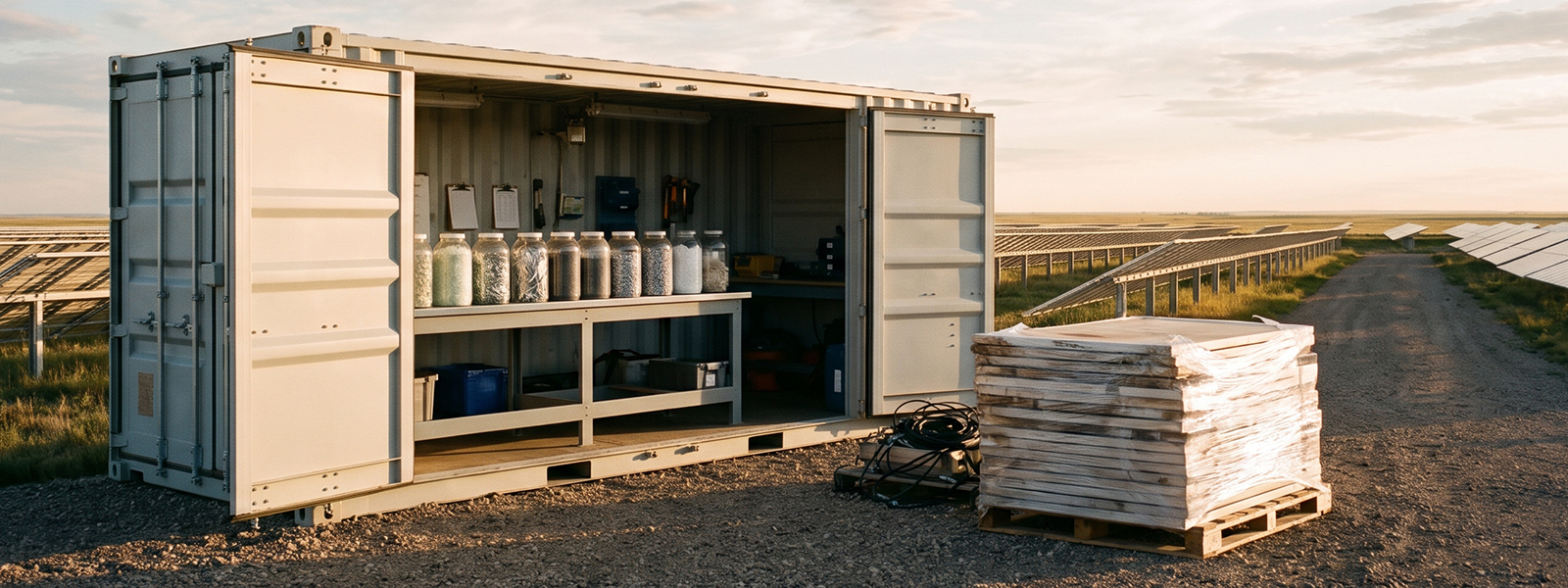
Its core idea is to process panels where they come down. Shipping old panels is expensive: Carrocci described a recent job that took six transport trucks, with every load shrink-wrapped, banded, and palletized. Sunset instead builds recycling units inside shipping containers, deliberately skipping expensive robots and vision systems so they can be made fast, at low capex, and from local supply chains. For a large solar project, it can send 10 units to site and train the O&M contractor to run them.
- Speed: the aluminum extraction unit strips a panel every 30 seconds, and the next extraction step takes about 1 minute 20 seconds. Granulators handle twisted or hail-damaged panels as a last resort.
- Silver: analysis under a $500,000 CAD contract with the Southern Alberta Institute of Technology found about 60% of the silver in the bus bars, which can be separated cleanly. Electrostatic separation recovers another 20-30% from the silicon fraction.
- Glass: solar glass is high in silica, so a large glass recycler blends it in for supplementary cementitious materials. Water filtration is another use being explored.
“By dissection, we find that we can get way better material purity instead of just grenading the panel and separating afterward,” Carrocci said. Sunset applies the same approach to wind: it has deconstructed two turbines so far and is developing a mobile blade shredder, so blades can be baled on site instead of hauled down the highway.
Lessons from Alberta
Two features of Alberta's approach stand out. It collects the fee on new panels but also funds the legacy fleet, so existing owners face no recycling bill. Its reclamation rule also covers the whole site, from foundations to gravel roads, not just the panels. Both choices come straight from the experience with orphaned oil wells: nobody wanted renewables to become the next unfunded cleanup.
The early lessons from Carrocci's talk:
- Fund the legacy fleet. Covering installed panels through the fee on new ones avoids a stranded liability, as long as the fee is set high enough and reviewed regularly.
- Make the agencies talk. Two well-meant rules created a double cost. One fee and one reclamation estimate would have avoided it.
- Consult the people who do the work. A fee designed largely from outside examples now needs fixing in practice.
- Reuse needs certification first. Sunset gives some panels a second life, for example, for pond pumps and off-grid water monitoring, and sees potential in agrivoltaics and municipal sites. Until a CSA- or UL-approved certification process exists, Carrocci said, the market stays “super limited.”
For US asset owners, Alberta offers a concrete reference point for what a fully funded program and site-wide reclamation security can look like in practice, including the friction that comes with a first mover. Carrocci also pointed out that silver is on the US critical minerals list, though not yet on Canada's.
His closing message was an invitation. With Canada looking to diversify its trade relationships, he wants to work with European partners: “We have technology, you have technology, we can maybe put it together.”
Read more about the other sessions in our main report, The line has arrived: takeaways from Recycling Solar & BESS 2026.
