“We shall deal with that down the line.” For 20 years, according to Jan Clyncke of PV CYCLE, that sentence was the solar and storage industry's entire end-of-life strategy. It lived in a small decommissioning line in the financial model, often offset by an optimistic scrap value, and in EPC contracts where the obligation ended at the fence.
At the Recycling Solar & BESS Summit in Amsterdam on 8 October 2026, co-organized by PV CYCLE and Solarplaza, the message from the stage was clear: that line has arrived. Over one day, recyclers, producer responsibility organizations (PROs), manufacturers, asset owners, investors, lawyers, and policy experts worked through who pays, who is liable, where retired hardware really ends up, and what the next wave of EU legislation will change. Below, we group the day's main insights by theme.

Key takeaways
- End of life is no longer a year-25 problem. Repowering, early failures, and two EU regulations are pulling the waste wave forward.
- Recycling a 500 MWh LFP battery park costs an estimated €7 mln, roughly 5% of capex, rising to €10 mln with transport.
- Liability does not leave on the truck. Asset owners stay accountable for where their decommissioned panels and batteries end up.
- EPR only rewards compliant companies when it is enforced, and enforcement across the 27 member states is lagging.
- The value is real: silver makes up 0.07% of a module's weight but 60% of the value of its recovered materials.
- Reuse is getting a rulebook. IEC PAS 63525, expected in Q1 2027, sets tests, pass criteria, and a mandatory label for reused modules.
- Alberta shows one way to fund it: a $14 CAD fee per new panel that also covers the panels already installed.
Four forces arriving at once
In his opening keynote, Jan Clyncke, Managing Director of PV CYCLE, argued that Europe faces four problems landing on the same timeline, on top of an end-of-life infrastructure that was never built for them:
- Repowering. Swapping 15-16% efficient modules for 22% ones on the same grid connection, land, and permits can deliver two to three times the output. Physically, it means a whole site becomes waste in one project window. A single 50 MW plant can mean 150,000 to 190,000 panels, arriving at the recycler as a convoy rather than a stream.
- Early failures. Potential-induced degradation, backsheet cracking, delamination, glass breakage, and hail and transport damage mean waste expected in 2050 can appear in 2028. It often arrives with no producer standing behind it and an uncollectible warranty.
- The new WEEE Regulation. The European Commission's proposal is expected in mid-November. Clyncke hopes it will drop collection targets for PV, set clear financing requirements for all panels wherever they are installed, and move collection away from municipal drop-off points to an industry network.
- The EU Battery Regulation (2023/1542). For BESS owners, it brings EPR for industrial batteries, recycling efficiency and material-recovery targets, recycled-content requirements, and the digital battery passport.
The result: collection networks designed for refrigerators and washing machines, treatment capacity concentrated in a handful of countries, and a black mass processing industry that is growing but not yet big enough. Clyncke warned owners that recyclers will not build capacity ahead of reliable volume forecasts. Wait until the repowering permit is in hand to call one, and 'the market has priced our urgency into the gate fee.'
Who pays: the economics of end of life
Can the extended producer responsibility (EPR) fee ever be zero? Maarten Dubois, Director Sustainability & Circularity at Deloitte, gave a short answer: 'Yes! But it is not realistic that this will happen in your sector.' EPR exists because, in economic terms, waste is a product with a negative price. The scheme collects the money at the product stage, when it is still there.
Some streams already run at a (near) zero fee: lead-acid batteries, newspapers, scrap cars (less than €1 per car in Belgium until recently), and aluminum. The material value simply covers the recycling. Solar and BESS are different, partly because manufacturers keep designing out expensive materials.
A €7 mln bill per battery park
Dubois shared figures from a study Deloitte is running for OVAM, the Flemish waste agency. For a typical 500 MWh LFP park in Belgium, at a 2040+ horizon:
- Recycling costs about €2.4 per kg, plus about €1 per kg for pickup and transport.
- The park holds roughly 3,000 tons of batteries.
- Treatment alone comes to about €7 mln, or around 5% of capex, rising to roughly €10 mln with transport.
Under the Battery Regulation, producers must take back end-of-life batteries free of charge (Article 61) and provide a guarantee covering those costs (Article 58). The catch: the 'producer' is the company that first places the battery on a national market, not the plant operator. Over a 20-year lifetime, Dubois noted, it is quite likely that some producers will have left the market. In Belgium, battery PRO Bebat is willing to facilitate but not carry the financial risk for utility-scale BESS, so guarantees must be arranged individually.
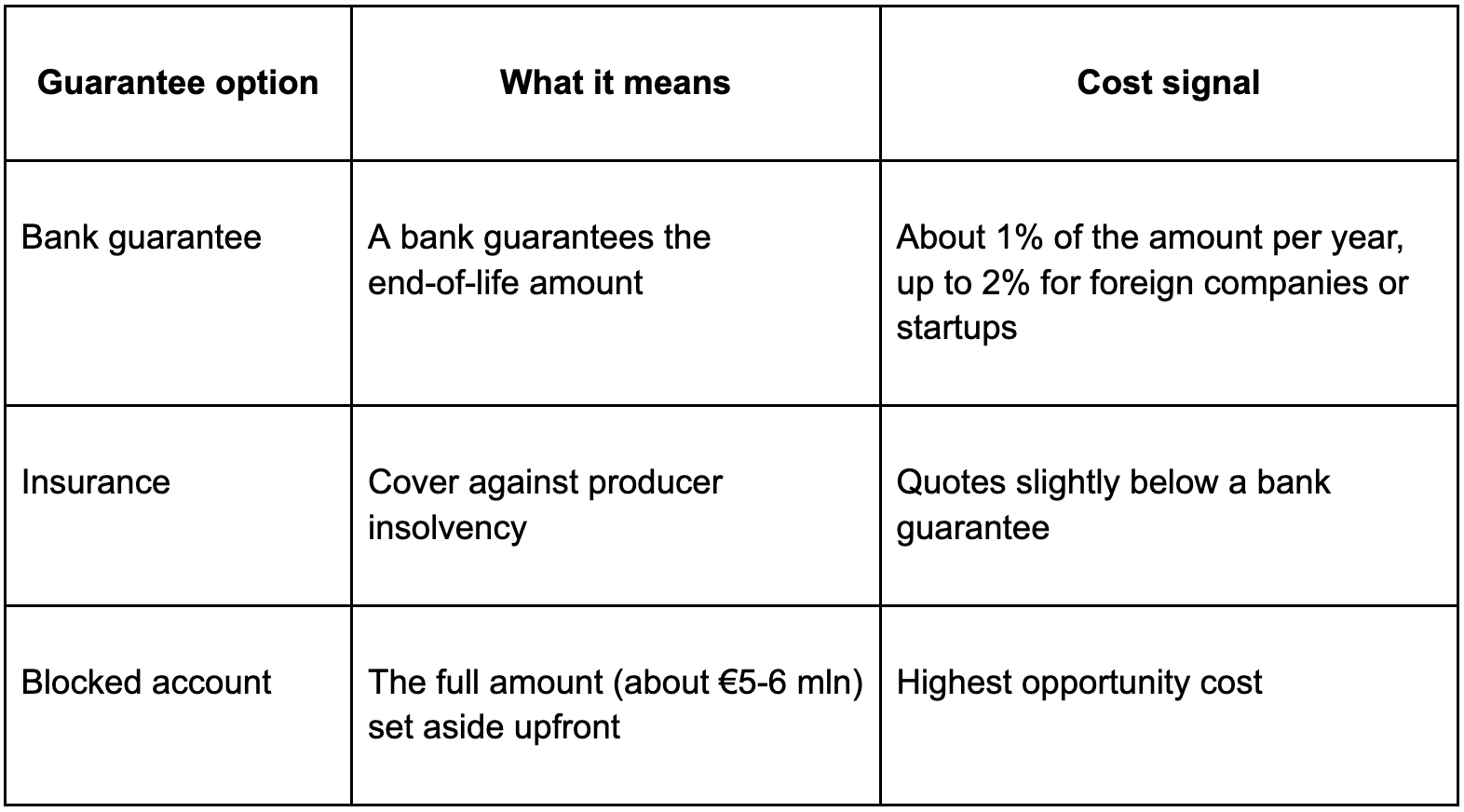
Either way, Dubois estimated, the guarantee adds roughly 1% to capex. Other routes, such as a parent-company guarantee or a contractual transfer to the operator, are not accepted by the Flemish government, which wants full cover from day one. Dubois expects practical implementation in Belgium in 2027, with other member states likely to follow.
When he polled the room, the most popular answer was partial upfront coverage, with a PRO organizing the system. The open question is where 'partial' should sit. The same dilemma, he added, applies to solar panels and every other product with a long lifecycle.
Compliance pays off only when it is enforced
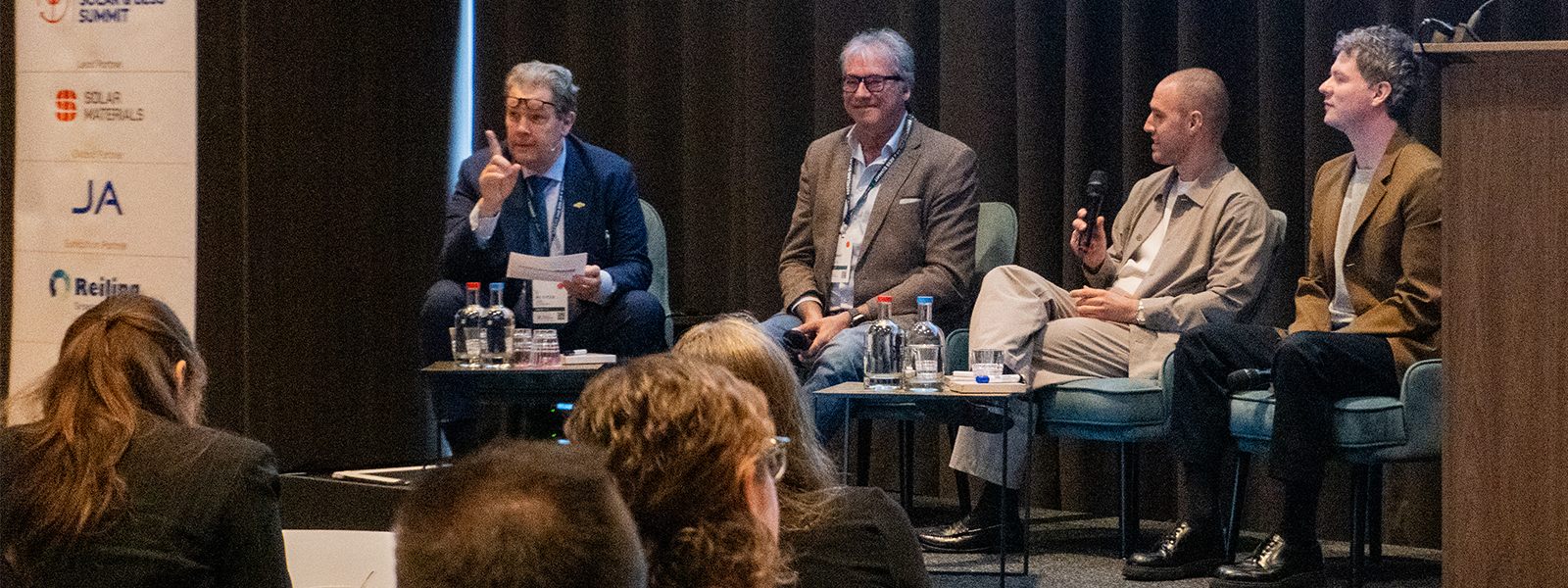
Does EPR compliance give your organization a competitive edge? A large majority of the room said yes. One asset owner summed it up: lenders require it, it protects the company's reputation, and it de-risks the business.
The 13% who said no had a point too. Michiel van Schalkwijk, Board Member of the Dutch PV producer responsibility organization Stichting OPEN, explained that a compliant producer pays the PRO fee while non-compliant competitors may not. At €2.4 per kg, that can be 5-10% of the margin on smaller systems. Without enforcement, compliance becomes a disadvantage.
Eric Ruyters, Secretary General of Eucobat, the European association of battery PROs, agreed that enforcement is the missing link. The Battery Regulation's EPR chapter has been in force since 18 August 2025, yet he knows of no member state that is fully on schedule. Translation into 27 national versions creates new gray zones (“there's a lot lost in translation”), and the EPR chapter's dual legal base lets countries add their own requirements. He called parts of the battery sector 'a strong cowboy market' and argued for a separate BESS subcategory within industrial batteries, so its financing can be organized properly.
Tim Moolhuijsen, Sustainability Advisor at Eneco, saw EPR as a long-term strategic advantage because it forces owners to plan decommissioning early instead of facing unexpected costs later. He did warn that large upfront guarantees favor established utilities over smaller and newer asset owners. Thies Peters of the Netherlands Enterprise Agency (RVO) added that Europe's toughest competition sits outside the EU, where recycling and production are cheaper.
Where are Europe's LFP recyclers?
Ruyters asked the room if anyone knew of an operating LFP battery recycling facility in Europe. Silence, apart from a mention of one pilot project. He noted that many initiatives and license requests exist, but none is effective yet, and that stricter shipment rules for waste batteries take effect on 9 December. Moolhuijsen and Peters added that recycling capacity alone will not stop cheap imports. Europe also needs the production capacity to use the recovered materials.
Heavy lifting: BESS safety and inverter value
Batteries: plan for the fire
Johan van Peperzeel, founder of DoorVeen and former owner of battery collector Van Peperzeel, has spent decades collecting batteries 'from button cell to submarine' for Dutch PROs. His first message: €1 per kg for BESS transport may be too low. Damaged lithium-ion batteries, from crashed EVs to failed racks, need dedicated packaging, fire-resistant containers, and dangerous goods handling.
His company equips storage and transport containers with condensed aerosol fire suppression. The aerosol interrupts the fire's chemical reaction and keeps the container stable for around 45 minutes, or longer with more units. He pointed to a recent incident in Northern Ireland where a thermal runaway stayed contained in one container, with no casualties. The practical advice: always have a plan B. Once the doors open, wearing full protection and with trained responders, you have roughly 10-15 minutes to remove the rack that caused the problem.
Inverters: the friendlier stream, with surprises
Ullrich Didszun of UDZ Consult, a pioneer of German e-waste recycling and Lead Auditor at WEEELABEX, brought what he called a friendlier message. Inverters contain aluminum, copper, ferrous metals, and printed circuit boards, and the economic material balance is positive. Asked for a figure, he put the value at around €1,000 per ton once the inverter is ready for treatment.
His advice for recyclers and owners:
- Decide reuse or recycling before pickup. Share data sheets and performance data upfront, and get a quote from reuse specialists.
- Check for batteries. Inverters rarely contain them, but they are often linked to battery systems, which can trigger dangerous goods rules.
- Mind the logistics. Sending a truck for two or three devices makes preparation, loading, and transport the highest cost.
- Know the classification. Most inverters count as 'dual-use' under the WEEE Directive, so they can also end up in household collection streams.
- Separate by hand first. Pure metals, circuit boards, and cables fetch the best value before mechanical treatment. Plastics are recyclable when their bromine and cadmium content stays below the limits of the POP Regulation.

Where retired hardware really goes
Clyncke showed a set of photos and asked the room when they were taken. Most guessed correctly: within the last year. They showed broken and half-working solar panels at a second-hand market in Accra, Ghana, one of them used as a road surface.
“The panels are gone,” he said, describing how it feels once a repowering truck leaves the site. “They are not gone, not at all.” Under European waste law, the holder of waste must ensure it is properly treated, and handing it to a contractor does not automatically discharge that duty. The loophole is well known: exporting waste is restricted, exporting used products for reuse is not. A pallet of broken panels labeled 'used, functional' can leave a European port as a commercial shipment. When a journalist finds it, Clyncke warned, the name in the story will be the fund, utility, developer, or bank behind the original asset, and the reputational damage will outlast any fine.
The secondary market dilemma
The numbers back him up. Lianne van Aagten, a lawyer at Kennedy Van der Laan who moderated the secondary market panel, pointed to a big gap between the waste volumes forecast under EU rules and what actually reaches recycling facilities. Asked where used modules go today, Stefan Wippich, CEO and Co-Founder of the SecondSol marketplace, was direct: mostly to Africa, the Middle East and North Africa, Syria, and Afghanistan, with no real reuse market in Europe.
Malte Fislake, Operations Manager at Reiling PV-Recycling, which runs both testing lines and recycling, sees value in reuse only when it is genuine reuse “and not using a loophole.” Testing itself is doable, Wippich added. The cost lies in moving thousands of modules to a facility. SecondSol therefore relies on monitoring and maintenance data and on-site measurements before buying, and would like a unique product identifier so data from different owners of the same module type can be combined. Why doesn't that data flow yet? “It's the solar industry,” he replied.
On liability, Van Aagten was clear: under Dutch law, the owner or holder of a component is responsible for damage, whether it is in its first or second life. Her advice is to insure. Van Peperzeel added that anyone who rebuilds used battery cells into a new storage system becomes a producer, with all the obligations that come with it.
Asked for the one thing policymakers should do in the next two years, the panel answered:
- Stefan Wippich: “Stop illegal waste export.”
- Malte Fislake: more transparency and monitoring of what actually happens to modules.
- Johan van Peperzeel: a level playing field, starting with consistent rules inside Europe. Whether black mass counts as a product or as waste already differs 'only 100 kilometers from here.'
What's inside counts: Europe's silver mine
Petra Schmigalle, Head of Supply & Sales at SOLAR MATERIALS, showed why recyclers chase a material that barely registers on the scale.
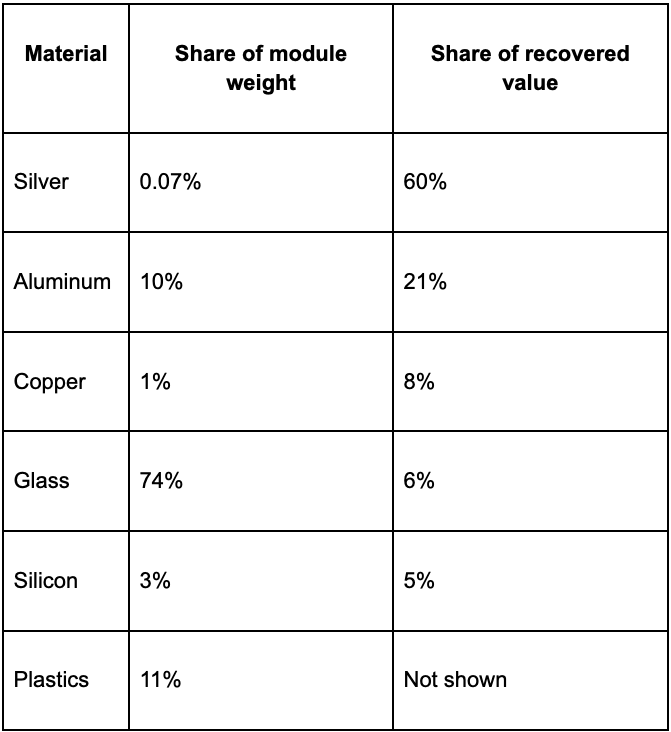
Sources cited on the slide: Dias et al., Waste Management (2016); World Bank Pink Sheet (2025 annual average).
The stock is already installed. Europe's first solar wave, through 2011, added up to roughly 216 million modules. At about 20 kg per module and a conservative 0.05% silver content, that is around 2,160 tons of silver, compared with global silver production of about 25,000 tons a year. Most of it should come back by 2031 at the latest. Echoing a call heard earlier in the day to keep raw materials in Europe, Schmigalle noted: 'They are already in Europe.'
SOLAR MATERIALS separates modules in what it calls a reverse module production line, recovering copper cable, the aluminum frame, glass, silver, silicon, and plastics with a 99% recovery rate. The remaining 1% is mainly plastic that currently goes to landfill, an issue the company is researching. Its plant in Magdeburg, Germany, handles 14,000 tons a year, about 700,000 modules, or at least 1,500 modules a day over three shifts. Capacity doubles to 28,000 tons next year.
The economics move with the London Metal Exchange. On some days this year, Schmigalle said, the raw materials from one 18-year-old module sold for as much as €30. The recovered silicon is pure enough for new solar cells, but with little PV manufacturing left in Europe and Chinese producers preferring cheaper virgin silicon, it currently goes to other industries. Her biggest challenge is not technology but the gray market. Her closing line: “Silence is golden, right? But nobody cares about gold here. So let's talk about the silver.”

Reuse with rules: IEC PAS 63525
Reuse ranks above recycling in the EU waste hierarchy, but the session on reuse versus recycling made clear that it needs rules to be credible. Serge Noels, a standardization expert and project leader of IEC PAS 63525 on the reuse of PV modules, walked through the standard that is about to be provided.
The work started in December 2021 as an informative technical report within IEC TC 82, initiated at PV CYCLE's request and with the project lead funded by PV CYCLE. A team of 30 experts met 63 times. Because manufacturers in particular worried about the safety of reused modules, the document became a Publicly Available Specification (PAS) with mandatory requirements. The July 2026 ballot passed with 92.6% in favor, with Germany and the United States voting against. After technical comments on safety and the insulation test, a final ballot follows in November 2026, with publication expected in Q1 2027.
What the standard sets out:
- Sorting at the source. Collect modules by plant, production batch, type, labeled power, and maximum system voltage, together with label, bill of materials, and performance and maintenance records. The EU Circusol study found sorting and first tests at the decommissioning site to be the most cost-effective route.
- Five tests at a reuse facility. Visual inspection, IV performance, electroluminescence, a bypass diode test, and dry and wet insulation tests against electric shock.
- A calculated pass mark, not a fixed cap. Minimum residual power follows from the label, tolerances, degradation, and measurement uncertainty. In the worked example, a module must still deliver 84% of its original power after 12 years and 76% after 25.
- A mandatory label. Every reuse module gets a durable, machine-readable label with a unique identifier and a link to its test record, so inspectors can tell a reuse module from waste at the border.
Noels also mapped who sells reused modules today: specialized B2B refurbishers (the most common), EPCs, gray market white-label channels that relabel used modules, and OEMs, which stay clear to avoid brand dilution and liability. Drone-based infrared or electroluminescence scans can help preselect modules in the field, he added, but do not replace the tests.
Demand remains the weak spot. Tim Moolhuijsen asked from the floor how to find reuse destinations, since Eneco often ends up recycling panels that still work. Dan Carrocci of Sunset Renewable Asset Management sees low-risk uses in agrivoltaics and municipal infrastructure, but called the market 'super limited' until a certified testing process exists.
Designing for a 30-year life and an end of life
Does a module built to last 30 years become impossible to take apart? Moderator Germain Castermans of PV CYCLE framed the debate around three different operations, each with its own economics: direct reuse, preparation for reuse, and recycling.
For Ruiqi Hua, WEEE Manager at JA Solar, end of life enters the conversation 'right at the beginning' of product design. Recyclability and material restrictions become design requirements, followed by a design review. Clients in Europe and beyond now include recyclability and material transparency in their tender criteria. 'The regulation is giving our orientation,' she said. 'The clients, they are giving the market need.' She sees a trade-off rather than an incompatibility: modules must hold together for decades, but bonds can be less irreversible and junction boxes easier to remove.
Christina Maria Huber, Senior Policy Advisor on Sustainability at SolarPower Europe, pointed to PFAS as proof that dialogue works. While the EU is still deciding on a restriction, the industry has largely moved away from fluorinated backsheets on its own. In her view, recycling is rarely a technical problem: 'It's an economic question.' The standard route still removes the aluminum frame and crushes the rest, losing valuable materials. Volumes are too small at the member state level, so she called for European solutions, including easier cross-border transport of PV waste.
Elina Bosch, Senior Analyst at the Becquerel Institute, explained the limits of repair. Junction boxes, connectors, cables, and some backsheet cracks can be fixed. Anything inside the laminate, such as cell cracks, runs into the same design limits that complicate recycling. Studies she has seen put the share of reusable modules anywhere between 20% and 80% depending on the batch, and better data would help owners spot the batches worth saving.
What is coming from Brussels
Huber expects the Circular Economy Act proposal in mid or late November, framed as industrial policy for a resource-poor continent with a strong focus on critical raw materials. Her hopes for the related WEEE revision: PV as its own category, material recovery targets, a single European market for waste, and a recast of EPR. Recycled content targets will not be part of it, she said, because the WEEE rules cover waste management, not products. Ecodesign rules for PV may follow later, bringing a digital product passport, a recyclability index, and carbon footprint data.
Two more ideas surfaced. Huber suggested a deregistration mechanism for modules going into direct reuse, since the original producer will rarely be traceable after a second life. Hua welcomed EU-wide fee modulation, which would replace 27 national interpretations, as long as fees reflect real end-of-life costs and do not punish design choices that make a module last longer.
Lessons from Alberta
The speaker who traveled farthest came from Canada. Dan Carrocci, President of Sunset Renewable Asset Management, an Indigenous-owned Canadian recycler, described how Alberta became the first jurisdiction in North America with a solar recycling program.
The backstory explains the caution. Alberta, 'Canada's Texas,' is left with more than 78,000 orphaned oil wells whose cleanup fell on municipalities and landowners. When utility-scale solar and wind boomed, the province imposed a moratorium on new renewables, which forced Carrocci to lay off 120 employees, and then wrote new rules:
- Electronics Recycling Program (Renewables), from 1 October 2026. Run by the Alberta Recycling Management Authority (ARMA), it charges an eco-fee of $14 CAD per new panel, including transport. Panels already installed, roughly 4.5-5 GW according to Carrocci, are covered at no extra cost. The fee will be reviewed every two years.
- AUC Rule 007, effective 5 November 2025. The Alberta Utilities Commission now requires financial security for site reclamation, backed by a third-party cost estimate. In one Sunset report, reclaiming a 140 MWac solar project came to a net $18.7 mln CAD, or $134 CAD per kWac.
The catch: the two agencies did not coordinate, so reclamation reports written over the past year already include a recycling fee that the eco-fee now covers. “Policy's good, but it's got to be common sense,” Carrocci said. Industry was “barely consulted,” he added.
Sunset's answer on the technology side is to bring 'the factory to the field.' Its container-based units can strip a panel's aluminum frame every 30 seconds on site, cutting transport and pallet costs. Analysis with the Southern Alberta Institute of Technology showed that about 60% of a module's silver sits in the bus bars, which can be separated cleanly.
The 2030 roadmap: from diagnosis to action
The closing town hall, moderated by Dr. Pratik Vinayak Gholkar of Ecochain, asked how money can motivate circularity instead of becoming a hurdle.
Anouk Blum-den Heijer, Managing Partner at StartGreen Capital, described how her view as a lender has changed. End of life used to be someone else's problem once the debt was repaid. Now investors expect no reputational or financial risk, so it enters StartGreen's ESG analysis early. Her fund recently invested in a solar recycler for the first time, backed by long-horizon government money, a feedstock contract with OPEN, and technical due diligence on the value of the recovered materials. She was realistic about lifetimes, though: if a new park is cheaper than keeping the old one, refits will happen.
Maarten Dubois argued that markets will not sort this out alone, because “taxing a negative price is not so successful.” Regulation sets the boundaries, and the law already makes the producer responsible: “Just everybody ignores it at the moment.” Since the producer's cost ends up in the operator's price, producers and operators are “in the same boat.” He also warned that without manufacturing, Europe risks becoming a sorting industry that ships materials to Asia for the actual recycling, and he wants collection targets that reflect long lifecycles plus targets for critical raw materials.
Michiel van Schalkwijk explained how OPEN works: a PRO run by producers keeps fees low by getting the highest value out of the chain. He would process aluminum locally and silver in central facilities, calling the earlier Dutch target of collecting 65% of what is placed on the market “totally ridiculous” for PV, and said the Battery Regulation needs revision before PROs can properly cover BESS. With a magic wand, he would remove antimony and PFAS from modules, extend panel lifetimes, and stretch subsidy schemes and permits to 30 years so plants are not repowered early.
Five actions to start this year
Clyncke had already offered the clearest to-do list of the day. A bankable, audit-proof end-of-life strategy rests on five building blocks: a funded, ring-fenced reserve, complete producer and compliance records, contracted and traceable treatment, a documented reuse-or-recycle decision, and transfer-ready documentation. His calls to action:
- Asset managers: audit your portfolio this year. If you cannot name the producer, PRO, reserve, and treatment route for every plant, 'you have found a liability that is not yet on your balance sheet.'
- EPCs: stop treating end of life as out of scope and offer decommissioning and recycling as a bankable, documented service.
- Investors and lenders: make end-of-life reserves and compliance documentation a condition in term sheets and due diligence. 'You have more influence over the industry and its behavior than any regulator.'
Twenty years ago, Clyncke reminded the room, the industry bet that solar and storage would scale faster than anyone expected, and it won. It left one question for later. “Later has a date now.”