White Paper
14 September 2026
Estimated reading time: 10 min
Germany’s Utility-scale BESS Market
Germany’s utility-scale BESS market is entering a new phase. Installed capacity is rising rapidly, negative-price hours are increasing, and the project pipeline is expanding. However, grid access, regulation, and changing revenue models are making project execution more complex. Germany recorded 575 hours of negative electricity prices in 2025, while large-scale storage reached around 3.7 GW / 6 GWh by July 2026.
The challenge is no longer simply how much battery capacity can be announced. With a 9.5 GW project pipeline and more than 700 GW sitting in the grid-connection queue, the projects that succeed will be those that combine credible grid access, adaptable route-to-market strategies, appropriate system duration, and bankable financing structures.
Key takeaways
- Germany’s large-scale storage market is scaling rapidly: energy capacity more than doubled in around 18 months, reaching just over 6 GWh by July 2026.
- Grid access is becoming the key filter for project viability: Germany’s 9.5 GW BESS pipeline sits against a grid-connection queue exceeding 700 GW.
- The revenue stack is shifting away from frequency-led strategies: day-ahead and intraday trading could account for around 95% of BESS revenues by 2030.
- Project design and bankability are becoming decisive: longer-duration systems, tolling structures, and sophisticated route-to-market strategies are gaining importance as the market matures.
Visualizing Germany’s BESS market shift
To understand how Germany’s storage market is moving from rapid pipeline growth toward more selective project execution, this white paper highlights two developments that every developer, investor, and asset owner should be watching.
Germany could reach 8 GW and 16 GWh by the end of 2027
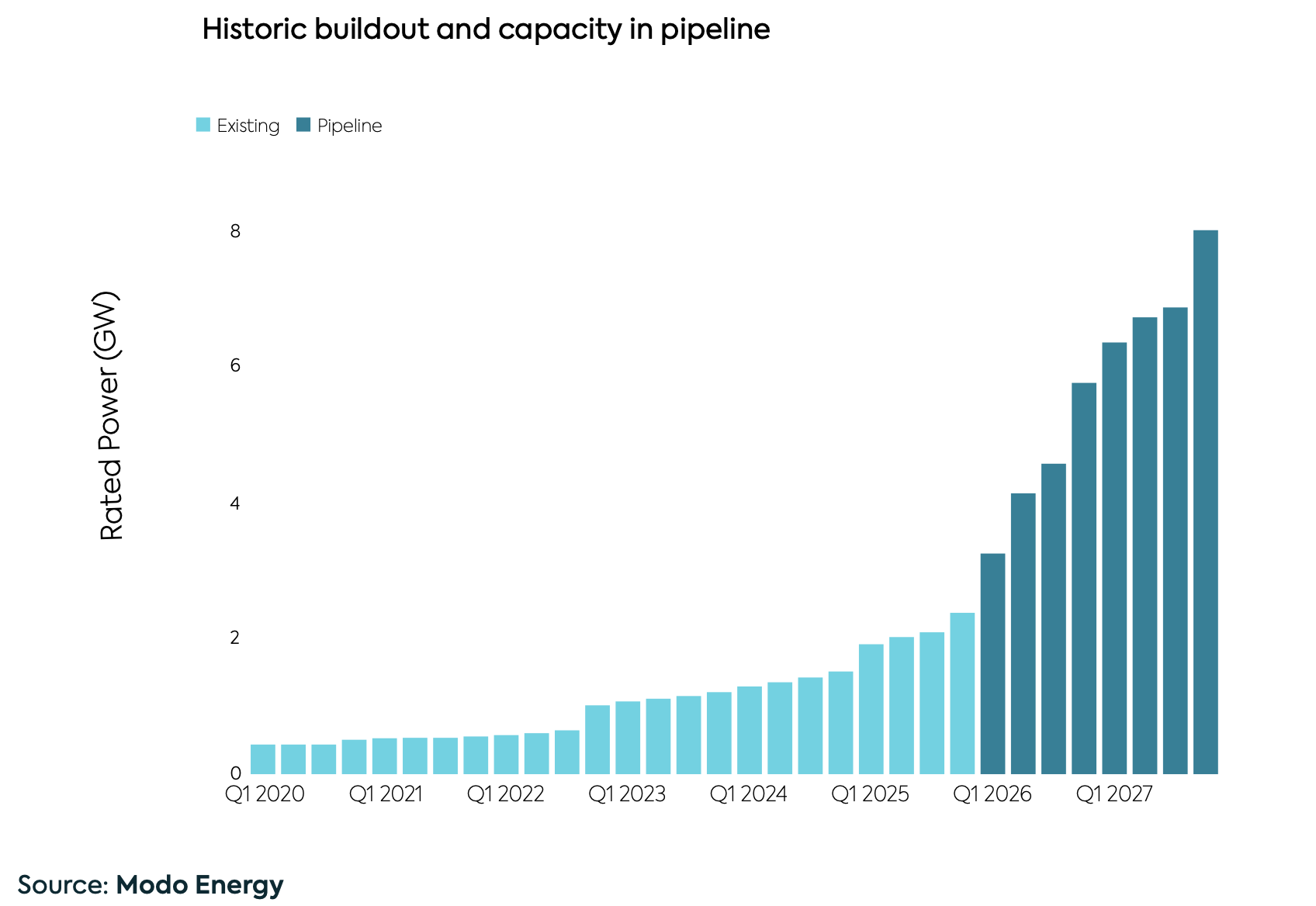
Germany’s utility-scale BESS pipeline is scaling quickly. Around 9.5 GW of projects were in the pipeline by the end of 2025, with approximately 5.6 GW scheduled for development during 2026 and 2027. If delivered on time, Germany’s operational fleet could reach around 8 GW / 16 GWh by the fourth quarter of 2027.
But the gap between pipeline and execution is becoming increasingly important. Grid-connection requests already exceed 700 GW, making project maturity and credible grid access far more valuable than announced capacity alone.
Longer-duration BESS is reshaping the investment case
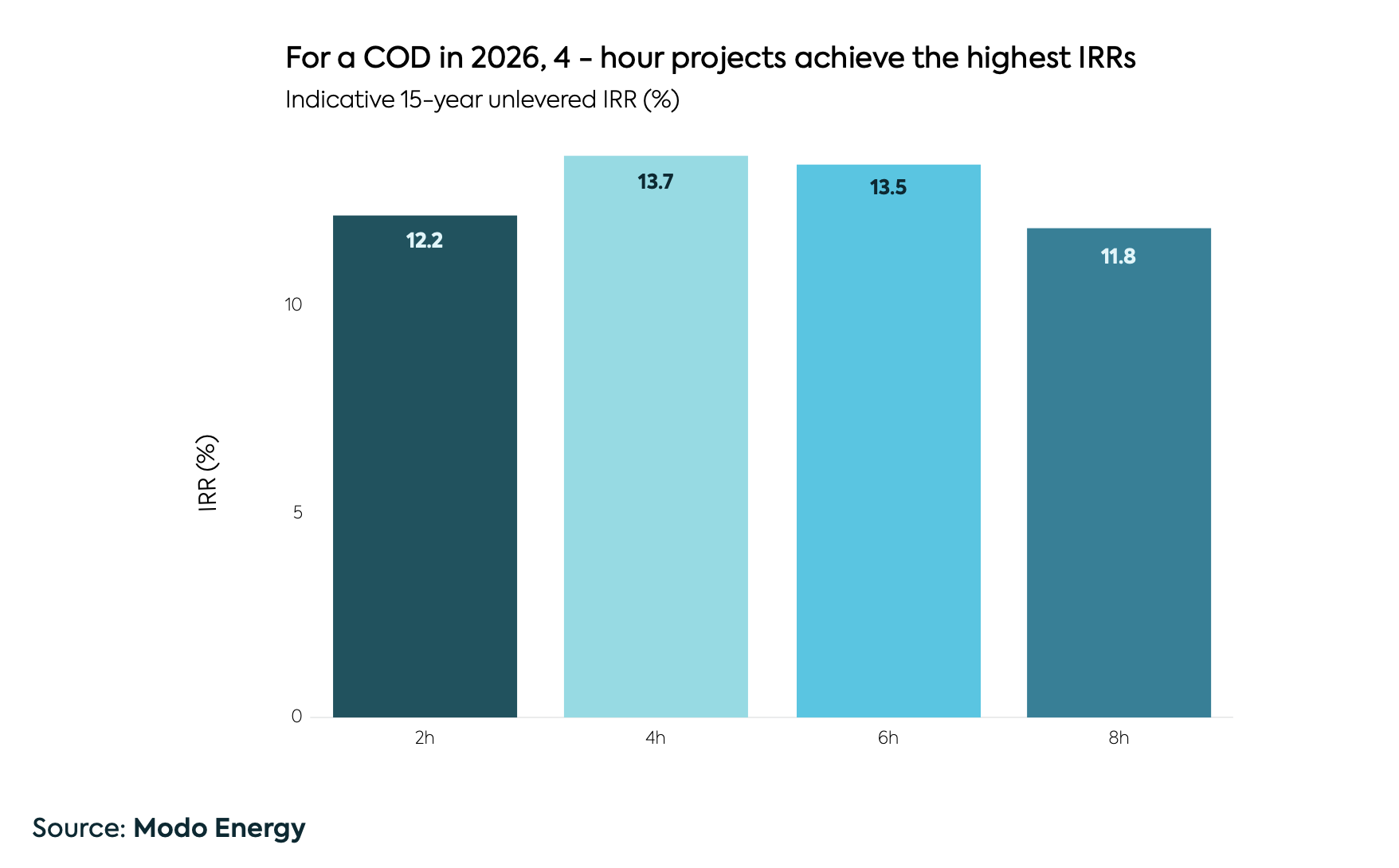
Changing revenue dynamics are also reshaping project design. Modo Energy estimates that a 4-hour German BESS entering commercial operation in 2026 could deliver a 13.7% unlevered IRR, compared with 12.2% for a 2-hour system, despite the higher upfront capex.
Longer duration is not automatically the right answer for every project. The optimal configuration depends on the expected revenue stack, grid-connection terms, cycling strategy, and financing structure. But as ancillary-service markets become more saturated and wholesale arbitrage gains importance, multi-hour flexibility is becoming increasingly valuable.
Access the full analysis
Download the complete white paper below to explore Germany’s utility-scale BESS market in depth, from installed capacity and pipeline growth to grid access, evolving revenue models, project duration, regulation, and bankability. Discover what will separate executable projects from speculative pipeline as Germany’s storage market enters its next phase.
To dive deeper into these market dynamics, connect with leading developers, investors, optimizers, grid operators, and financiers at the Solarplaza Summit Energy Storage Germany in Düsseldorf on 8 December 2026.
To learn more about
the topic beyond this white paper,join Solarplaza Summit Energy Storage Germany on 8 December, taking place in Düsseldorf.
