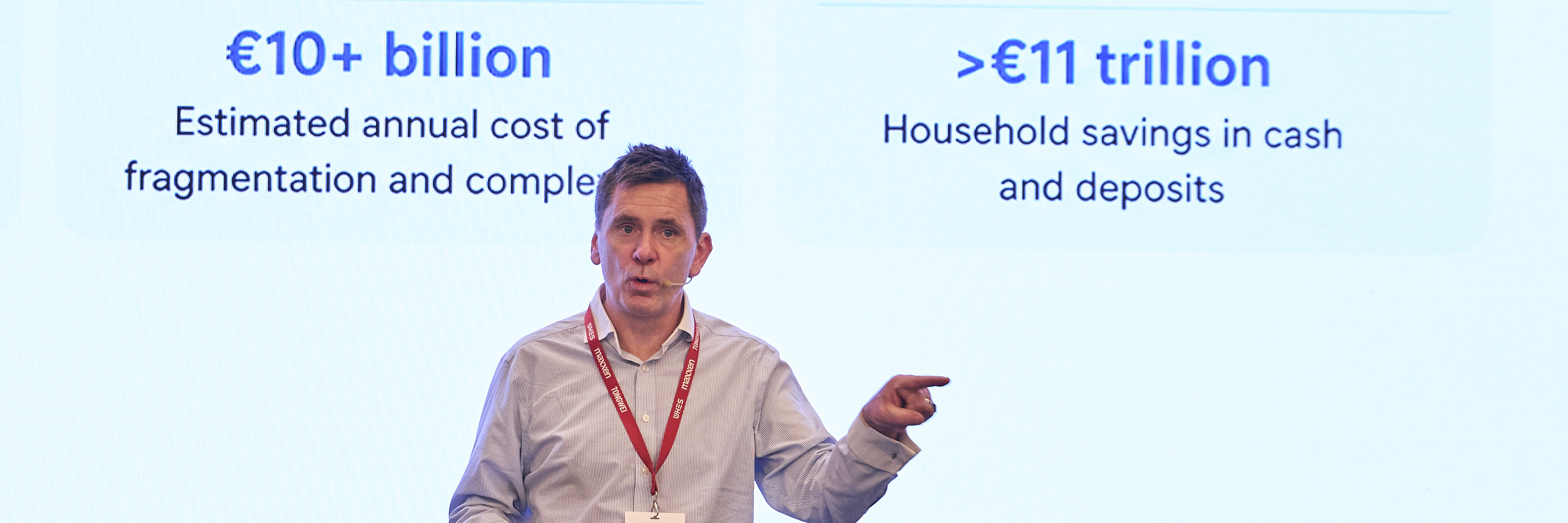
During his keynote address at the Solarplaza Summit Italy 2026 on July 9, 2026, Gerard Reid, Co-Founder and Partner at Alexa Capital, delivered an analysis of the macroeconomic and technological shifts impacting European power markets. Reid examined the intersection of capital deployment, energy security, and the energy demands of artificial intelligence.
Key takeaways
- The Fifth Industrial Revolution: The global economy is entering an industrial transformation driven by AI, solar PV, battery storage, semiconductors, and robotics.
- Exponential energy growth: Solar PV and batteries represent the world's first exponential energy technologies, scaling at rates faster than legacy fossil or nuclear infrastructure.
- AI’s electricity demand: AI infrastructure requires immense power capacity; OpenAI alone targets 250 GW of power capacity by 2033 to support compute demands.
- The grid bottleneck risk: European capital markets and permitting frameworks remain fragmented and slow, risking economic stagnation if infrastructure buildouts fail to match global deployment speeds.
The end of the golden era
Reid argued that continental Europe's historical period of stability built on inexpensive imported gas, globalized supply chains, low interest rates, and outsourced security has ended. European nations must now adapt to a fragmented geopolitical landscape marked by high energy costs, volatile commodity markets, and intense international competition in technology and manufacturing.
The convergence of AI and clean power
Reid highlighted that the global economy is entering its Fifth Industrial Revolution. Previous industrial shifts relied on steam engines, coal, oil, and traditional software. The current shift is defined by the convergence of cheap clean power and advanced computing.
Artificial intelligence requires immense quantities of electricity. Data centers, machine learning model training, and automated industrial facilities are shifting power grids from demand-following supply systems to supply-orchestrated demand systems. OpenAI alone targets 250 GW of power capacity by 2033, a demand load equal to the combined generation capacity of Germany, France, and the UK.
Reid noted that major technology companies are directing hundreds of billions of dollars USD toward data infrastructure. To capture this growth, energy systems must deliver low-cost electricity quickly.
Solar and storage as exponential technologies
Traditional power plants, such as nuclear or combined-cycle gas turbines (CCGT), require long construction timelines and high capital commitments. In contrast, solar PV and battery storage operate on technology learning curves, yielding continuous cost reductions and rapid deployment capabilities.
- Plug-and-play adoption: Behind-the-meter solar and residential plug-in balcony systems are scaling without government subsidies. In markets like Germany and Pakistan, falling hardware costs have reduced payback periods for self-consumption solar to under three years.
- Ubiquitous storage: Battery cell prices have dropped over 80% since 2013. Storage is expanding from utility-scale grid installations into electric vehicles, commercial buildings, and household appliances.
Strategic imperatives for energy investors
To navigate this changing environment, Reid outlined key principles for energy investors and corporate leaders:
- Invest where demand grows: Target capital toward regions and sectors experiencing power demand expansion, particularly digital infrastructure, EV charging networks, and industrial electrification hubs.
- Prioritize execution speed over certainties: Long-range price forecasts are increasingly unreliable. Strategic advantage belongs to developers who can permit, finance, and construct modular assets quickly.
- Leverage AI for asset optimization: Deploy software and machine learning to manage power plant dispatch, battery state-of-charge, and real-time market participation.
- Avoid stranded legacy assets: Capital tied to slow-moving, centralized fossil fuel infrastructure risks write-downs as cheaper solar and storage assets dominate wholesale markets.
If you want the full picture of the market dynamics, grid connection reforms, and project finance discussions analyzed at The Solarplaza Summit Italy 2026, read our complete event report here: Italy's solar & storage market Is evolving. Here's why.

