Utility-scale floating photovoltaics (PV) has operated in Europe for several years, particularly in the Netherlands and France. Recent landmark projects provide further evidence that the technology successfully attracts commercial debt, institutional investors, and industrial customers.
The 74.3 MW Les Îlots Blandin project in France secured more than €50 million in debt, while the 31 MW Obourg project in Belgium supplies electricity directly to Holcim's industrial operations. Meanwhile, ongoing trials in Germany, Portugal, Spain, and the Netherlands continue to validate advanced panel configurations, dynamic mooring systems, and offshore applications.
These developments are significantly bolstering commercial confidence in floating solar. While higher upfront capital requirements, site-specific engineering, and detailed permitting require careful management, pioneering installations are proving how floating PV can capture strategic market opportunities.
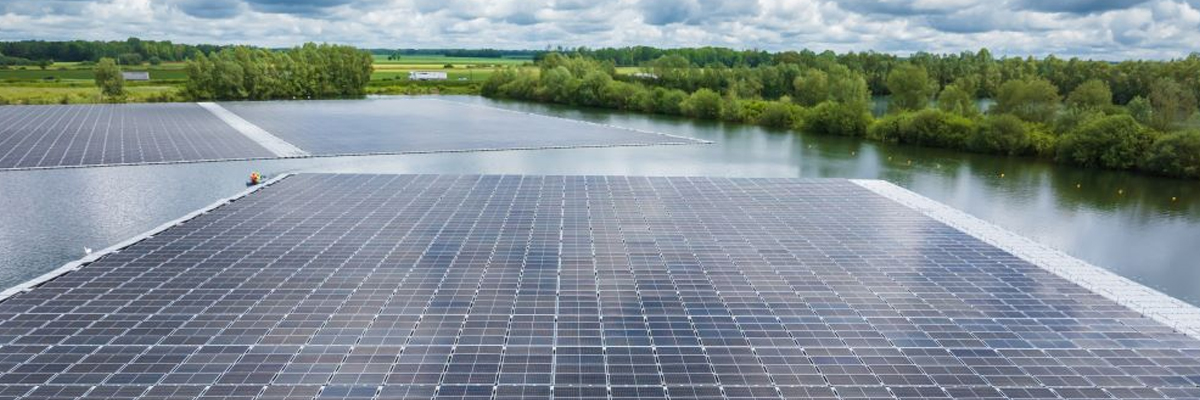
Les Îlots Blandin project - Image source: Ciel & Terre
Key takeaways
- Commercial banks and institutional investors are increasingly financing large-scale floating solar projects across Europe, establishing the technology as a credible infrastructure asset class.
- The industrial self-consumption model and hydropower co-location offer strong commercial structures by shielding projects from wholesale price volatility and maximizing existing grid connections.
- Tailored site-specific engineering and proactive permitting strategies allow developers to mitigate technical risks and secure project finance effectively.
Recent projects are strengthening the investment case
The Les Îlots Blandin project reached full operation in June 2025 on former gravel pits in Haute-Marne. Q Energy secured more than €50 million in debt from Crédit Agricole Transitions & Energies and Bpifrance. Velto Renewables, backed by Canadian institutional investor La Caisse, acquired a 50% interest and became a long-term co-owner.
The involvement of established lenders and institutional capital indicates that floating solar easily satisfies rigorous project-finance standards. The project also illustrates the thorough preparation involved in developing floating assets: development officially started in 2019, followed by technical configuration assessments, leading into construction in September 2023.
The 31 MW Obourg project in Belgium presents a strong alternative commercial model. TotalEnergies and Holcim commissioned the plant in March 2026 on a former chalk quarry converted into a lake. The project generates around 30 GWh per year for Holcim's industrial operations and is set to cover up to 15% of the electricity used by its GO4ZERO facility by 2030.
Direct industrial consumption strengthens the revenue case by linking production to a known electricity user. This arrangement reduces exposure to wholesale price fluctuations and grid constraints. This model offers clear benefits for industrial sites with adjacent quarries, reservoirs, or water-treatment facilities.
Both Les Îlots Blandin and Obourg showcase strong commercial pathways. Whether combining commercial debt with institutional ownership or supporting direct industrial demand, floating solar demonstrates clear financial viability when paired with suitable counterparties and robust revenue structures.
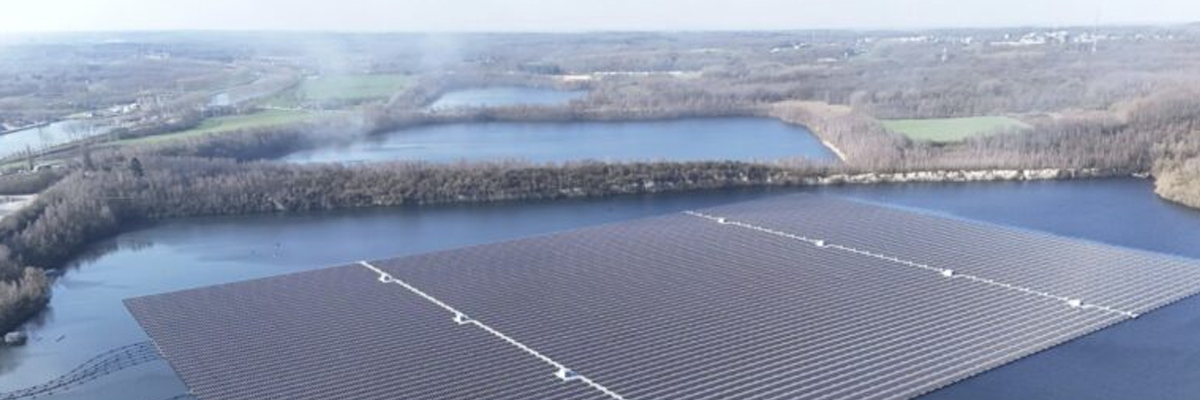
Obourg Project - Image source: TotalEnergies
Optimizing bankability across diverse site conditions
Floating solar now benefits from more than a decade of operating experience in Europe, offering lenders and insurers a solid track record to evaluate performance and risk management. Equipment provider Ciel & Terre notes that this operational history is steadily building confidence among investors, lenders, and insurers. Additionally, lower module prices have helped reduce overall capital expenditure.
Because water body characteristics vary, floating plant designs adapt to specific environmental factors. Water depth, changing water levels, wind, waves, and lakebed conditions guide the selection of anchoring and mooring systems. Shoreline access influences construction and maintenance logistics, while humidity and water chemistry determine equipment choices.
Innovations in technology are directly addressing these variables. The EDP floating solar laboratory at the Alto Rabagão reservoir in Portugal demonstrates how technology solves complex site challenges. At this location, water levels can vary by up to 50 meters. Fred Olsen 1848 installed automatic tension buoys that continuously adjust the mooring system as water levels shift, while Sperra supplied a specialized gravity anchor.
These engineering solutions significantly broaden the range of hydropower reservoirs suitable for floating solar. They also highlight why thorough technical assessments are standard practice for lenders. Technical due diligence routinely evaluates extreme-weather assumptions, fatigue loads, anchoring conditions, cable movement, warranties, and maintenance access. Insurers similarly review exposure to mooring systems, storm resilience, electrical performance, and repair accessibility.
Proven equipment and tailored designs work together to de-risk projects. With suitable site selection, appropriate warranties, insurance coverage, and clear operational frameworks, floating solar assets readily secure bankable financing structures.
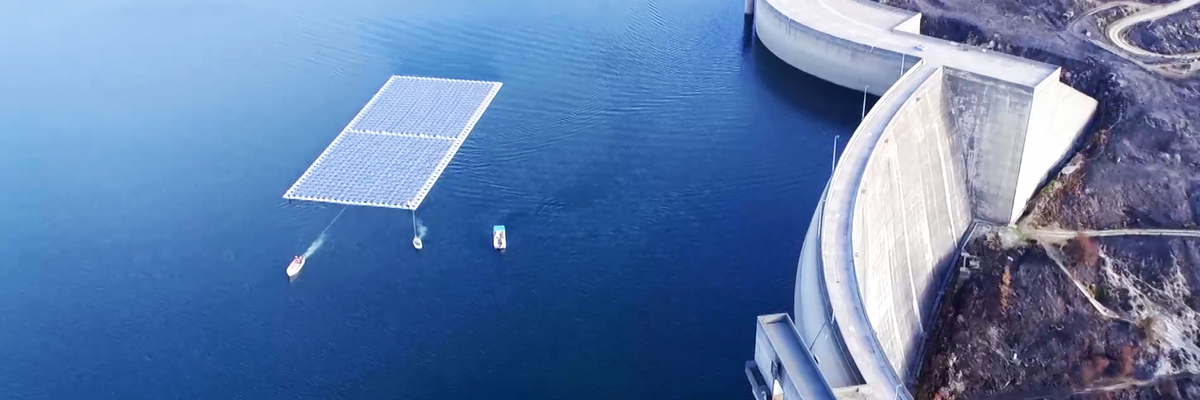
Alto Rabagão floating laboratory - Image source: Ciel & Terre
Navigating cost structures and regulatory pathways
Floating solar projects often require higher upfront construction and operating investments than ground-mounted PV due to specialized floating structures, anchoring systems, protected cabling, and specialized installation. However, floating solar delivers distinct value that conventional ground-mounted systems cannot offer at the same location, such as bypassing expensive land acquisition, utilizing existing grid connections, or providing direct power to co-located industrial consumers.
In several European markets, floating projects participate alongside conventional ground-mounted systems. For instance, Q Energy noted that floating and ground-mounted projects compete within the same French tender system. To optimize overall project economics, developers can incorporate complementary elements, as demonstrated at Les Îlots Blandin, where a small ground-mounted section was integrated. Meanwhile, dedicated market support exists in select regions, such as Italy, which offers a premium tariff for floating solar.
Navigating regulatory frameworks effectively is an integral part of project development. Floating solar projects may involve approvals related to energy generation, water usage, spatial planning, and environmental management. Local authorities assess surface coverage, distance from shore, navigation, dam safety, water quality, biodiversity, and existing water access.
Clear standards are helping structure development across Europe. In Germany, floating solar projects typically observe a 40-meter shoreline buffer and a maximum surface coverage of 15% of the water body. The Lake Jais project, featuring vertical panel configurations, covers just 4.65% of the lake, remaining well within regulatory limits while providing valuable operational data for vertical floating solar.
Securing regulatory approvals early simplifies financing, as lenders expect key permits before committing debt. Early engagement and structured planning help prevent development delays, protect project budgets, and streamline vendor contracting.
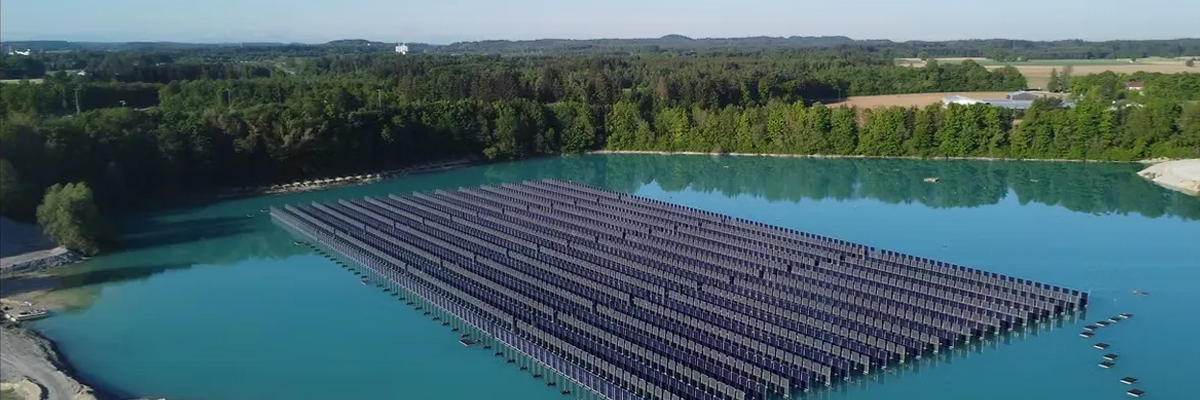
Lake Jais project - Image source: SINN Power
High-value use cases drive market clarity
Recent project developments demonstrate clear commercial advantages on artificial and heavily altered water bodies. Projects like Les Îlots Blandin (former gravel pits), Obourg (rehabilitated chalk quarry), Lake Jais (gravel extraction lake), and Slovenia's proposed 140 MW Družmirje project (lignite mining lake) demonstrate this focused strategy.
These locations present straightforward development paths: they face minimal land-use conflicts, often feature clear ownership structures, and benefit from existing industrial infrastructure.
Co-locating with industrial demand presents a compelling revenue model. Direct supply connections, like TotalEnergies and Holcim's Obourg project, help industrial facilities achieve decarbonization goals while shielding power off-takers from wholesale market price volatility. Similar opportunities exist at active mines, cement plants, water-treatment facilities, and electricity-intensive industrial sites situated next to reservoirs or artificial lakes.
Hydropower co-location offers another strategic opportunity. Combining floating solar with hydropower plants enables shared usage of existing grid infrastructure, significantly reducing grid connection expenses. Solar generation also provides complementary power during high-solar periods or dry seasons when hydro output fluctuates.
Developers continue to advance ambitious pipelines across Europe. In Slovenia, state-owned utility HSE is progressing spatial planning for the proposed 140 MW Družmirje project, intending to combine company capital, loans, and funding from the EU Just Transition Fund.
Artificial industrial water bodies and suitable hydropower reservoirs represent clear, scalable pathways for floating solar in Europe. By resolving land constraints
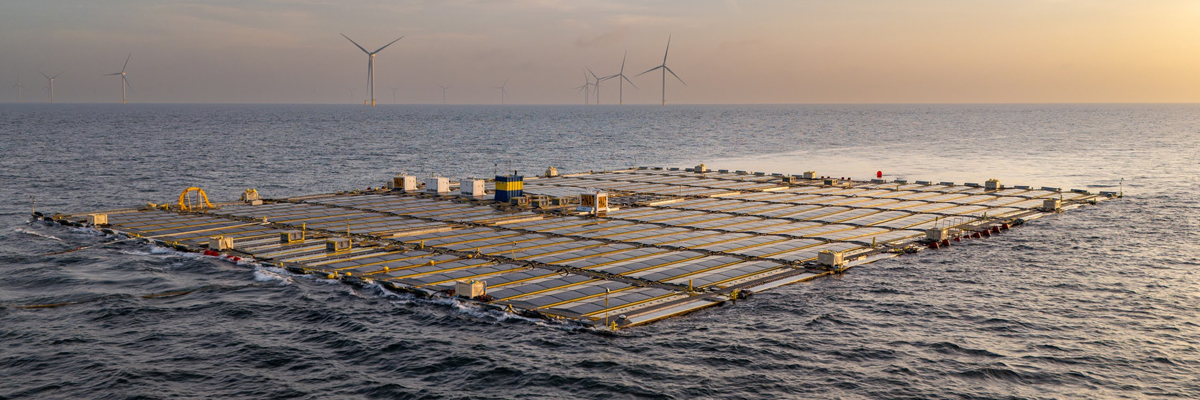
HKN1 - Image source: Oceans of Energy
The expanding frontier of offshore floating solar
Offshore floating solar is rapidly progressing, with pioneering projects in the Netherlands and Spain demonstrating the technology's long-term potential in open-sea environments.
In June 2025, Oceans of Energy completed assembly of the Nymphaea Aurora system for installation within the Hollandse Kust Noord offshore wind farm. The project tests the strategic co-location of solar within existing offshore concessions to maximize energy yield. At the Port of Bilbao, Landatu Solar installed a marine demonstration system to evaluate structural performance against wave dynamics, wind loads, corrosion, and anchoring requirements.
Sharing offshore space and electrical infrastructure with offshore wind farms provides a strong commercial rationale for future scale. While open-sea operating conditions require robust engineering to handle structural loads and marine environments, ongoing pilots are building the operational track record needed for broader deployment.
Strategic positioning for floating PV growth
Floating PV is establishing itself as a credible, bankable infrastructure asset class across Europe. With commercial banks underwriting large-scale projects, institutional investors acquiring equity stakes, and industrial off-takers utilizing on-site generation, the sector's value proposition is clear.
While floating solar follows a targeted development path due to site-specific engineering and water rights considerations, its ability to generate clean power without competing for agricultural or commercial land makes it a vital tool in Europe's energy mix.
The strategic focus centers on artificial industrial lakes, direct industrial self-consumption, and grid-connected hydropower reservoirs. By delivering specific advantages—such as land preservation, optimized grid capacity, and price stability—floating solar continues to create substantial, high-value opportunities across the European energy market.
Sources
1 Q Energy (2025) Europe’s Largest Floating Solar Power Plant Inaugurated in France by Q ENERGY and Velto Renewables. Retrieved from https://qenergy.eu/media/detail/europes-largest-floating-solar-power-plant-inaugurated-in-france-by-q-energy-and-velto-renewables/
2 TotalEnergies (2026) Belgium: TotalEnergies and Holcim Inaugurate Europe’s Largest Floating Solar Power Plant Dedicated to Self-Consumption. Retrieved from https://totalenergies.com/newsroom/belgium-totalenergies-and-holcim-inaugurate-europes-largest-floating-solar-power-plant-dedicated-to-self-consumption/?lang=eng
3 Holcim (2026) Powering Our Belgium Operations with Europe’s Largest Floating Solar Power Plant. Retrieved from https://www.holcim.com/who-we-are/our-stories/floating-solar-power-plant
4 REGlobal (2026) Floating Solar Is Getting More Reliable and Profitable: Ciel & Terre’s Vincent Grumetz. Retrieved from https://reglobal.org/floating-solar-is-getting-more-reliable-and-profitable-ciel-terres-vincent-grumetz/
5 Offshore Magazine (2026) Floating Solar Pilots and Scale-Up Efforts Spread across Europe. Retrieved from https://www.offshore-mag.com/renewable-energy/news/55368348/floating-solar-technology-projects-onstream-under-development-at-sites-in-europe
6 Balkan Green Energy News (2025) World’s First Floating Solar Power Plant with Vertical Panels Comes Online. Retrieved from https://balkangreenenergynews.com/worlds-first-floating-solar-power-plant-with-vertical-panels-comes-online/
7 pv magazine (2025) Slovenia Plans 140 MW Floating Solar Plant. Retrieved from https://www.pv-magazine.com/2025/09/26/slovenia-plans-140-mw-floating-solar-plant/
8 LightHief Energy (2026) Floating Solar PV Projects in Europe: Technical Risks, Costs, and Opportunities. Retrieved from https://lighthief.energy/floating-solar-pv-projects-in-europe-technical-risks-costs-and-opportunities/
9 Oceans of Energy (2025) Oceans of Energy Offshore Solar Farm “Nymphaea Aurora” Ready for Tow Out to Hollandse Kust Noord Offshore Wind Farm. Retrieved from https://oceansofenergy.blue/2025/06/27/offshore-solar-farm-nymphaea-aurora-ready-for-tow-out/

