Finland’s battery energy storage system market has developed at a remarkable speed. In only a few years, the country has moved from having very little grid-scale storage to seeing several 50–100 MW projects announced, built, or in development. What began as a reserve-market opportunity is now becoming a broader flexibility story, shaped by the growth of variable renewables, grid constraints, price volatility, new industrial electricity demand, and the search for more bankable revenue models.
To gain a deeper understanding of the mechanics of the Finnish market, we spoke with Matti Parpala, CEO and co-founder of Will & Must Oy. He explained how the Finnish BESS market has already passed through its first major phase.
“For some time, there was a huge opportunity to make outsized profits in the reserve markets,” he explains. “No wonder that BESS capacity has grown from nearly zero to around 1.5 GW in just a couple of years.”
That initial boom was driven by attractive reserve-market revenues. But as more batteries enter the market, the easy part of the opportunity is fading. “There will be a decent revenue stack available also in the future,” Parpala says, “but given market saturation, the biggest gold rush is clearly now behind, at least for now.”
Key takeaways
- Market maturation: The "gold rush" era of reserve markets is fading due to saturation. Success now requires complex revenue stacking across wholesale, balancing, and intraday markets.
- Shift to longer duration: Developers are moving from fast-response systems to longer-duration batteries to bypass grid connection limits (focusing on MWh over MW) and capture wholesale trading value.
- Hybrid complexity: Integrating batteries with renewables is valuable but often requires operational independence from the generation asset to remain commercially viable.
- Tolling as a de-risking tool: As merchant risk grows, tolling agreements are becoming essential for managing revenue and securing project financing.
- Data center demand: Data centers are a near-term driver for storage due to their inflexible power needs, whereas hydrogen remains speculative, relying on future policy and infrastructure.
- Domestic strengths: Finland's ecosystem is increasingly led by local firms in engineering and software, positioning them well to capture both domestic and international opportunities.
From two-hour batteries to longer-duration storage?
One of the clearest signs of market maturation is the shift toward 2-hour battery systems. Finland’s early BESS projects were often designed around fast-response reserve products, but the market is now moving toward assets that can capture value from a broader set of revenue streams, with wholesale trading becoming increasingly important.
Parpala believes that even longer-duration batteries could appear in Finland in the coming years. The logic is partly technical, partly commercial.
“Grid constraints apply to megawatts, not megawatt-hours,” he notes. In other words, increasing the energy capacity of a battery can create additional value without necessarily increasing the grid connection size. As reserve-market revenues become more saturated, longer-duration batteries may also be better positioned to capture wholesale-market opportunities.
Cost declines could further strengthen this trend. If battery capacity becomes cheaper, adding more energy capacity to an existing connection becomes more attractive. However, Parpala also points to a possible policy wildcard. A draft Finnish investment support scheme was published in May 2026, which, according to him, would only make BESS projects with at least 12-hour duration eligible for support.
If implemented, such a scheme could push the market in a new direction. “This could incentivize developers to build a few mega-batteries,” Parpala says.
That would add a new layer to Finland’s BESS market. Alongside the current wave of 2-hour systems, developers could begin assessing projects with substantially higher energy capacity, especially where grid connection limits make it more attractive to increase megawatt-hours rather than megawatts. The result would be a more diverse storage market, with project duration increasingly shaped by wholesale-market exposure, grid-connection economics, and policy design.
Hybrid wind and storage is valuable, but not always straightforward
Another major development is the integration of batteries into hybrid renewable energy plants, particularly wind and storage combinations. In theory, the benefit is clear. Storage can shift wind or solar production to more valuable hours, reduce curtailment risk, and improve the commercial profile of renewable projects.
But in Finland, Parpala warns, the business case is not always simple. “Integration helps to shift PV or wind energy production to a better time of day, but there has been discussion that making a hybrid project work commercially in Finland might not be very straightforward unless the battery can also operate in a standalone mode.”
A battery that can only charge from the co-located renewable asset may have fewer revenue opportunities than one that can also charge from and discharge to the grid independently. In a market where revenue stacking is increasingly important, operational freedom can be crucial.
There have also been technical lessons. Parpala notes that early hybrid projects faced challenges around integration and commissioning. More recently, however, both the grid code and developer expertise have improved.
“Now several hybrid projects have been successfully connected,” he says. “Careful planning is definitely required, especially if retrofitting a battery to an up-and-running renewable asset.
Negative prices and a tougher commercial environment
Finland’s power market has also seen recurring negative electricity prices, reflecting the growing share of weather-dependent generation and periods of oversupply. Although the number of negative-price hours decreased from 2024 to 2025, volatility remains a central part of the Finnish storage story.
For batteries, this creates both opportunity and risk. Negative prices can provide attractive charging opportunities, but they are not enough on their own to guarantee strong project economics.
Parpala describes the current environment as more difficult than during the early BESS boom.
“Overall, the landscape has become more difficult for BESS, and the demand for projects is softening,” he says. This is visible in falling ready-to-build project prices and reduced appetite for projects with high operating costs, such as those connected to expensive distribution system operators.
At the same time, he does not see the long-term fundamentals disappearing. “Rising electricity demand, more intermittent generation, and falling battery costs all seem to support BESS economics in the future.”
The market is therefore becoming more selective. Projects with strong grid connections, flexible operating models, and access to multiple revenue streams are likely to remain attractive, while more marginal projects may struggle.
The revenue stack moves beyond reserves
The most important commercial shift in Finland is the movement away from a reserve-dominated business case toward a more complex revenue stack.
“The Finnish reserve market seems already to have become quite saturated,” Parpala says. “The balance has shifted from reserve markets to wholesale business.”
This does not mean reserve revenues are disappearing. Rather, batteries will increasingly need to optimize across multiple markets: reserve products, wholesale trading, balancing markets, intraday opportunities, and potentially imbalance exposure. That creates more sophisticated business models, but also more risk.
As BESS becomes a more conventional technology, Parpala expects tolling agreements to become more prominent. Under such arrangements, the asset owner receives a fixed revenue per MW, while a counterparty receives the right to operate and optimize the battery.
This could have an important impact on financing.
“Tolling agreements enable larger shares of project financing and may, in part, keep the investment engine running. I think we might already be seeing this phenomenon in Finland.”
For investors and lenders, this is an important sign of market maturation. As revenues become more complex and merchant exposure becomes harder to underwrite, contracted structures may help unlock larger projects.
Domestic players gain ground
In the early phase of Finland’s BESS boom, many projects were led by international developers, technology providers, and investors. Today, Finnish companies are playing a more central role across development, engineering, software, services, and trading.
Parpala sees this as a positive sign for the Finnish economy.
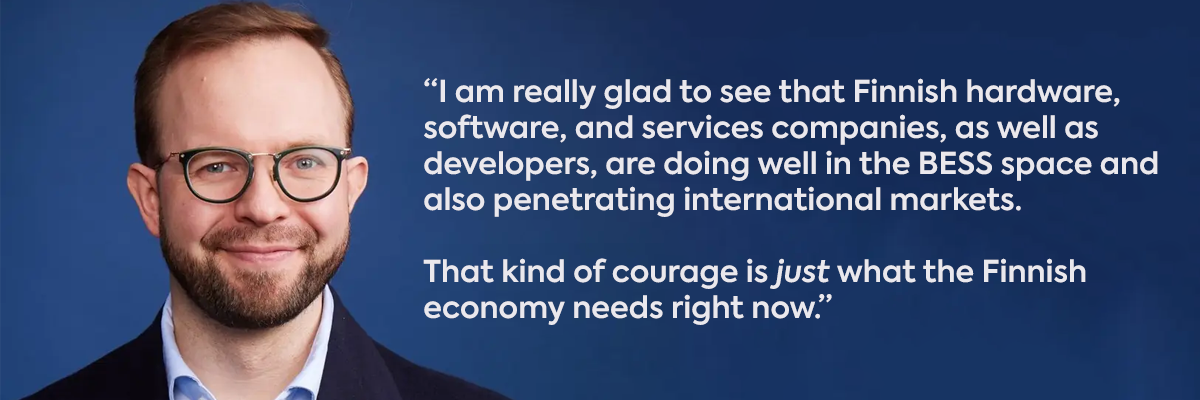
“I am really glad to see that Finnish hardware, software, and services companies, as well as developers, are doing well in the BESS space and also penetrating international markets,” he says. “That kind of courage is just what the Finnish economy needs right now.”
He also points to a possible geopolitical and regulatory driver. If the European Commission tightens rules around the use of components of Chinese origin, Finnish and European companies could see new opportunities, particularly in the European BESS supply chain.
“I really hope that the Finnish players are ready to play ball,” he says.
The next step for Finland’s BESS ecosystem may be to turn its growing domestic expertise into internationally competitive capabilities in technology, software, and systems integration.
Data centers, hydrogen, and the shape of new demand
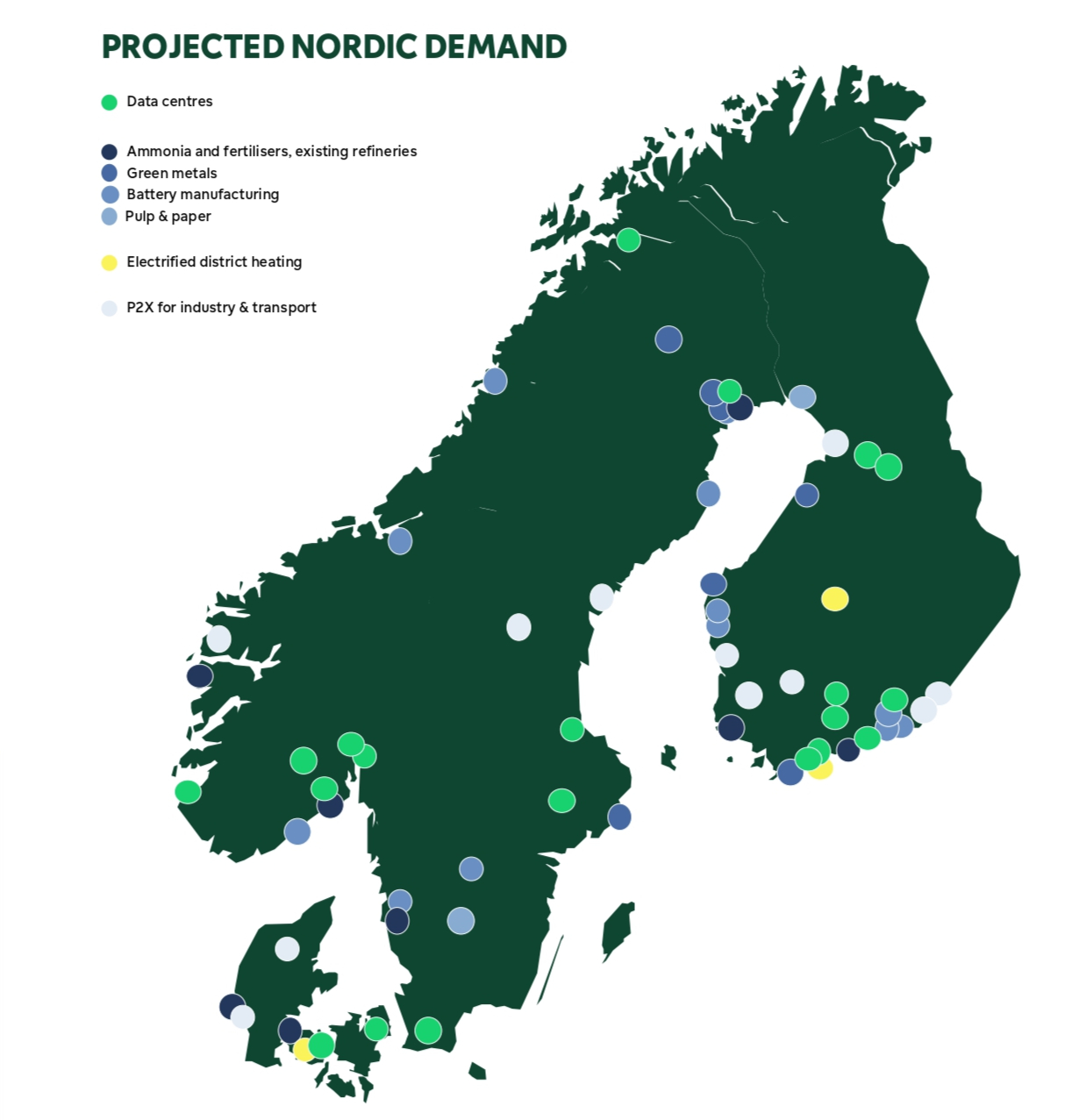
Looking ahead, one of the most important questions for Finland’s BESS market is how new electricity demand will develop. Data centers, hydrogen production, battery manufacturing, transport electrification, and new industrial loads could all reshape the Finnish power system. But not all new demand creates the same need for batteries.
Source: Fortum
Parpala sees data centers as particularly relevant for BESS because of the speed and nature of their expected growth.
“The ramp-up of data centers may be very rapid,” he says. Their share of Finnish power consumption could increase quickly, and unlike some industrial loads, data centers have a relatively inflexible demand profile. This creates pressure on the grid and supports demand for both new renewable energy production and additional flexibility.
Data centers may also create a direct need for storage due to their backup power requirements. In Parpala’s view, this makes them different from hydrogen projects.
“If we assume loads of new power consumption from the hydrogen industry, that likely also means there will be capacity to store and transfer electricity in the form of hydrogen,” he explains. Hydrogen production is also more sensitive to electricity prices than data centers, meaning that some hydrogen loads may be able to operate flexibly, ramping production up or down depending on market conditions.
This flexibility could reduce, rather than increase, the need for additional BESS in some circumstances. Hydrogen infrastructure could bring its own form of energy storage, while data centers would impose a steadier, less flexible load on the electricity system.
Parpala also sees a difference in certainty. While hydrogen and its derivatives could become major sources of electricity demand, their development depends heavily on political incentives, infrastructure investments, and clarity around hydrogen pipelines and downstream markets. By contrast, he sees data center development as more likely to proceed in the near term based on market economics.
“My inherent assumption is that lots of data center capacity will be built in the next few years based purely on market economy, whereas the profitability of hydrogen, and especially its derivatives, requires political incentivization and investments in infrastructure, and unfortunately, there is quite little clarity and certainty on those aspects in the current political climate.”
For Finland’s BESS market, this distinction matters. Hydrogen may represent a larger opportunity for long-term electricity demand, but data centers could create faster, more immediate pressure on the grid. That makes them an especially important driver for near-term flexibility needs.
Finland’s next BESS chapter
The first wave of Finland’s BESS market was defined by fast growth, attractive ancillary-service revenues, and rapid project development. The next phase will be more complex.
Longer-duration storage, hybrid renewable plants, wholesale-market participation, tolling agreements, domestic technology providers, and new industrial demand are all becoming part of the picture. For Parpala, the fundamentals remain promising, but the market is becoming more demanding. The easy gold-rush phase may be over, yet the need for flexibility is only increasing.
The insights shared by Parpala in this article are only the tip of the iceberg. At the upcoming Solarplaza Summit Finland PV & Storage, he will join the panel discussion “How to Stay Ahead of a Market With an Oversupply of Projects: The Prospects Until 2030 for Renewables in Finland.” The session will explore the growing concern about project saturation and pipeline bottlenecks in the Finnish renewable energy market and offer strategies for developers looking to maintain a competitive edge.
As financing, offtakers, and grid connection capacity become harder to secure, the projects that stand out will be those with a clear route to bankability. The panel will examine how developers can differentiate their projects in a more crowded market, and what it will take to succeed in Finland’s next phase of renewable energy and storage development.
To hear more from Matti Parpala and other market experts, join us at Solarplaza Summit Finland PV & Storage in Helsinki on 11 November 2026.