White Paper
24 November 2025
Estimated reading time: 10 min
Developments in the Baltic power market
This white paper examines how the integration of the Baltic electricity system with Europe is reshaping market design, flexibility, and investment opportunities. It explores the impacts of synchronization and PICASSO integration on market stability, the shift to fifteen-minute intraday and day-ahead trading, and the emerging revenue streams for BESS in this increasingly interconnected environment.
Together, these developments show how the Baltic power sector is evolving into a more dynamic and resilient part of the European energy landscape.
Key takeaways at a glance:
- 15-minute Day-Ahead trading boosts arbitrage revenue, with 1-2h systems performing noticeably better than under the former hourly regime.
Cycle count is already increasing, as storage assets respond to sharper, shorter-lived price spikes. - Short-duration batteries gain an edge, thanks to lower CAPEX and high responsiveness at quarter-hour granularity.
- Widening spreads and balancing volatility are creating some of Europe’s most attractive short-term BESS returns.
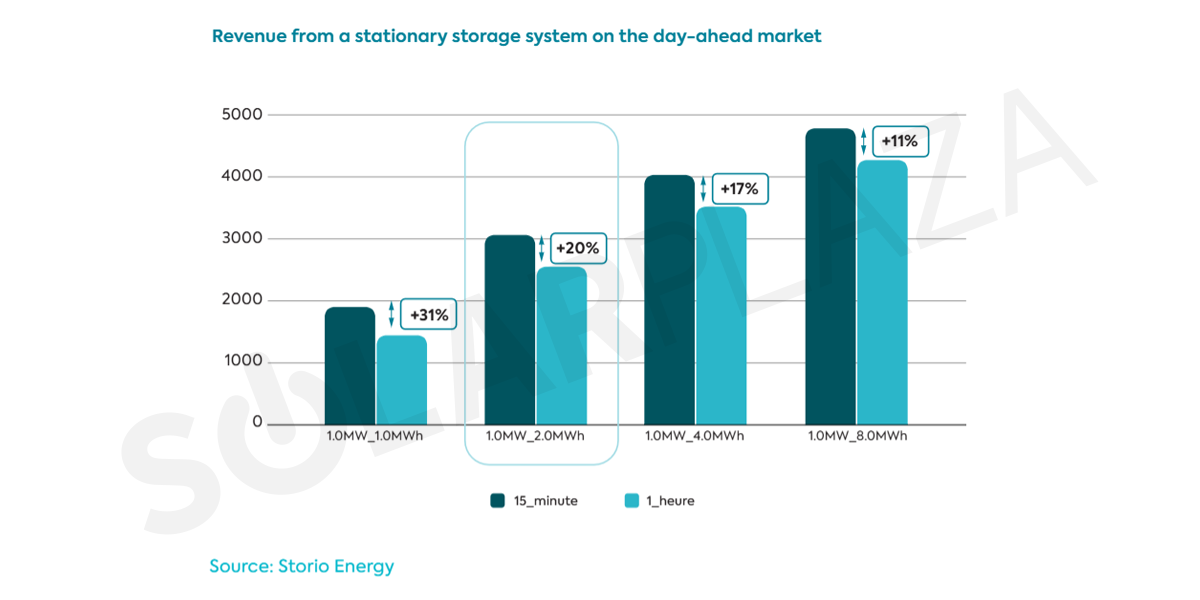
These dynamics become especially clear when looking at BESS performance under the new quarter-hour market design. Early analysis from Storio Energy shows that across multiple battery configurations, quarter-hour exposure consistently lifts revenues, with the strongest relative gains seen in short-duration units. Uplifts range from more than 30% for 1-hour systems, which are highly sensitive to short-lived intraday volatility, to solid double-digit improvements for larger 8 MWh setups.
Building on these developments, Solarplaza will host the 4th edition of the Solarplaza Summit Baltics PV & Storage in Vilnius on 18 March 2026. The summit will convene leading regional and international experts to discuss the financing of BESS projects, the challenges posed by volatile power prices and grid constraints, and the opportunities arising from cross-border PPAs and hybrid asset models.
To further explore these trends, revenue drivers, and the wider Baltic flexibility landscape, download the full white paper below!


To learn more about
the topic beyond this white paper,join Solarplaza Summit Baltics on 18 March, taking place in Vilnius.
