Introduction: What is Agri-PV
Agri-PV can be understood best in terms of a purpose-driven solution to the future challenges facing our global food and energy system.
Firstly, the growing scarcity of land. Instead of solar PV and agriculture competing, Agri-PV involves dual and simultaneous land use for both energy generation and crop production with minimal impact on crop and soil yield.
Secondly, efficiency and co-benefits. Both agriculture and the solar industry can co-benefit from this arrangement. Research has shown that certain crops thrive better in an Agri-PV arrangement as compared to traditional methods due to the shading and climate protection provided. In terms of solar, the increase in land use efficiency can allow for the continued expansion of PV energy generation to spur the clean energy transition.
Finally, sustainability, resilience, and future-proofing. With climate change, the incidence of crop damage caused by an increase in extreme weather events is growing annually - Agri-PV provides then an additional level of crop protection while also generating a passive income in terms of energy production to ensure that farms of the future are able to adapt and grow.
Guidelines and Key Considerations
These are structured according to the key themes raised by the webinar speakers and questions from the audience. This is by no means an exhaustive list of key considerations, and we will explore more to come at our summit on the 4th of October.
A) Crop Considerations
The most important guideline to establish, emphasized by both speakers, is evident in the name itself. Be it agri-PV, or agrivoltaics, the main objective is always a focus on protecting agriculture first.
This forms the basis upon which all agri-PV installations are designed and installed. How does this translate into practice?
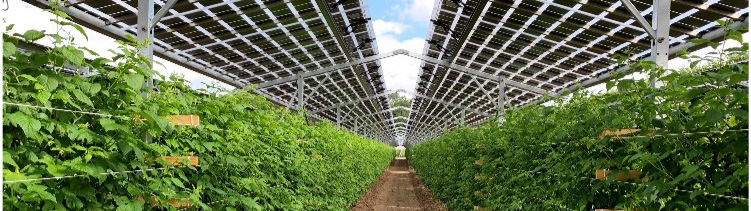
Constantin: All Zimmerman solutions are designed with the goal of protecting crops from extreme climate conditions (e.g. heavy rain, hail, and sunburn) as well as features to help crops thrive. In terms of protection, we do rigorous testing, such as the wind tunnel test and comprehensive reports on the basis of dynamic force calculations. In terms of support, we explore the integration of nets for better rain distribution possible. There is also great flexibility in span and maximum crop height so the crops are not damaged.
Elena: From the installation side, it is important to pay close and sensitive attention to the lifecycle of the crops, and structure height so as to avoid any disruption and damage to the crops during the construction phase. During the crop lifecycle, installation activities are planned according to the annual cycle and harvest of the crops. The phases to consider are ground preparation, seeding, and germination - during which, the conditions require extra care.
With this in mind, what are the main points to look for while developing a project?
Constantin: The Combination of PV and agriculture must work. Considerations are light and water availability, height and width of machinery, acceptance of the farmer, and suitability of the crop.
Elena: I would agree with the above, the coexistence of agriculture and the PV installation takes precedence above all else. We take a lot of care and respect when it comes to the life cycle of the crops. I would also add that seasonal considerations such as the weather have an impact on the soil and ground conditions, the surrounding area, as well as the height of the structure all have to be considered to ensure that the project is cost-effective with minimal impact on the agricultural landscape.
Have any of you built APV plants where the ceralas are grown? From this, what are the differences from an EPC perspective compared to fruit plants?
Constantin: In a fruit plant the synergies between Agri and PV are much greater than in a farm with cereal. These synergies are usually designed specifically for a special crop. Hence the crop is more difficult to change. Cereals will be much easier to develop as the adaption of the PV plant is smaller (standard Modules, standard substructure.
B) Sustainability and Climate Change
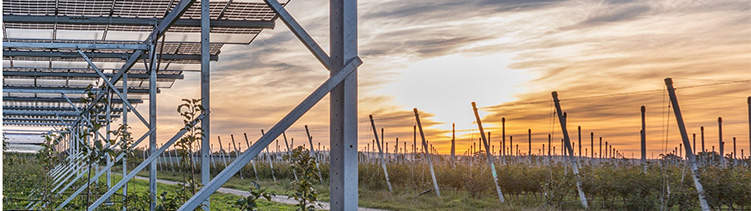
Over the past decade, Europe has experienced many climate-related natural hazards such as droughts, forest fires, heatwanes, storms and heavy rain. Climate change will not only intensify these events, but also increase their frequency.
- Zimmerman: Reducing the amount of plastic, Reducing use of pesticides and fungicides
- EV Klips: the use of specified machinery.
Are there any considerations for Agri-PV that take into account climate change and the future changing environment: more erratic weather, thunderstorms, flooding?
Constantin: Agri-PV in itself is a form of climate change mitigation. Going forward, the weather is expected and projected to get more extreme. With this, it makes even more sense to build Agri-PV and profit from the protective effect.
C) Cost Considerations
What is the difference between the CAPEX and OPEX cost between Agri-PV and standard ground-mounted PV?
Constantin: Yes, there is a difference, this depends strongly on how the system is designed. For example, there are highly elevated Agri-PV systems for crops such as apples and raspberries; these typically go up to 2.5 - 4 meters, which require more materials (i.e. steel) which in turn cost more. At the same time, usually these projects have semi-transparent modules, this also has to be taken into consideration.
However, there are also advantages to consider. For example, installing Agri-PV could result in a lot of savings for hail nets. I’ve had a conversation with a farmer who mentioned that he spends around 7000 Euros for hail nets every year per hectare. To contrast this, our structure can remain for 25 years, without requiring the annual replacement of hail nets.
So any calculation of cost must take this all into consideration, and with that, you might have something closer to a standard ground-mounted PV.
Elena: Installation costs are definitely higher, given the expertise and the manual labor required on certain occasions to protect the crops. I would say the real question is better rephrased as, “is it worth the money”? To that, an answer would be yes. Taking into account the external benefits from the dual usage of the land, a resilience structure that maintains for, as Constantin said, up to 25 years and the better performance of crops - results in a very high return on investment with both elements working together.
Do you involve civil engineering support for the installation phase? How different are the costs between extreme conditions (from easy soil to the harder one) with a 1 being the base scale of easiest to 100 being the most difficult?
Elena: We are still able to work with difficult soil conditions (e.g. extremely soft soil and muddy conditions), however, this has an impact on the cost with the additional usage of construction plates for site access in order to reduce the risk of heavy machinery sinking into the soil and becoming stuck. Construction plates are quite a significant cost driver, not only because they get damaged by heavy machinery and might require replacement throughout the installation phase, but they aren't readily available in certain countries, resulting in import costs as well.
Since Agri-PV uses specialized machinery and H&S norms and insurances, what is the impact on construction cost?
Elena: So this would definitely add to the construction costs. Higher structures require higher health and safety requirements (not dissimilar to working on roofs), and the manual labor and expertise that comes along with this is also a cost driver as well. Furthermore, It is also important to take into consideration the sustainability of the project as well, as there might be higher emissions from the specialized machines used.
D) Yield and Profit Considerations
In your experience, what is the expected PV yield for an agri-PV installation?
Constantin: It is not different from standard PV plants if comparing the Yield /KWp. But you will get less kWp /ha depending on the fruit or crop it can vary from 0,4MWp/ha with Strawberries up to 1,2MWp/ha in combination with animal husbandry.
From your perspective and experience in the field, what are the biggest pain points that are preventing agri-PV from scaling faster?
Constantin: The ever-changing legal situation and little experience with the effects on different crops. From a German perspective, there are a few but it seems to change every three months. Furthermore permitting is challenging, there seem to be different perspectives and experiences from stakeholders undergoing the permitting process - this results in a lot of insecurity and uncertainty for investors and developers.
Elena: The first and the most important is the legal framework and the lack of clear guidelines in terms of legislation, which is missing from a lot of European countries. We have the example of Italy where that is currently picking up, so it does seem like it’s just a matter of time for the rest of European countries to follow suit - but this is a lengthy process.
Is the energy from the Agri-PV projects you have built used for on-farm self-consumption, or can the Farmer export the surplus energy to the local grid, and receive a payment for it?
Constantin: The answer is both. The more self-consumption the farmer has, it is easier for him to see the business case given that they do not have to purchase power at a higher price. But it is difficult to use all of the power by oneself, you would require batteries and additional costs. For example, in Germany, there are some benefits for agri-PV plants - there is the EEG tender scheme which provides farmers with an incentive of 1.2 cents per kilowatt to encourage this.
What type of crops do you both work the most with? Which have the most promising results?
Constantin: We work with mainly horticulture. Most of our projects have been on raspberries followed by apples.
E) Technical Considerations
What type of modules were used in the example project shown by Constantin? This is specific to size and Wp. Furthermore, is there an estimation of installed capacity per ha?
Constantin: The modules in Kressbronn have a size of 2278x1134 and a transparency of 50%.
Are the existing panel solutions good enough for the purposes of Agri-PV or is there a need for specific, tailored panel solutions?
Constantin: The trend is moving towards using standard Modules in agri-PV to bring down the cost.
What was the biggest (installed capacity) agri-pv project that you have developed so far?
Constantin: The biggest has been 20MW in the Netherlands. (Click here to see who was involved and to see images of the project)